Is there another way to use the enable pin of an IC besides using a microcontroller?

MrChips

Joined Oct 2, 2009
35,018
I am curious to know if there's a circuit or a way to utilize an enable pin to turn on/off an IC without a microcontroller.
There are multiple ways to do this. We just need more information.
What will initiate this action?
What is the load, i.e. where is this signal to be used?
Can you provide a circuit schematic of your application?
 

Thread Starter

rfengineer28

Joined Apr 28, 2021
79
There are multiple ways to do this. We just need more information.
What will initiate this action?
What is the load, i.e. where is this signal to be used?
Can you provide a circuit schematic of your application?
yes, so I have a gate driver (low side) that has an enable pin, and I would like to turn it on if it senses a signal from (pwm) coming from the source into the input of the driver, and I would like for it remain off if it doesn't detect that signal.
 

crutschow

Joined Mar 14, 2008
38,674
If the PWM peak voltage is the same as needed for the enable pin, then you could just use a series diode and capacitor to ground to rectify the signal to give a DC level.
How fast do you need to turn the enable on and off when the PWM signal appears and stops?
What is the PWM frequency?
 

Thread Starter

rfengineer28

Joined Apr 28, 2021
79
If the PWM peak voltage is the same as needed for the enable pin, then you could just use a series diode and capacitor to ground to rectify the signal to give a DC level.
How fast do you need to turn the enable on and off when the PWM signal appears and stops?
What is the PWM frequency?
Thank you very much, this worked exactly like I needed.
 

Thread Starter

rfengineer28

Joined Apr 28, 2021
79
If the PWM peak voltage is the same as needed for the enable pin, then you could just use a series diode and capacitor to ground to rectify the signal to give a DC level.
How fast do you need to turn the enable on and off when the PWM signal appears and stops?
What is the PWM frequency?
I would like to turn it on/off as fast as possible the frequency of the pwm is 4kHz
 

crutschow

Joined Mar 14, 2008
38,674
I would like to turn it on/off as fast as possible the frequency of the pwm is 4kHz
The theoretical fastest would be 1 cycle of the PWM or 250us.
In practice, because of the filter, it will be somewhat longer.

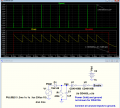
Below is the LTspice simulation of such a circuit:
It uses a CMOS CD40106 Schmidt trigger inverter to get a clean output pulse from the slow changing input.
The Enable output goes low about 335µs after the last PWM pulse.
It's shown for a very low duty-cycle which is the worst-case for this circuit.

1657247744480.png
 

MisterBill2

Joined Jan 23, 2018
27,986
"Output enable" works well for multiplexing 8 bits onto an 8 bit wide data bus to communicate with a multi digit display. And that was back in 1980.
 

Thread Starter

rfengineer28

Joined Apr 28, 2021
79

Ian0

Joined Aug 7, 2020
13,227
Another use for the enable pin is with an overcurrent detector, independent from the microcontroller.
When an excess current is detected in the output stage, the hardware pulls the enable pin down (or up, as appropriate) and turns off all transistors in the bridge. That way, you still get overcurrent protection if the microprocessor has crashed, or is doing something else.
 

MisterBill2

Joined Jan 23, 2018
27,986
I am curious to know if there's a circuit or a way to utilize an enable pin to turn on/off an IC without a microcontroller.
Now it is fairly clear that the TS was referencing some specific IC device, which the TS did not mention which device. So this was another case of the lack of mind reading ability for many of us leading to a lack of communication .
 

MisterBill2

Joined Jan 23, 2018
27,986
OK, the TS should have mentioned that the particular IC with an enable pin is an H-bridge motor driver. MANY ICs have enable pins, and even output enable pins.
Most of the real world does not include microprocessors. But they are becoming more common. The micro is especially handy for those unable to create logic circuits that work.

This is what is rather irksome about the whole "Nuts and Volts" agenda: the idea that nothing can be done without an arduino micro board and some of the add-ons. Not even a simple voltage comparator to switch on a light as it gets dark.
 
Last edited:

MisterBill2

Joined Jan 23, 2018
27,986
The Real World is analog! Even the switching portion, because semiconductor switches are not really instant, just fast, and almost all circuit elements exhibit a bit of reactance, even wires.
 

MaxHeadRoom

Joined Jul 18, 2013
30,772
Most of the real world does not include microprocessors.
Not really true anymore ! :rolleyes:

The micro is especially handy for those unable to create logic circuits that work.
That comes off as a little condescending, IMO ?! :(

There were those that were probably saying that when IC's appeared and replaced discrete transistor circuits! :rolleyes:
 
Last edited:

MisterBill2

Joined Jan 23, 2018
27,986
OK, Max, consider that the CNC machine without all of that analog I/O to make the motors run the right way at the right time is only a small box with a keypad, knobs, and a display. Fun to fiddle with but not very useful, except maybe to tell a machine operator what to do next.
And for the small projects, the same photo sensor with a comparator and adjustment pot can decide when to switch on the lights, but it does require more circuit analysis than an arduino package.
 

nsaspook

Joined Aug 27, 2009
16,431
...
That comes off as a little condescending, IMO ?! :(

There were those that were probably saying that when IC's appeared and replaced discrete transistor circuits! :rolleyes:
A lot condescending IMO. (from an expert on condescending per some here) :)

[condescending]
I usually hear this from people who don't actually understand embedded controller programming from the hardware end. The design abstraction to computer code from a deep understanding of hardware/math and physics seems alien to them.
[/condescending]
 
Last edited:

MisterBill2

Joined Jan 23, 2018
27,986
Does embedded programming include PLC code? And certainly there is a level of functionality below which having a micro, and developing code for it, does not make sense as far as the cost goes.
 
Top