Is there a solution? Daytime Running Lights (Halogen vs. LED)

Thread Starter

Tonyr1084

Joined Sep 24, 2015
9,744
Flickering is one problem. They flicker because of PWM. However, I don't want the flickering, I want dimmer lights when on DRL.

I'll be posting a video shortly on YT showing the flickering. Only one thing I need to figure out is how to obscure the license plate on my wife's car.
 

Thread Starter

Tonyr1084

Joined Sep 24, 2015
9,744
Here's the video of DRL and LED how they don't function well together. And it should be noted that visually they appear to be on constantly but you can detect flickering.
 

MisterBill2

Joined Jan 23, 2018
27,584
My simple suggestion totally removes the possibility of a power back-feed into the existing system, because it uses a relay to transfer to a different feed supply. The "common" terminal feeds the headlights load, the N.C. terminal connects to the PWM output of the present system. So with the relay not powered the connection is exactly the same. But with the relay operated the N.O. contact supplies the feed from the resistor connected to the battery positive side. The contacts of the relay I suggest are rated for 30 amps, so it should be quite adequate.

The simple way to discover the value and power ratings of the resistor can easily be discovered if a DC power supply with meters is available. Simply connect it to power the headlights and adjust the voltage until the brightness is what you want. Then read and record the voltage and the current drawn. The resistor value will be what would drop the voltage difference between the battery voltage and the actual voltage at the measured current. The minimum resistor power rating will be the product of that voltage difference and the measured current.

To operate the relay a diode and capacitor in series from the PWM headlight feed to the relay coil positive terminal will be required, with the relay coil negative side to the DC common. Probably a diode across the relay coil to keep the current flowing thru the coil when the PWM voltage is off.
The unintended side effect will be a momentary operation of the relay when the headlights are switched on. That will not last longer than a very few seconds.
 

crutschow

Joined Mar 14, 2008
38,529
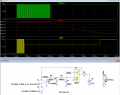
Here's a relay solution with resistor that detects the three states -- Off, PWM, and full-on:
(I believe it's similar to what MB2 suggested.)
When the PWM signal is detected, a relay bypasses the PWM and connects the LEDs to 12V through a resistor.
With a steady 12V, the relay directly connects the 12V to the LEDs.

Below is the LTspice sim of a circuit to do that:
With a PWM signal from the lights (green trace) the relay is energized (red trace) and the LED is connected to 12V through R3 (yellow trace).
With a steady lights signal, the relay is turned off, and the lights' 12V is applied directly to the LEDs (at about 425ms here).
With no signal (at the start) no voltage is applied to the LEDs.

At the start of the PWM signal there is a short delay due to the relay operate time (about 40ms here).

The value of R3 value and power rating must be experimentally determined to give the desired LED DRL brightness.

1750351981548.png
 
Last edited:

MisterBill2

Joined Jan 23, 2018
27,584
Here's a relay solution with resistor that detects the three states -- Off, PWM, and full-on:
(I believe it's similar to what MB2 suggested.)
When the PWM signal is detected, a relay bypasses the PWM and connects the LEDs to 12V through a resistor.
With a steady 12V, the relay directly connects the 12V to the LEDs.

Below is the LTspice sim of a circuit to do that:
With a PWM signal from the lights (green trace) the relay is energized (red trace) and the LED is connected to 12V through R3 (yellow trace).
With a steady lights signal, the relay is turned off, and the lights' 12V is applied directly to the LEDs (at about 425ms here).
With no signal (at the start) no voltage is applied to the LEDs.

At the start of the PWM signal there is a short delay due to the relay operate time (about 40ms here).

The value of R3 value and power rating must be experimentally determined to give the desired LED DRL brightness.

View attachment 351469
There are a few differences, I put a fuse at the battery connection. In the relay circuit, R2 and C1 are gone, D4 moves to where C1 was located. Probably C2 will not need to be that high a value. Relay chatter is avoided by allowing relay current to continue flowing thru the shunt diode D4, so no filter cap is required. That is a trick that I have used quite a few times since 1968. It works quite well on 60Hz, it should work even better at a higher frequency.
Unfortunately I can only describe the difference, not edit the graphic.
 

Thread Starter

Tonyr1084

Joined Sep 24, 2015
9,744
Internet has been spotty.

When the Multi-Function Selector (MFS) is set to Auto, in daylight only the DLR comes on. And only if the emergency brake pedal is not locked down. There are no other lights on in the daytime. With the MFS set to OFF no lights come on. When set to parking lights (don't know if they still call them that) no headlights come on - day or night. When set to headlights - the headlights and parking lights come on.
 

MisterBill2

Joined Jan 23, 2018
27,584
That can work!! With the DRL power active at some duty cycle, the relay will be energized and so the headlights would be powered thru the resistor. AND, if anything in that added part fails, they will be powered directly. So the headlights will work at night.And all it needs besides the relay is one capacitor and two diodes. AND a power resistor of some unknown value. Two ohms may be a good guess. That is where the experiment with the metered power supply comes in.
 
I've found this discussion to be interesting...but missing a piece:

Have you consulted a lawyer - or given more thought to what you are attempting to do?

Because the way I see it, you are in SLC, USA, land of sue-happy people. Should you or your wife get into an accident that potentially had something to do with lack of lighting, DRLs, or anything of that nature (and maybe even if it doesn't) - and if things got serious enough to warrant it - your modifications will be found. And things won't be so nice from that point forward.

Even the changing of the headlights to LED lamps could potentially be a reason to find you liable, since the system was designed for HID. This is a piece of safety equipment on your vehicle...again, think about what you are trying and wanting to do, and what the potential ramifications might be down the road, should the "unthinkable" occur.

If at that point you say, "f-it, I'm doing it anyways" - then I'm not sure I can add much that hasn't already been said, except to say you may not be able to do what you want.

Because I'm thinking that the LED headlights are not just "simple LEDs" with maybe some kind of internal ballast resistor. They may be (and likely are) much more complicated than that, with some kind of LED driver circuit inside, monitoring the current and making adjustments as needed to keep that current to the LED(s) constant. Throwing an extra resistor in series with that circuit may not do much, except perhaps slow the fan keeping the LED(s) cool (and no guarantee about that either; it would depend on how the driver circuit is designed, what kind of fan is being used, if the fan speed is controlled in some manner externally or internal to the fan, etc).

Are you 100% certain it is PWM being used to dim the headlights to DRL levels? You've seen the waveform on a scope?

Before doing anything, I would verify that, first - rather than making any assumptions that it is doing so. To me, it seems probable that such is the case (if the headlight is used as the DRL too, you'd only have 2-3 connections to the HID lamp itself; 1 connection each for "driving" vs "high-beam", and perhaps a third to ground, unless the lens assembly is grounded itself - so the only way to provide something for DRL would be to PWM the "driving" mode, probably - unless something weird was done to instead make the "high beam" side the DRL, using PWM too to control the brightness).

There could also be something the "computer" is doing because it doesn't see the same load on the circuit as the HID would show, and it either disables the PWM, or increases the duty-cycle, or something strange like that. I'm just thinking how on turn and brake signals, when you switch to LED on some vehicles, you have to add an extra resistor in series to make the flasher run at the right rate (or run at all) - otherwise you get "solid on" and/or "fast flashing" (I had to do that to my TJ when I switched everything except the headlights over to LED - plus several other things because the TJ is "special" in how it's signalling system works - even the "flasher" had to be a particular device, more than just "LED ready").

You might want to do some bench testing of these various ideas, first. I would first find out what the PWM frequency is, and what it all looks like on a scope. Also, what the voltages all are for the HID lamp at its various settings. Once you know that, then set a circuit to do those same functions on your bench (make sure you keep the HID lamp positioned in a similar manner to the OEM headlight assembly - and maybe add some external cooling - you don't want such a thing just "sitting on your bench" - and you definitally should not touch the bulb period with bare fingers).

Once you have a bench setup that works the same way as the vehicles system (ie, on, off, high-beam, DRL), and the HID bulb appears to show the proper light levels and such...

Then switch over to the LED "bulb" and start experimenting with changes to make it work; when you first start, the LED should do what they are currently doing "in the car" right now (this would how you really know that your bench system does replicate the car system properly). It will be much easier to devise and/or test a solution on your bench, than in the vehicle - plus you won't be making a mess of the vehicle's harness or wiring system in all of the effort. Plus - air conditioning may also be had on the bench easier than outdoors right now (though that depends on your current electronics bench setup, of course).

But I still think that there may be more complicated driving electronics inside the LED "bulb" that might be getting in the way, and short of being able to modify that circuit...there may not be a way to make those bulbs dim properly - using PWM or otherwise. And they probably aren't designed to be "taken apart" (ie, so if in a fit of madness you think, "well, let's build our LED driver outside of the LED bulb, and just make the bulb a "true LED" without the driver internal to the lamp - trust me, you probably don't want to go down that route).

A bench setup, though, will tell you whether or not a simple resistor (or any other simple method) will control the LED bulb's brightness - and once you know what to use (or if anything can be used) - you can then attempt to apply it to the vehicle's system.

Regardless, though - you might still want to give some thought as to liability concerns - because even if everything works out properly - you will have (in some manner) modified a safety system of the vehicle, and all of the potential concerns that could bring, too...and again, even switching the bulbs to LEDs might trigger such issues, too...
 

Parkera

Joined May 3, 2016
127
I used to work for a company that made DRL modules for GM cars. This was back in the late 1990’s, so some things may have changed in circuitry since then. Halogen lights were the norm with the low beam bulbs rated at 35 watts and the high beam bulbs rated at 55 watts.

The specification for DRL brightness was 80% of the low-beam lamps, applied ONLY to the low-beam bulb (or filament). The reason for 80% brightness is because, below that at the minimum battery voltage of 9 volts, the Halogen cycle may not start, which VERY significantly shortens bulb life. Remember that a Halogen bulb is basically a tungsten bulb, which is basically a resistor. You could change the intensity by simply reducing the voltage applied to the bulb.

At that time, three methods were used to achieve 80% brightness. The first method was to simply insert a diode in series with the bulb. This method is very temperature sensitive, but really cheap. The second method was to insert a power resistor in series with the bulb. It cost slightly more, but was less temperature sensitive. The third and most expensive method was to use PWM. Because of the thermal time constant of the filament, a relatively low PWM frequency (as low as 25 Hz) could be used and not create any flicker that the human eye could detect. The duty cycle is 80% with a 5% tolerance if I remember correctly.

Fast forward about 35 years and there are now several options for headlights, including LED. Due to the very antiquated lighting specifications for cars that were based on sealed-beam headlights, you can’t simply replace the Halogen bulb with an LED “bulb” legally and expect to get the same light pattern that will not cause discomfort or blind other drivers (day or night).

The reason for this is an incandescent bulb produces the light along the length of a very precisely defined filament shape and is designed to work with a specific shape of reflector/lens combination that produces light more or less on a flat plane. LED replacement bulbs generally are made up of a series of point-source lights arranged so that light is produced more or less spherically in all directions. With an undefined light source and an undefined reflector/lens, it is anybody’s guess what the emitted light pattern will be.

Because of this problem, and the number of complaints, it looks like the headlight specifications will “soon” receive the first really significant update since the 1950’s. This update will include LED lighting. In the meantime, some states are beginning to pass legislation specifically outlawing replacement LED headlights unless it is a retrofit kit supplied by the OEM.

Now the history and legal lesson is over; I have done my due diligence.

The TS mentioned that replacing the halogen bulb with an LED was super bright, but there did not seem to be any difference between regular and DRL brightness, even though the vehicle uses PWM to change the brightness. I can tell you that, to the eye which has a logarithmic response to light, you will see very little difference between 80% and 100% brightness. (The original thought for DRL was 50% intensity.)

Many of the posts so far have suggested that a resistor in series, possibly through a relay, is the simplest/best solution. That could certainly be made to work, but since LEDs are current operated devices, with a very non-linear and temperature sensitive voltage characteristic, you really want to drive them from a current source. Current source modules are readily available on Amazon or through LED vendors such as www.superbrightleds.com. Many of these modules will contain PWM circuitry, or a separate PWM module could be used to modulate the current source. You could roll your own based on a 555 astable circuit.

1750473744460.png

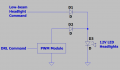
With this circuit, if there is no DRL command and no headlight command, the lights are off. With a DRL command, the low-beam lamp is driven at 100% voltage, but with an 80% duty cycle through D2. D1 prevents any back feeding to the computer. The result is 80% average power (which is the brightness). When a full low-beam headlight command is given, full voltage is delivered to the LED bulb through D1, over-riding the “zero” PWM voltage by reverse biasing D2. Andrew Ayers 1 brought up some possibilities regarding how the computer will react to other than expected loads. The worst that can happen is it won’t work as expected. No damage can happen to the computer because of the diode isolation.

By using a “diode OR” gate, only the low-beam filament harness needs to be cut. The headlight and DRL commands can simply be tapped off of the existing harness. Because the diodes isolate the PWM module, there is no danger to the computer. I have also used this technique to add tail lights/stop lights to antique cars and it works very well.

The diodes can be any diode that can carry the LED current (probably less than 1 amp). If you also want the option of using Halogen bulbs, then the diodes have to be rated for at least 5A for one bulb. (You could use parallel diodes for each lamp, or an 8-10A diode for two lamps.)

For a standard DRL brightness, the PWM should be set to 80% duty cycle, but if you want them dimmer, just lower the duty cycle until you get the brightness you like. The LED cooling fan will probably turn a bit slower, but the air movement should be roughly proportional to the heat generated by the LED.

I like to use a PWM frequency of about 1 kHz, but this is not critical as the eye generally only responds to something less than 50 Hz or so. Going higher in frequency won’t make any difference in operation, but it does increase switching losses some, thus increases heat dissipation by a small amount. Switching losses are probably nothing to worry about, but why not increase the safety factor when it is free.
 

Thread Starter

Tonyr1084

Joined Sep 24, 2015
9,744
Even the changing of the headlights to LED lamps could potentially be a reason to find you liable, since the system was designed for HID. This is a piece of safety equipment on your vehicle...again, think about what you are trying and wanting to do, and what the potential ramifications might be down the road, should the "unthinkable" occur.
Your safety advisory is well received.
Screenshot 2025-06-21 at 4.59.15 AM.png
Screenshot 2025-06-21 at 5.06.27 AM.png
Screenshot 2025-06-21 at 5.04.51 AM.png
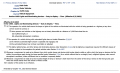
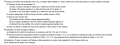
So Code 41-6A section (7) (c) (i), (ii), (iii) says lighting can not be brighter than the vehicle's OEM lighting. Section (10) identifies it as an infraction.

To reiterate what has been said so far - I installed HID some 8 years ago. Over that time the HID has lost its brilliance. However, OEM was Halogen. I believe I said that already, but if not - it's said now. It has also been said that as far as headlights go - the low beam is baffled so as to not cast a light above the preset (OEM) beam angle. The issue is not one of blinding oncoming traffic as has already been discussed in this thread but one of longevity of LED lamps flashing at a high rate.

Because I'm thinking that the LED headlights are not just "simple LEDs" with maybe some kind of internal ballast resistor. They may be (and likely are) much more complicated than that, with some kind of LED driver circuit inside, monitoring the current and making adjustments as needed to keep that current to the LED(s) constant.
I'm Sure there is some internal circuitry or scheme to control the brightness. It's out of concern again for longevity of the lamp itself.
To be clear, if you viewed the video you would see that there is the projector lamp assembly (OEM, unmodified) which is baffled, and the separate high beam which is purely a reflector lamp. No baffling of any kind. Each lamp is individual from the other and can be changed out by simply twisting the bulb and unlocking it from the headlamp assembly.
Are you 100% certain it is PWM being used to dim the headlights to DRL levels? You've seen the waveform on a scope?
Again, if you've watched the video you can see the high beams flashing on and off. No, I haven't tested the waveform. I estimate it to be around 27 flashes per second. Given the camera frame rate is 30 FPS (frames per sec), at any given moment the camera aperture may be open when the LED is lit. Due to the dissimilar rates part of the time the LED can appear to be off. If you haven't watched the video yet I suggest you give it a review.
To me, it seems probable that such is the case (if the headlight is used as the DRL too, you'd only have 2-3 connections to the HID lamp itself; 1 connection each for "driving" vs "high-beam", and perhaps a third to ground, unless the lens assembly is grounded itself - so the only way to provide something for DRL would be to PWM the "driving" mode, probably - unless something weird was done to instead make the "high beam" side the DRL, using PWM too to control the brightness).
Again let me clarify - review the video. You will see Low Beams are independent from High Beams. Camera rate reveals the lights flash on and off.

IF I were to put halogens back into service (as was OEM) the tungsten filament would glow at a lower brightness because of PWM. It is not the LB that is DRL it is the HB. High Beams are used for DRL.
 

Wolframore

Joined Jan 21, 2019
2,619
I would just detect the PWM as a signal and pass on a different PWM based on what works for that LED vs Halogen. Keep the duty cycle low for LED (our eyes sense light non linearly) and use a high PWM rate so you can’t see flicker. Seems to be high complexity for just some headlights, in my opinion, possibly not worth the trouble.
 

Thread Starter

Tonyr1084

Joined Sep 24, 2015
9,744
So Code 41-6A section (7) (c) (i), (ii), (iii) says lighting can not be brighter than the vehicle's OEM lighting. Section (10) identifies it as an infraction.
I might add that there are MANY vehicles on the road with similar modifications that are being tolerated by law enforcement. In fact, a Highway Patrolman drives a Chevy Camaro (late model) with violet headlamps. Seems the attitude is fairly lax regarding section 7. Even section (d) (paraphrased) does not impair visibility of other drivers.

As discussed earlier in this thread it has been mentioned that some people modify their lamps incorrectly resulting in blinding oncoming light at night. I've seen it - I hate it - I recognize that people who make these modifications have no understanding of how their particular headlights work. For headlamps that are purely reflector style the OEM bulb has an internal baffle that under low beam operation the beam is blocked from reflecting up into the eyes of oncoming traffic. Use of a specially designed bulb that blocks the beam from being reflected upwards has been the standard since I first started messing with cars. I remember the sealed beam headlamps in my 72 Nova, they had two separate filaments. Low beam had the baffle whereas the high beam filament was not baffled and cast a full width beam of light.

But I'm not asking about LB's, or even HB's for that matter. I'm asking about DRL and the flash rate. My 17 Tacoma does not have DRL, it has what some call an "Eyebrow" lighting arrangement. There's a row of LED's encompassing the headlamp assembly that lights up when set to Auto. Day or night, that eyebrow is lit when driving. My wife's car does not have that feature. It uses the HB for DRL. If it were a halogen bulb in its place then there would be no visible flashing. But with the LED bulb I can see (barely detect visually) the LED flashes. Further proof is made evident by the video.

I do appreciate the safety warnings and the experience of others. It's that experience that has brought me to addressing this subject. The LED lamps were not that expensive, less than $30 (US). If I burn them out prematurely due to DRL PWM Flashing it's not like a thousand dollar investment gone up in smoke. Nor is this a matter of properly lighting the headlights during normal night time operation. There is no issue as far as normal operation. Only asking about DRL and finding a solution to the problem.

I've seen some bulbs that claim to be DRL capable, others that claim to be CAN Bus compatible. Little more expensive, and maybe in the future I'll investigate whether they are a feasible alternative. For now this is a question that might lead to a solution for my wife's car.
 

Thread Starter

Tonyr1084

Joined Sep 24, 2015
9,744
(our eyes sense light non linearly)
I can barely see the flashing. It is nearly fast enough to not be perceived as a flash, much like the frame rate of the camera. But the digital camera makes it clear there's PWM going on. Whatever rate that may be.

I was thinking a cap would smooth out (average) the voltage of the PWM. But LED's aren't voltage based, but rather, current based (stated so for those who think I might be mistaking how LED's work).
 

MisterBill2

Joined Jan 23, 2018
27,584
OK, and what I see is that my proposed scheme with the low beam feed thru the Normally Closed relay contact will comply IFF the resistor value is correctly selected. Certainly there will be some variation in intensity as the temperature changes, but if the resistor value is correct, the brightness of the DRL mode will be satisfactory.
BUT, please be aware that if the vehicle driver has a history of confrontation with the local law enforcement personnel, ALL BETS ARE OFF!!!
 

Parkera

Joined May 3, 2016
127
Strictly on the issue of flashing - you mentioned the camera's aperture rate causing the "blinking" on the video, and is proof that the headlight system uses PWM. I totally agree with those statements. It should also be ignored when addressing the problem with the LED because it is the response to the HUMAN EYE that matters. The eye doesn't respond to rates much above 50 Hz, so if you use a PWM rate of a couple of hundred Hz or above, the eye CAN'T detect it. Cameras can, but not the eye.

As to the matter of PWM shortening the life of an LED - the LED is a semiconductor diode and can respond to Megahertz flash rates without issue of any kind. The LED drivers may have some issues at some higher frequency, but again, it won't be any kind of an issue for at least the low tens of kHz. All of the components of concern are semiconductors devices and respond just like any diode or transistor. Incandescent bulbs and relays are the components that don't like a large number of switching on and off cycles, although incandescent filaments can tolerate kHz flash rates quite well because their thermal mass doesn't let them thermally cycle.

So in short - don't worry about any negative effects on the PWM rate to either the LED or to the eye above, say 200 Hz. In fact, the higher the rate, the finer the brightness resolution.

Simply adding a capacitor to a PWM driver output does not do any filtering because both the high and low levels usually see a low impedance. Therefore the capacitor charges rapidly, but also discharges just as rapidly. The net result is zero. For a capacitor to work as 'smoothing', the discharge impedance has to be much higher than the charge impedance. Remember, the discharge impedance is made up of the device impedance in parallel with the driver impedance. For a capacitor to work, some kind of a switch (usually a diode) is needed to isolate the capacitor from the driver.
 

MisterBill2

Joined Jan 23, 2018
27,584
In many instances in the past few years, at night, turning my head quickly, I was able to produce the appearance of flashing tail lights. I think that others have seen that also. Back a few years, not currently.
 

Thread Starter

Tonyr1084

Joined Sep 24, 2015
9,744
In many instances in the past few years, at night, turning my head quickly, I was able to produce the appearance of flashing tail lights. I think that others have seen that also. Back a few years, not currently.
I've definitely seen that. Lots of Cadillacs do that. Low flash rate.

A little off subject, but the other day I had the vibrating massager going on my neck. I noticed the LED clock numbers were cycling up and down. That's of course due to my eyeballs bouncing around in my eye sockets and the strobe rate. For those who don't know - a digital clock only. lights one segment at a time. At a very high rate the clock sweeps through all LED's. If a number was to be produced it would light the segments of that number one segment at a time.

OK, back on topic:
It's common for the wife to switch the headlights completely off. That means the DRL are off too. So I may be chasing a rabbit I can't catch. Not without spending more money than I feel like spending. I may just live with it.
 

Regected424

Joined Nov 27, 2022
8
TBH, I just skimmed this....substantial thread. Much love to the NIMBY and Karens out there.

Getting back to the main issue of DRL going on full at all times rather than dimming after switching to LED bulbs. Most of these for high power operation have their own DC-DC converter built in. This gives the elements within the bulb a known power to guarantee brightness and life. A PWM on the power input will just get filtered out by this. You will need to find bulbs rated for PWM, or get the PWM around the DC-DC in the bulb.

Depending on how much effort you want to expend on the problem, you could add a FET after the DC-DC and feed the PWM signal to this FET. That would give you full power at night, and PWM during the day. (simplified version, but you get the idea) For a more involved solution (and more fun if that's your thing), you can gut the electronics from the bulb and build up your own based on the output of the stock DC-DC, but adding in the PWM signal to enable/disable the output.

As for the question of CAN-BUS compatible bulbs, that just says they have the means to stop the ECU from throwing an error code due to the more efficient LED elements. Some just use resistors to keep the load on the circuit, thus negating the efficiency gains. Others have active signaling to tell the ECU all is good.
 

Thread Starter

Tonyr1084

Joined Sep 24, 2015
9,744
Regected424 Thank you for the input. At this point I think I'm just going to live with it the way it is. My 17 Tacoma doesn't use DRL on the high beams it has an eyebrow that is lit day or night if I keep the MFS (Multi Function Switch) set to Auto. The wife's car has DRL on the high beams, no eyebrows. She always turns the headlights on and off to her suiting, so DRL is never active when she drives. Drives me crazy, but that's a short drive. When I drive it I always find it OFF. So this is why I think I'm just going to accept nature as it is rather than trying to bend it to my will.
 
Top