It might help to consider the fundamentals of typical node-subscript notation.
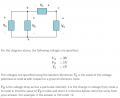
You have three nodes in the problem, a, b, and c.
A single node subscript refers to the voltage at that node relative to some reference point that is simply arbitrarily defined as being at 0 V.
You are given one such voltage, namely
Va = 1 V
You aren't told which point in space is at 0 V, but wherever it is, Node a is 1 V higher than that.
A double node script is merely a shorthand for the difference between the voltages on two nodes. So
Vab = Va - Vb
Vba = Vb - Va = -Vab
We also use other, non-node subscripts to refer to various voltages. In this case, the diagram defines four of them, one for each component, using the component labels, A, B, C, D.
The diagram indicates the polarity of the defined voltage, which is the positive node minus the negative node associated with that label. So
VA = Vb - Va = Vba
Now you do the same for the other three.
With these in mind, what is the value of VB?
In fact, what are all of the following: Va, Vb, Vc, VA, VB, VC, VD
It might help to consider the fundamentals of typical node-subscript notation.
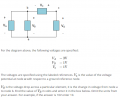
You have three nodes in the problem, a, b, and c.
A single node subscript refers to the voltage at that node relative to some reference point that is simply arbitrarily defined as being at 0 V.
You are given one such voltage, namely
Va = 1 V
You aren't told which point in space is at 0 V, but wherever it is, Node a is 1 V higher than that.
A double node script is merely a shorthand for the difference between the voltages on two nodes. So
Vab = Va - Vb
Vba = Vb - Va = -Vab
We also use other, non-node subscripts to refer to various voltages. In this case, the diagram defines four of them, one for each component, using the component labels, A, B, C, D.
The diagram indicates the polarity of the defined voltage, which is the positive node minus the negative node associated with that label. So
VA = Vb - Va = Vba
Now you do the same for the other three.
With these in mind, what is the value of VB?
In fact, what are all of the following: Va, Vb, Vc, VA, VB, VC, VD
True. However, "you" could draw a ground and place an independent voltage source from Va to ground, and the problem states that is voltage source is 1 volt.

 Facebook
 Google
 GitHub
 Linkedin

 45.7 KB Views: 2