Is Switch Wired Correctly

Thread Starter

clangray

Joined Nov 4, 2018
261
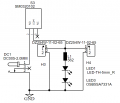
Connection to Pin 3 is a bit redundant, but should still work OK.
BTW, you used an earth GND symbol, is the common actually at earth potential.?
So I can either connect pins 2 & 3, then to the circuit. Pin 1 is power supply. Alternatively I could connect pin 2 to circuit, 1 to power supply and 3 as NC. I think this is right.
 

dl324

Joined Mar 30, 2015
18,326
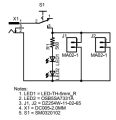
Ok, resolved except for your schematic advice: are you saying to not include component information. Without them I make it harder for the reader to find the info?
It's more important that a schematic be used to convey circuit intent, not be an assembly diagram. I think it's acceptable to put the LED part numbers on a separate part of the schematic. This can be carried to a detrimetal extreme, so take note.

It would be preferable to use J designators instead of part numbers for the 2 pin headers. The 'H' designators are non-standard and are too far away from the connectors. I missed them at first.

EDIT: The symmetrical placement of the headers is affecting your ability to draw a clean schematic. Schematics look cleaner if there are no gaps in the component designator numbering sequence (unless it's a part of a larger assembly).
1675787310580.png
The larger than necessary space between the power jack and LEDs was intentional to make the spacing of the vertical wires equal. L is the designator for inductors; resistors use R.
 
Last edited:

ThePanMan

Joined Mar 13, 2020
918
I think his question was around S3. ;)
Yes, I see that now. Thanks for the clarification
What is the barrel jack used for?
I keyed in on the wrong part of the circuit. Max has it correct, the question DOES revolve around S3.

I also agree with dl324 drawing. It's easier to follow. Also, since it is the only switch in the diagram convention suggests it should be "S1". Labeling it "S3" suggests it is a part of a larger diagram. Though it doesn't matter to your question, labeling is as important as everything else. You also indicate R1 to be a 562. That suggests it's a 5.6KΩ resistor. That's a very high resistance if that is in fact the intended value. The 5 and 6 are numerical while the 2 is the 10X multiplier. In other words, 5 & 6 & (two zeros) 00. Another convention for resistor identification for a 5.6KΩ resistor could be simply 5K6 which tells us it's 5,000Ω and 600Ω for a value of 5600Ω.

Sorry to seem like I'm being nit picky, but we like convention. The one thing dl324 left out was the R1 in his BOM (Bill Of Materials), the part that lists all the components beneath the schematic. Only information contained within the schematic is identifiers such as R1, LED1, LED2, etc. along with pin numbers for connectors and switches.
 

MaxHeadRoom

Joined Jul 18, 2013
30,659
Personally I have no issue with reading schematic capture versions, If someone already has a schematic drawn up, they are all mainly quite readable without going through the procedure of re-drawing to post a question.
I have done the same, using KiCad to whip up a quick schematic. !
 

Thread Starter

clangray

Joined Nov 4, 2018
261
I have done the same, using KiCad to whip up a quick schematic. !
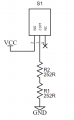
I need to try KiCad sometime. In the mean time, I am digesting all the posts which may take a while. Until then can someone please tell me whether switch S1 is configured correctly? Thankyou.

Power Board 5.png
 
Last edited:

Jon Chandler

Joined Jun 12, 2008
1,596
You also indicate R1 to be a 562. That suggests it's a 5.6KΩ resistor. That's a very high resistance if that is in fact the intended value. The 5 and 6 are numerical while the 2 is the 10X multiplier. In other words, 5 & 6 & (two zeros) 00. Another convention for resistor identification for a 5.6KΩ resistor could be simply 5K6 which tells us it's 5,000Ω and 600Ω for a value of 5600Ω.
Ahhhh, no. 562 ohms is a standard 1% resistor value. It's not the code marked on a surface mount resistor.

There are so many pedantic comments in this thread that are entirely unhelpful. The point of a schematic is to show the circuit clearly. Personal preferences are just that.

The three-bar earth-ground symbol is is commonly used in virtually every schematic I have seen, with the triangular ground symbol rarely used except when needed to shoe ground in special circumstances.
 

MaxHeadRoom

Joined Jul 18, 2013
30,659
The three-bar earth-ground symbol is is commonly used in virtually every schematic I have seen, with the triangular ground symbol rarely used except when needed to shoe ground in special circumstances.
Doesn't make it right, :rolleyes: Why bother with a 'Standard' in first place, if no one follows it??
 

Jon Chandler

Joined Jun 12, 2008
1,596
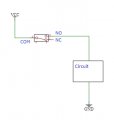
A simple schematic would have answered the question of this post 29 messages ago. Connecting a power switch is not a difficult problem to solve once the nomenclature is understood. A quick schematic, with the commonly used but "improper" ground symbol, "unprofessional" colored traces and "too much white space" answers the question.

switch circuit.jpg
 

MaxHeadRoom

Joined Jul 18, 2013
30,659
From one of AAC's own articles:
Quote: "The earth ground symbol is, unfortunately, used in many applications in electronics and electrical engineering, often meaning different things to different people, so it may be a bit confusing to some beginners.
For instance, the earth ground symbol is also used as a common ground symbol or a 0V reference.
This is a bit misleading because a 0V reference is not actually connected to earth ground." :rolleyes:
 

Attachments

MaxHeadRoom

Joined Jul 18, 2013
30,659
So I guess that anyone that responds to a question here, should strictly answer the question posed, and totally ignore any other mistakes, errors or bad practices the Original Poster may make? :(
 
Last edited:
Top