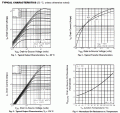
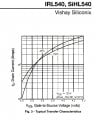
I have found MOSFET datasheet. I have attached datasheet but I don't understand how much gate to source voltage it needs to turn on fully. Where can I see this information in datasheet
I'm curious...I looked in the datasheet, but they do not graph Rds vs Vgs. Is that not something worth knowing?...Since Drain-Source resistance is higher with less Vgs.
I'm curious...I looked in the datasheet, but they do not graph Rds vs Vgs. Is that not something worth knowing?...Since Drain-Source resistance is higher with less Vgs.
It may be worth knowing, depending upon the application.
But your original question was about the gate-source voltage to fully turn it on.
For that you use the information posted in post #4.
That gives the worst-case values, which is normally what you design to.
The current scale on the vertical axis is drawn using a log scale.
You will notice that the horizontal lines representing current levels are not evenly spaced.
The lowest line is labeled 10^0. This means 1A.
The next 8 lines are 2, 3, 4, 5, 6, 7, 8, 9A.
The next line is labeled 10^1. This means 10A.
The next 5 lines are 20, 30, 40, 50, 60A.
The top of the chart is 70A.
The current scale on the vertical axis is drawn using a log scale.
You will notice that the horizontal lines representing current levels are not evenly spaced.
The lowest line is labeled 10^0. This means 1A.
The next 8 lines are 2, 3, 4, 5, 6, 7, 8, 9A.
The next line is labeled 10^1. This means 10A.
The next 5 lines are 20, 30, 40, 50, 60A.
The top of the chart is 70A.
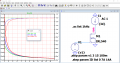
Math does not add up to datasheet. Datasheet says at 4V Vgs, RDSon resistance is 0.11 ohms (worst case). At 50V Vds, that would give 454A of current. Your graph is for a 20us pulse, not steady state. Hence more confusion....
It would be nice for vendors to show typical graph of Vgs vs RDSon at a fixed voltage (about 1/2 of maximum V breakdown?)...
Datasheet says at 4V Vgs, RDSon resistance is 0.11 ohms (worst case). At 50V Vds, that would give 454A of current. Your graph is for a 20us pulse, not steady state. Hence more confusion....
If you also notice, that RDSon value is given at a specific drain-source current of 14A.
It would seem obvious that it won't be that low at 454A of current, over 15 times its maximum rating.
And they test with a short pulse so self-heating won't affect the measured value (RDSon increases slightly with temperature).
If you also notice, that RDSon value is given at a specific drain-source current of 14A.
It would seem obvious that it won't be that low at 454A of current, over 15 times its maximum rating.
And they test with a short pulse so self-heating won't affect the measured value (RDSon increases slightly with temperature).
Somewhat. But, in "normal" use by most hobby people, reading those charts and tables don't exactly match what we are trying to build in terms of values/currents/pulse/etc. Even that 14A rating is for a pulse width < 300us. For a simple on/off MOSFET switch, I guess we have to try and figure out those charts. After that, have to figure RDSon and how much heat we have to dissipate vs trying to turn it fully on. Other than RDSon and maximum continuous current (28A @25C), everything else is an "experiment" in figuring out what to read...
Anyway, reading the datasheet requires one to know how the device is to be used, under what voltage and what load (current)....
On a datasheet the printed specs are for guaranteed maximums. The graphs are for "typical specs" that are better or worse than the printed maximum specs.
Vgs(th) is the voltage at which the device just starts turning on:
A conservative design would use 2V.
The graph in post #9 is for typical devices and, as one infamous member would say, you aren't guaranteed to get a typical device. Though most devices will be typical because the min/max values represent outliers.
They do not print the day of the week on transistors. I think devices with "typical" specs are made of a sunny Wednesday and ones with minimum and maximum specs are made on rainy other days. The phase of the moon has a minor effect on the specs.
Devices that fail the guaranteed specs are thrown in the trash but scavenged and sold on ebay.
I have found MOSFET datasheet. I have attached datasheet but I don't understand how much gate to source voltage it needs to turn on fully. Where can I see this information in datasheet
The voltages are shown very clearly in post #4
But "fully on" also depends on the current.
That means that the voltage for a specific application depends on the intended on state current.

 Facebook
 Google
 GitHub
 Linkedin