IRF540 Isolation Board

Thread Starter

febinkoshyjacob10

Joined Jul 14, 2025
3
Dear All,

I have a IRF540 isolation board (commonly available model). While using this, I made a circuit by giving 12Vdc Voltage to the Board. In the input side, I have given 5Vdc and digital signal for switching from a NI Daq Card. I observed the output from a Oscilloscope, when the switch is ON 12V is coming, while the switch is OFF 12V floating value is coming. Then checked with a DMM, by removing the oscilloscope, at that time proper switching was happening, 12V when ON and 0V when OFF.

Can anyone please help me in resolving this issue?
 

BobTPH

Joined Jun 5, 2013
11,463
Dear All,

I have a IRF540 isolation board (commonly available model). While using this, I made a circuit by giving 12Vdc Voltage to the Board. In the input side, I have given 5Vdc and digital signal for switching from a NI Daq Card. I observed the output from a Oscilloscope, when the switch is ON 12V is coming, while the switch is OFF 12V floating value is coming. Then checked with a DMM, by removing the oscilloscope, at that time proper switching was happening, 12V when ON and 0V when OFF.

Can anyone please help me in resolving this issue?
You need to load the output to see how it actually operates as a switch. A 1K resistor to ground should do.
 

wayneh

Joined Sep 9, 2010
18,087
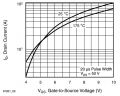
The IRF540 is not a logic-level MOSFET and needs more like 10V on its gate to fully lower the ON resistance. At 5V the ON resistance is over 10Ω.
1752501102513.png
 

sghioto

Joined Dec 31, 2017
8,633
Can anyone please help me in resolving this issue?
Interesting because the IRF540 is a N channel mosfet with low side switching.
With a properly connected load the voltage should read 12 volts to ground from the mosfet output and 0 volts when activated.
All the boards I have seen have isolated optocoupler inputs so 5 volts is fine for switching.
 

Irving

Joined Jan 30, 2016
4,996
So, this board controls one or more MOSFETs from low level input:

1752500602874.jpeg

With 5v input, the diode current is around 7mA; most NI DAQ cards are good for 20mA, so no problems there. The PS2801 has a CTR of 0.8 to 6, or 5.6 - 42mA through the transistor. At VPP of 12v that will result in a gate voltage of between 11 and 11.8v, which should turn the MOSFET on fully.

The general use for this board is to control a load, eg a motor or relay between the + and - connections, by switching the current through it on and off, not to generate a voltage output. From your description you are wanting a voltage output? A resistor between + & - connection will give a voltage output at the - connection with respect to ground and the resistor value will be determined by the load current you wish to deliver. Note: A voltage output is inverted logic. The output will be 0v when the input is +5v and near 12v when the input is 0.
 

bertus

Joined Apr 5, 2008
22,882
Hello,

Did you see point 6 of the specifications?
It can be used to control the 100V/33A DC circuit. However, it is suggested that the controlled DC voltage is more than 9V.

Replace the IRF540 with IRL540 if you want to control with a logic signal.

Bertus
 

Irving

Joined Jan 30, 2016
4,996
Replace the IRF540 with IRL540 if you want to control with a logic signal.
Not necessary, the MOSFET gate is isolated by an optocoupler. The 9v criteria applies to VPP, the controlled output voltage, nothing to do with the controlling input signal. However, if you wanted to control an output load @5v on VPP the existing MOSFETs will be OK up to around 2 or 3 amps.

It can be used to control the 100V/33A DC circuit.
No it can't; quoting the 'absolute maximum' rating of the MOSFET as the board's "capability" is totally meaningless.

Given there is no heatsink on the MOSFETs they are limited to around 1.5W, at VPP of 12v that would be around 7A max if only one MOSFET was on at a time.

Also any VPP > 20v will destroy the MOSFETs as there is no protection for the gate.

Lastly, as an isolation product it's flawed as input and output share a common ground!
 
Last edited:
Top