Ipod nano to trigger actuator ?

Thread Starter

Jbidinot

Joined Sep 17, 2013
14
Hey guys,

I would love some help.

I have an ipod nano that plays a video, in the video at a certain point it will play a sine wave and at that moment i need an actuator to be triggered.

Is it possible to use an electronic switch that the output voltage from the ipod will trigger when the sine wave plays through the output jack that will be wired to the electronic switch to activate the actuator.

I believe the Ipod puts out 1.5v at max volume.

The actuator is 12vdc 300ma

What would i need to buy?
 

Alec_t

Joined Sep 17, 2013
15,103
Is the sine wave a constant, known frequency? For how long does it play? For how long must the actuator be driven?
 

wayneh

Joined Sep 9, 2010
18,088
Yeah, you need 1) a steady tone long enough that it is unlikely to appear at any other time, and then 2) a detector centered at the frequency of that tone. It can 3) integrate the signal and when the tone has been detected for a long enough time, 4) trip a signal to a monostable (latching) switch. This will 5) control a transistor that switches the current on for your actuator by completing its path to ground.
 

Thread Starter

Jbidinot

Joined Sep 17, 2013
14
Is there not a type of electronic switch like a Relay that i can use to make this simple. The sine wave is just what the sound clip happens to be but it isn't audible. My plan was to literally cut off the headphones and attach the wires to a relay, so when the "sound" plays, the relay would receive the voltage from the headphone jack, which would then activate the relay and complete the circuit powering the the actuator. This is for a prototype and needs to be very simple.

I just don't know what relay to buy that will work. I have 2 9 volt batteries in series powering the actuator. i believe the ipod nano's headphone jack puts out 1.5v..

will this work if i can find the right relay?

As i'm sure you can tell my electronics knowledge is minimal..

Thanks so much for the help guys
 

Alec_t

Joined Sep 17, 2013
15,103
You can't just substitute a relay for headphones and expect a useful result. The circuit won't be simple. Wayneh's post #4 sets out the necessary functions the circuit must perform.
 

djsfantasi

Joined Apr 11, 2010
9,237
How about an OP amp to an envelope follower to transistor?

Alec_t's questions regarding how long the tone is and how long the actuator must be activated are important design considerations.

And as he also points out, this a little more complicated than a relay.
 

wayneh

Joined Sep 9, 2010
18,088
The sine wave is just what the sound clip happens to be but it isn't audible.
Huh? How do you expect an iPod to pass a sound wave outside the audible range? Well OK, old folks can't hear much above 11kHz but younger folks can allegedly hear nearly up to the limits of the iPod's output specs.
 

ebeowulf17

Joined Aug 12, 2014
3,307
I think by "not audible," the OP means that it won't be played out loud - the audio track will be used exclusively for this triggering mechanism.

If I'm understanding this correctly, it potentially simplifies things at least a little. There's still no way you're driving a relay directly off of a headphone output, but maybe you don't need to worry about frequencies and filters. Maybe you just rectify the ac audio signal to dc and control a transistor with that. Maybe you also don't need the circuit to handle timing, because the sine wave in the video could be played for the exact length of time you want the actuator to be active.

Don't think of this as audio per se. Instead just imagine what circuit would be required to accept a 1.5VAC input and use that to control a transistor, and in turn a relay.

I'm way too new at this to get it right without a lot of research, but it seems like a rectifier, maybe a smoothing cap, then a transistor if the headphone output delivers enough current, or a comparator driving a transistor. Shouldn't be too hard, right?
 

Thread Starter

Jbidinot

Joined Sep 17, 2013
14
ebeowulf gets it :) thank you for the help i feel like i'm headed in the right direction. Anymore help is highly appreciated, i need to figure out what parts to buy to make it all work
:)

Sure wish i could tell you guys what this is a part of... one day i will post the final product when its all done... minds will be blown :)
 

wayneh

Joined Sep 9, 2010
18,088
Please clarify - are you trying to pull a signal out of regular audio content that accompanies the video, or are you going to use a tone added to an otherwise quiet track, that is not meant to be heard by the user? The former will be difficult to impossible, the latter will be relatively easy.
 

wayneh

Joined Sep 9, 2010
18,088
That's great! And do you want tone on = switch on, tone off = switch off? In other words, the state of the switch will be the same as the state of the tone? Or do you need the tone to trip the switch for some period of time no matter what happens to the tone?

Also, let us know what power source you have available for your actuator.
 
Last edited:

Thread Starter

Jbidinot

Joined Sep 17, 2013
14
tone on = switch on tone off=switch off.. exaclty

right now i've just got 2 9v batteries in series for 18v... the actuator only needs 12v but its being used to seal an airway so the more voltage the more force it applies and just works better, longevity is not an issue at this point, just trying to get the whole thing to function as required for now.
 

wayneh

Joined Sep 9, 2010
18,088
OK, well here's how I'd do it. I'd couple the audio signal (do we know the frequency?) through a 0.1-1µF capacitor in series with the the signal. This will prevent any DC passing from or to the iPod, protecting it.

Next, a series diode would rectify the audio into positive peaks. These would get stored in an electrolytic capacitor, maybe 10-47µF. This capacitor would have a parallel resistor to ground to drain it, when no tone is present. Maybe 100KΩ. (All component values need to be calculated out, and I haven't bothered yet.)

I would use a comparator (LM339, for example) to watch the voltage on the capacitor and compare it to a variable reference voltage of ~0.2V or so. When the tone is present, it will send 1V peaks across the diode (losing ~0.6V) and charge the capacitor to ~0.4V. When the tone disappears, the 100K resistor will drain the cap to below the comparator's reference voltage.

Finally, the comparator's output can control a MOSFET such as IRF540N (I have a bunch!) to switch the actuator's ground lead. You will want a reverse-biased diode across the poles of the actuator to dissipate it's inductive spike, to protect the MOSFET when the actuator is switched off.

All of this can be powered directly from your 2 batteries. You should be aware that 300mA is a lot of current for a 9V battery. It won't last long.

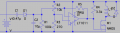
A first draft with an LT part in place of the LM339:
Screen Shot 2015-04-06 at 2.24.01 PM.png
A genuine voltage reference would be better than the resistor divider shown. And I may have the logic backwards. L1 is your actuator.
 

Attachments

Last edited:

ebeowulf17

Joined Aug 12, 2014
3,307
OK, well here's how I'd do it. I'd couple the audio signal (do we know the frequency?) through a 0.1-1µF capacitor in series with the the signal. This will prevent any DC passing from or to the iPod, protecting it.

Next, a series diode would rectify the audio into positive peaks. These would get stored in an electrolytic capacitor, maybe 10-47µF. This capacitor would have a parallel resistor to ground to drain it, when no tone is present. Maybe 100KΩ. (All component values need to be calculated out, and I haven't bothered yet.)

I would use a comparator (LM339, for example) to watch the voltage on the capacitor and compare it to a variable reference voltage of ~0.2V or so. When the tone is present, it will send 1V peaks across the diode (losing ~0.6V) and charge the capacitor to ~0.4V. When the tone disappears, the 100K resistor will drain the cap to below the comparator's reference voltage.

Finally, the comparator's output can control a MOSFET such as IRF540N (I have a bunch!) to switch the actuator's ground lead. You will want a reverse-biased diode across the poles of the actuator to dissipate it's inductive spike, to protect the MOSFET when the actuator is switched off.

All of this can be powered directly from your 2 batteries. You should be aware that 300mA is a lot of current for a 9V battery. It won't last long.

A first draft with an LT part in place of the LM339:
View attachment 83551
A genuine voltage reference would be better than the resistor divider shown. And I may have the logic backwards. L1 is your actuator.
That's great! I'm glad you put this up, cause I really wanted to understand this one better. I had a feeling I was missing something right at the front end... and it was the coupling capacitor to block DC. The rest of what you've drawn is conceptually pretty similar to what I imagined, but I'm not sure if I could've worked out all the details on my own. If you end up calculating the appropriate values for the components, I'd love to hear your thought process on that part as well.

Thanks!
 
Last edited:

wayneh

Joined Sep 9, 2010
18,088
The product of R1 and C2 will determine the turn-on and turn-off delay times, and the TS needs to provide input. If the delay needs to be very short, the values will become more limited. The value of C1 will also affect the turn-on time. It's like a pump filling up C2. The larger the ratio of C1 to C2, the faster that C2 will fill when the tone starts.

You can play with the LTspice file all you want, to see how component values affect the results.
 
Top