hey everyone i want to build a ion thruster for a project of mine and it needs to lift like 100 kg ( 220 lbs ) so it needs to be powerful enough tho what electronics ( Kv and Amp config do i need to use)
kV and A well beyond what you would be safe handling and well beyond your means I suspect.what electronics ( Kv and Amp config do i need to use)
Show us your calculation that informs you that this is feasible. In other words, what velocity and how many of whatever ion you have chosen must be expelled to get over 220 lbs of thrust.hey everyone i want to build a ion thruster for a project of mine and it needs to lift like 100 kg ( 220 lbs ) so it needs to be powerful enough tho what electronics ( Kv and Amp config do i need to use)
+1Show us your calculation that informs you that this is feasible. In other words, what velocity and how many of whatever ion you have chosen must be expelled to get over 220 lbs of thrust.


Welcome to AAC!hey everyone i want to build a ion thruster for a project of mine and it needs to lift like 100 kg ( 220 lbs ) so it needs to be powerful enough tho what electronics ( Kv and Amp config do i need to use)
i have access to nasa files to that matter of ion hall thrusters lol no but i mean the multistage ion thruster i need 4 multistage ion thrusters for a project of mine+1
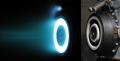
These are real ion (Hall ) thrusters.
View attachment 305041
https://psyche.asu.edu/2018/01/19/electric-thrusters-psyche-spacecraft-work/
View attachment 305042
The “SPT-140” Hall thrusters on Psyche use up to 5 kW of power to produce about 0.06 pounds of thrust.
hmmm not really but you can look up to the plasma channel lol thats my inspiration source he made oneIf you can get the thruster to have similar efficiency, you will need about 18MW to power it. Do you by any chance own a medium sized power plant?
Ion thrust devices are for low gravity conditions where the high impulse is useful where the mass reaction works vs other forces that react with the device total masshmmm not really but you can look up to the plasma channel lol thats my inspiration source he made one
The mass ejected to provide thrust to the spacecraft is the propellant, which is
carried onboard the vehicle and expended during thrusting. From conservation
of momentum, the ejected propellant mass times its velocity is equal to the
spacecraft mass times its change in velocity. The “rocket equation” describing
the relationship between the spacecraft velocity and the mass of the system is
derived as follows.
Do keep us informed on the progress of your project.