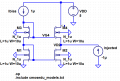
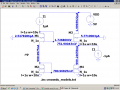
For the circuit below as the injected current equal to -1uA the current through M4 is 1uA and there is no current through M2.
What I am confused is why there is not a case that M4 current is 2uA and M2 current is 1uA and it still satisfies KCL law.
Because, although it will still satisfy KLC, M4 wouldn't be a current-mirror any more since it wouldn't be carrying the same current as M3 (which is the definition of a current mirror).
Because, although it will still satisfy KLC, M4 wouldn't be a current-mirror any more since it wouldn't be carrying the same current as M3 (which is the definition of a current mirror).
Sure it can. A simple mirror like this has very poor output impedance so as you increase the voltage drop across the source-drain terminals of the reflector transistor above that of the generator transistor, the current in the reflector will increase above the reference current.
For the circuit below as the injected current equal to -1uA the current through M4 is 1uA and there is no current through M2.
What I am confused is why there is not a case that M4 current is 2uA and M2 current is 1uA and it still satisfies KCL law.
The current flowing in M4 will be determined by the gate-source voltage and the drain-source voltage. The gate-source voltage is fixed by M3 to a value that is consistent with 1 uA in M4 when the drain-source voltage of M2 is about a threshold voltage drop (since M1 is diode-connected). In order to get more current out ofM4, the voltage across M4 must go up meaning that the voltage across M2 has to go down and, hence, the current in M2 has to go down.
In a real circuit, you would expect the current in M4 to increase slightly and for there still to be a bit of current in M2, but the "ideal" answer will be close enough for many applications.
The current flowing in M4 will be determined by the gate-source voltage and the drain-source voltage. The gate-source voltage is fixed by M3 to a value that is consistent with 1 uA in M4 when the drain-source voltage of M2 is about a threshold voltage drop (since M1 is diode-connected).
M4 gate voltage is fixed but how about source voltage? Why Vgs is fixed here?
Let's assume that M2 current is 1uA so Vds2 = Vgs2 = Vgs1 = constant.
So Vgs4 is fixed and for M4 current to be 2uA, we can increase Vds4 by increasing VDD until the current is 2uA.
Why it is wrong here?
For the circuit below as the injected current equal to -1uA the current through M4 is 1uA and there is no current through M2.
What I am confused is why there is not a case that M4 current is 2uA and M2 current is 1uA and it still satisfies KCL law.
Most interesting. I must have something to learn here. I am used to seeing the injected signal going to the other side (with the collector-base or drain-gate connected together).

 Facebook
 Google
 GitHub
 Linkedin