Infinite resistance chain

Shagas

Joined May 13, 2013
804
I'm not sure what you mean by 'last resistor'
Also the current depends on the amount of chains .
Try it yourself , is very simple to work with :
http://www.falstad.com/circuit/e-ohms.html
You don't need to download it or anything( you can though) , you can work with it and edit it right there.
Just select the whole circuit and delete it . Then you will have a black space to work in.
Right click on the workspace and select the components that you want to add and once a complete circuit is formed you will see simulator in action.Add a voltage source under category "inputs/outputs" . You can vary simulator speed and mouse over components to see current , voltage etc etc
Double click the components to edit their values
 

WBahn

Joined Mar 31, 2012
33,198
I did the calculations in a spreadsheet and it had converged by the ninth step. I believe it had converged by the sixth step, but I need to recreate the spreadsheet since I didn't save it. BTW, it converged to an integer + irrational number.
I agree. But I was also pretty sure that Shagas did NOT do that and so wanted to discuss it in terms of the experiment I'm pretty sure he actually did.
 

WBahn

Joined Mar 31, 2012
33,198
I solved this using a very simple solution that I found here (scroll down a bit):

http://www.schoolphysics.co.uk/age1...ml?PHPSESSID=5b0029c25a5894099c6df916f68d95ac

I know there are other more complicated solutions, but I would suggest they will be cut off with Occam's razor. Thanks. :)
The Eectrician and I have been trying to get you to do that on your own, instead of just searching the internet continuously hoping to find a site that just happens to have the solution to your homework all ready for you to copy down and turn in.

At least go through the math enough to determine that the exact solution is

Req = (1 + sqrt(3))R
 

Thread Starter

Teszla

Joined Jun 7, 2013
43
The Eectrician and I have been trying to get you to do that on your own, instead of just searching the internet continuously hoping to find a site that just happens to have the solution to your homework all ready for you to copy down and turn in.

At least go through the math enough to determine that the exact solution is

Req = (1 + sqrt(3))R
None of my homework is supposed to be turned in, I'm just doing it to learn.
Of course I went through the math, I want to understand the math of it. But sometimes math is not enough, but also a visualisation (in this case a simple illustration) helped me understand it. Your help is of course very welcome (I think you also helped me very well with earlier problems), so please don't be disencouraged by my way of learning. ;)
 
Last edited:

WBahn

Joined Mar 31, 2012
33,198
None of my homework is supposed to be turned in, I'm just doing it to learn.
In that case, most of what I said either doesn't apply or is heavily muted. Something that is trying to learn something instead of just get an answer to turn in can learn a great deal from seeing someone else's solution because they are going to look at it with the right attitude and objective.

Still, keep in mind that looking at someone else's solution and approach can help you develop the ability to solve problems, it doesn't get you nearly all the way. That is only done by struggling to solve problems without seeing how someone else approached it. The reason is mostly because even if you understand why the approach worked, that is very different level from understanding why that approach was taken in the first place.
 
I'm not sure what you mean by 'last resistor'
Also the current depends on the amount of chains .
Try it yourself , is very simple to work with :
http://www.falstad.com/circuit/e-ohms.html
You don't need to download it or anything( you can though) , you can work with it and edit it right there.
Just select the whole circuit and delete it . Then you will have a black space to work in.
Right click on the workspace and select the components that you want to add and once a complete circuit is formed you will see simulator in action.Add a voltage source under category "inputs/outputs" . You can vary simulator speed and mouse over components to see current , voltage etc etc
Double click the components to edit their values
I haven't made clear my reason for wanting you to post your results.

I don't get the same result that you do. This means that either you are getting an incorrect result, or I am. To determine where one of us is making an error it would help to compare results for shorter networks.

If we assume a 1 volt is applied to the a-b terminals with all the resistors being 1 ohm, and that the current is calculated in the "last" resistor, please list your calculated currents for chains of 1, 2, 3, 4, 5 and 6 sections.

What I mean by "last" resistor is the resistor at the far right end of the chain.

The result for a single section chain is obviously .333333333 amps.
 
Last edited:

t_n_k

Joined Mar 6, 2009
5,455
@ The Electrician,

I think the values in amps would go as

1/3, 1/11, 1/41, 1/153, 1/571, 1/2131, 1/7953 , .....

for (finite) 1, 2, 3, 4, 5, 6, 7, .... sections

I also have the finite Req values in ohms according to sections as ...

\(\text{3, 2\dfrac{\small{3}}{\small{4}}, 2\dfrac{\small{11}}{\small{15}}, 2\dfrac{\small{41}}{\small{56}}, 2\dfrac{\small{153}}{\small{209}}, 2\dfrac{\small{571}}{\small{780}}, ....}\)

I think the series relationship is given by the condition ...

If a term in the series is \(\text{2\dfrac{\small{a}}{\small{b}}}\) then the next term is \(\text{2\dfrac{\small{a+2b}}{\small{a+3b}}}\)
 
Last edited:
Yes, that's what I get. The result at the end of 5 stages is very different from the 377.22μA Shagas reports in post #17. Makes me wonder if the app he used is giving such bad results after 5 stages (perhaps due to inadequate arithmetic?), or if he made a mistake somewhere along the way.

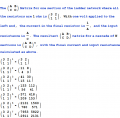
Here's how I get the numbers:


Attachments

Top