Indicator circuit

Thread Starter

xw0927

Joined Dec 19, 2010
114
I wish to add-in a indicator circuit to indicate a situation of "low battery" in my Boost-converter, is there any kind of circuit I can refer to?

Or perhaps, is there an indicator shows that the output voltage is not at its desired output voltage value.

My input voltage is a 12v 1.2Ah battery...

Regards,

Xm
 

wayneh

Joined Sep 9, 2010
18,110
You could achieve this with a comparator circuit (look at LM339), using a voltage reference (such as 7805 or a zener diode) and then a voltage divider to bring the battery voltage down to near the reference. For instance if the reference voltage is 5, and you want the light to trigger at 10v at the battery, divide the battery voltage in half for comparison to the reference.

A simpler approach might be an LED in series with a zener diode. You might be able to find the right values that turn the LED off when there is insufficient voltage to drive it. I suppose you could add a transistor to reverse the sense, so the LED goes ON when the voltage drops. Huh, I appear to be rambling out loud.
 

Wendy

Joined Mar 24, 2008
23,798
I've done the LED/zener circuit. It works, but you are still better to do the comparator window circuit (zener will still be required as a voltage reference). The display is much less ambiguous and brighter. A LM393 is a dual version of the quad LM339, and a 8 pin DIP besides.
 

Thread Starter

xw0927

Joined Dec 19, 2010
114
Thanks you guys...
But, do you guys have the example schematic ...
Or how could I get the example circuit for that?


Thanks
 

Wendy

Joined Mar 24, 2008
23,798
Bedtime for me, but two resistor divider circuits, one with a zener to fix the voltage independent of the power supply, the other off the power supply itself. Since one divider moves with the power supply voltage and the other is fixed, when they cross the comparator will flip. With two comparators you can set a window as opposed to single cross over level.

I'll try to draw one tomorrow.
 

Thread Starter

xw0927

Joined Dec 19, 2010
114
Bedtime for me, but two resistor divider circuits, one with a zener to fix the voltage independent of the power supply, the other off the power supply itself. Since one divider moves with the power supply voltage and the other is fixed, when they cross the comparator will flip. With two comparators you can set a window as opposed to single cross over level.

I'll try to draw one tomorrow.
Thanks for your kindness... Sorry, I couldn't imagine how is the circuit... Thanks a lot
 

Wendy

Joined Mar 24, 2008
23,798
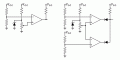
OK, the first schematic is more or less what you asked for. By setting up the resistors where if the voltage goes below a set point the output of the comparator goes high.

The second schematic shows a window comparator. If the power supply goes above or below a setpoint the output goes high. Remember, most comparators are open collector.


Attachments

Thread Starter

xw0927

Joined Dec 19, 2010
114
OK, the first schematic is more or less what you asked for. By setting up the resistors where if the voltage goes below a set point the output of the comparator goes high.

The second schematic shows a window comparator. If the power supply goes above or below a setpoint the output goes high. Remember, most comparators are open collector.

I will need some time to study about this circuit. Thanks a lot!
 

k7elp60

Joined Nov 4, 2008
562
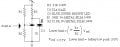
Here is one I just got working for my son-in-law to monitor a battery and let him know with it is down to 10V. It isn't for lead-acid so you will have adjust value of the resistors. It only works with LED's that have a Vf greater than 2V as the output is at 2V until the input voltage drops below the minimum value, then the output goes high. The value of R3 was selected for a superbright blue LED.
 

Attachments

Last edited:

thatoneguy

Joined Feb 19, 2009
6,359
Here is one I just got working for my son-in-law to monitor a battery and let him know with it is down to 10V. It isn't for lead-acid so you will have adjust value of the resistors. It only works with LED's that have a Vf greater than 2V as the output is at 2V until the input voltage drops below the minimum value, then the output goes high. The value of R3 was selected for a superbright blue LED.
Why is R3, in parallel with R1, not specified as 1% as well, or combined to be a single resistor?
 

CDRIVE

Joined Jul 1, 2008
2,219
Here is one I just got working for my son-in-law to monitor a battery......
I understand the concept here but I've never seen a Zener or Schottky Diode with voltage ratings lower than a LED... even a blue one. Admitted, I'm quite lax at staying current. Also, I couldn't find a data sheet for U1. Is that a Zener or Schottky? What does R1 do? 100K in par with 3.3K seems meaningless here.
I'm also bewildered with the line making connection from "Point A" to U1?
 

k7elp60

Joined Nov 4, 2008
562
I understand the concept here but I've never seen a Zener or Schottky Diode with voltage ratings lower than a LED... even a blue one. Admitted, I'm quite lax at staying current. Also, I couldn't find a data sheet for U1. Is that a Zener or Schottky? What does R1 do? 100K in par with 3.3K seems meaningless here.
I'm also bewildered with the line making connection from "Point A" to U1?
U1 is a programmable voltage reference. Try looking for a TL413. The AIZ specifies the temperature range and the package. The internall reference is very close to 2.5V R1(100K) and R2(32.8K) form a voltage divider. When the input voltage drops to very near 10V the output lead(junction of R3 and the LED) goes up above 2V. As long as the input voltage to the circuit is above 10V the output is 2V and a LED with a Vf of 2V or less would be on all the time.
I hope this makes sense now. The arrow and the line is just pointing to the junction of R1 and R2. When the voltage at that point equals the internal reference voltage(2.5V) the output (junction of R3 and the LED) goes high.
 
Last edited:

Thread Starter

xw0927

Joined Dec 19, 2010
114
U1 is a programmable voltage reference. Try looking for a TL413. The AIZ specifies the temperature range and the package. The internall reference is very close to 2.5V R1(100K) and R2(32.8K) form a voltage divider. When the input voltage drops to very near 10V the output lead(junction of R3 and the LED) goes up above 2V. As long as the input voltage to the circuit is above 10V the output is 2V and a LED with a Vf of 2V or less would be on all the time.
I hope this makes sense now. The arrow and the line is just pointing to the junction of R1 and R2. When the voltage at that point equals the internal reference voltage(2.5V) the output (junction of R3 and the LED) goes high.
hey dude, now i am trying to explain something regarding your circuit with my understanding. Please do correct me if I interpret this circuit wrongly.

R1 and R2 are voltage divider, when voltage supply is above 10V which makes the point A to be greater than 2.5V, so the U1 turns ON, due to the current is blocked, so the led turns ON. Am I right?

But, I have 1 question is that: How do you know the Vref? Is it obtained from datasheet? Or all types of TL431 have the same Vref?

Thanks
 

Wendy

Joined Mar 24, 2008
23,798
The TL431 is a programmable Zener Diode, perfect if you don't have the exact part handy. The resistors program the zener foldover voltage. You can look it up in the data sheet for details.
 
Top