Increase IR range

Thread Starter

Elecrical_Student

Joined Mar 5, 2022
19
Well, try this, why would it work? What about it makes you think it would do something different than it did?
I tried everything but can't understand why it isn't working. I spent more than 3 weeks to trying understand the reason why this circuit isn't working with no progression..
 

Ya’akov

Joined Jan 27, 2019
10,252
My teacher at the college told me to try this. He told me to decrease the duty cycle and it may make the difference but it only made it more complicated.
Well, you have to go about this systematically. Since IR LEDs are very similar in optical performance to the same size visible light LED, why don't you try to characterize what the IR emitter is doing with something you can actually see?

If you check the radiation pattern of a visible light LED, blue might work well, in a darkened room, maybe it will help with ideas on how to fix this. Think of it from the point of view of the detectors and try to work out what they are likely to "see", and what you might do to change that.
 

Audioguru again

Joined Oct 21, 2019
6,826
An IR LED is about 1.2V at 20mA but is 1.3V at a higher current. Two in series need 2.6V. The 2N2222A transistor saturates with a Vce of 0.3V when its base current is 1/10th its collector current. Then the LEDs current is 5V - (2.6V + 0.3)/20 ohms= 105mA. The voltage feeding the 1k base resistor must be (10.5mA x 1k) + 1V= 11.5V that your Arduino cannot produce.

Replace the antique 2N2222A with a logic level Mosfet. Calculate the frequency of the bursts of 38kHz pulses and the gap between bursts that match what the TSOP receiver needs.
 

ericgibbs

Joined Jan 29, 2010
21,452
hi E Student.
A quick check of the 2N2222/A datasheets will show that your circuit will work as you expect.
[provided you have built it as shown with those component values]

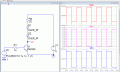
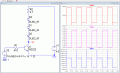
Image 1498, is for 3 IR diodes with a VCC of 4.8V, works OK.

Post your latest circuit diagram

E
 

Attachments

Thread Starter

Elecrical_Student

Joined Mar 5, 2022
19
hi E Student.
A quick check of the 2N2222/A datasheets will show that your circuit will work as you expect.
[provided you have built it as shown with those component values]

Image 1498, is for 3 IR diodes with a VCC of 4.8V, works OK.

Post your latest circuit diagram

E
My last circuit is the same as the 1496 circuit at the files you uploaded here.
Will it help if I will post my software here? I really can't understand why it doesn't work well.
 

ericgibbs

Joined Jan 29, 2010
21,452
hi ES,
Please post your program, use the Insert Option on top bar menu, select Code and paste in your program.
What is the IR emitter diode type.?

E
EG 1499.gif
 

Thread Starter

Elecrical_Student

Joined Mar 5, 2022
19
My infrared diode of the transmitter is IR333
Transmitter is TSOP4838
The program is:

Code:
void setup()
{
  pinMode(11,OUTPUT); //pin 11 at the Arduino NANO
}

void loop()
{

for (int i=0;i<190;i++)//100HZ
{
  digitalWrite(11,HIGH); //HERE I CREATE 38KHZ
  delayMicroseconds(10);
   digitalWrite(11,LOW);
  delayMicroseconds(10);
}
delay(5); //Delay between bursts
}
 

ericgibbs

Joined Jan 29, 2010
21,452
hi ES,
I have IR emitters and a TSOP on the bench, will set up a test rig.

I guess you are aware that some TSOP versions require a burst type modulation.?

To check if your IR Emitters are outputting IR, use the Camera on your mobile phone.
Shade the camera from ambient light, with your hand, and if the IR is pulsing you will see the flashes on the mobile camera.

Let's know if you can check the IR by that method.

E
 

Thread Starter

Elecrical_Student

Joined Mar 5, 2022
19
hi ES,
I have IR emitters and a TSOP on the bench, will set up a test rig.

I guess you are aware that some TSOP versions require a burst type modulation.?

To check if your IR Emitters are outputting IR, use the Camera on your mobile phone.
Shade the camera from ambient light, with your hand, and if the IR is pulsing you will see the flashes on the mobile camera.

Let's know if you can check the IR by that method.

E
I will check it in the evening when I will arrive at my home and send my update here.
Thank you very much !!
 

drjohsmith

Joined Dec 13, 2021
1,613
Ok.
So as this is homework
We can't tell you the answer .

Some background .
The Arduino code .
The delay instruction, stops the microcontroller for that period .
Look at writtimg the code so it loops , see the none blocking button code for the Arduino .

Next.
Sensitivity is what your asking about.
Signal to noise ratio

You can either .
Increase power of the transmitter
Decrease background noise
Increase receiver gain
Increase Sensetivity with maths .

First two are self evident .
More transmitters and in a dark room

Or , you could increase the receiver gain , but background noise is to much, then you increase the noise also. No win
So you need selectivity in the receiver .
Maths.
This is the fun part .
If you have a signal that's on or off, then any noise diytracts from the signal
But
If the signal is on off in a pattern, and you sample say 16 times , and correlate , the noise is averaged the signal is summed .
Then signals below noise can be detected. Assuming the receiver is not overloaded by the noise.
In its simplest, a synchronous receiver of the modulation achieves this.
 

Thread Starter

Elecrical_Student

Joined Mar 5, 2022
19
Ok.
So as this is homework
We can't tell you the answer .

Some background .
The Arduino code .
The delay instruction, stops the microcontroller for that period .
Look at writtimg the code so it loops , see the none blocking button code for the Arduino .

Next.
Sensitivity is what your asking about.
Signal to noise ratio

You can either .
Increase power of the transmitter
Decrease background noise
Increase receiver gain
Increase Sensetivity with maths .

First two are self evident .
More transmitters and in a dark room

Or , you could increase the receiver gain , but background noise is to much, then you increase the noise also. No win
So you need selectivity in the receiver .
Maths.
This is the fun part .
If you have a signal that's on or off, then any noise diytracts from the signal
But
If the signal is on off in a pattern, and you sample say 16 times , and correlate , the noise is averaged the signal is summed .
Then signals below noise can be detected. Assuming the receiver is not overloaded by the noise.
In its simplest, a synchronous receiver of the modulation achieves this.
I wrote that it is homework because It's a method that I got at my school.
It's without grade and only in order to increase the knowledge in electricity.
The main goal of this project is to learn more about these components and how it works, (The teacher tells us to
investigate and to learn from the Internet so this is what I am currently doing.
 

ericgibbs

Joined Jan 29, 2010
21,452
hi ES,
Your basic circuit 'works', it emits IR pulses, but the pulse rate is not what you are expecting.

I would suggest you check the IR libs.
eg:
// Include IR Remote Library by Ken Shirriff
#include <IRremote.h>

E
 

ci139

Joined Jul 11, 2016
1,995

Audioguru again

Joined Oct 21, 2019
6,826
hi E Student.
A quick check of the 2N2222/A datasheets will show that your circuit will work as you expect.
[provided you have built it as shown with those component values]
It might work if you can find a transistor with "typical" specs. It will not work with guaranteed minimum specs.
Where can you find typical or better?
If you design for minimum specs that all transistors will work.
 

Audioguru again

Joined Oct 21, 2019
6,826
You might be modulating the 38kHz PWM to the Philips CC5 remote control spec which does not include the TSOP spec that has certain lengths of data bursts and certain lengths of gaps between the bursts.
 

ericgibbs

Joined Jan 29, 2010
21,452
hi agu,
Doesn't the definition 'typical' have to be considered all in semiconductor specifications.?

The TS probably has only got a couple of 2N2222 on his bench, and no way of testing the spec, so he should try using the ones he has and advise the results.

I checked and tested his Arduino sketch/program, it works, but the frequency is way off the 38kHz mark.

The TSOP requires close to 38kHz.

E
https://forum.allaboutcircuits.com/ubs/tsop1738-when-used-as-a-beam-break-detector.729/
 

Audioguru again

Joined Oct 21, 2019
6,826
I think that a circuit made to be copied by others should use "worst case specs", not typical specs.
If a student builds only one or two then he can fiddle with resistor values to use transistors that have less than typical specs.
 

BobTPH

Joined Jun 5, 2013
11,544
Can you give us the part number if the exact part number detector you are using? I got far better range than you are getting with a single IR LED but only after I met the the specs for burst length and dead time. The one I was using behaved erratically when I did not. This is why I still think your modulation is incorrect.

Bob
 
Top