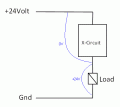
In series load schematic

GopherT

Joined Nov 23, 2012
8,009
in series means the same current must flow through both. The x circuit must be ale to handle the 100 mA. I suggest swapping the x-circuit and the load, So the CD40106 just needs a transistor on the output.
I suspect the problem is a grounded load is the core of the problem.
 

ScottWang

Joined Aug 23, 2012
7,501
As I mentioned at #11, the X circuit can't be works without any voltage cross on its two pins.

They are the same meaning as the coil of relay can't works in series with the load, only the contacts of relay can be works in series with the load.

InSeriesWithLoadProblem.gif
 

ScottWang

Joined Aug 23, 2012
7,501
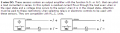
These kinds of output units are used the PNP or NPN with open collector, so the load will be in series with the output PNP or NPN, but the sensor as
Proximity sensor itself also needs the power supply to make the components of sensor to work and send the signal to drive the output bjt as NPN or PNP, and the output PNP or NPN can be drive the relay or other light load.

If the output is PNP then it is a output type to output the voltage and current, If the output is NPN then it is a sink type to sink the current from outside unit.
 

Thread Starter

hilologic

Joined Oct 27, 2016
15
No that isn't.
The proximity is really only 2 wires and the load is in series. Many industrial sensor uses two wire proximity sensor and some times has wide range of power supply AC or DC from 10 to 240 volt.
 

Thread Starter

hilologic

Joined Oct 27, 2016
15
No that isn't.
The proximity is really only 2 wires and the load is in series. Many industrial sensor uses two wire proximity sensor and some times has wide range of power supply AC or DC from 10 to 240 volt.
Sorry for the range I mean 24 to 240 volt.
I try this

timer2.PNG

Only two terminal 1 and 2 and one load in series.
 

ScottWang

Joined Aug 23, 2012
7,501
What I said in #25 is 3 wires sensor, their current of sensor and the current of load are different, when you using two wires Proximity sensor, because the sensor and load are in series, so the current of load must be small and equal to the current of sensor, and the voltage of power supply should be equal to the voltage of sensor plus the voltage of load, it means that the voltage of power supply should be great than the load, and that's why I posted the circuit in #23.

voltage of power supply = voltage of sensor + voltage of load
current of sensor = current of load

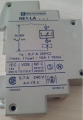
Attention must be paid to the minimum switching current, residual current and voltage drop when selecting low consumption relays or high impedance electronic controls to be used with these sensors.
OPERATING PRINCIPLES FOR INDUCTIVE PROXIMITY SENSORS
 
Top