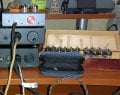
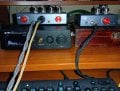
In search of the circuit diagram for the headphone amplifier xDuoo MT-604

Thread Starter

Samantha Sommers

Joined Jun 28, 2024
9
Hello, everybody!
I have 2 similar Chinese amps from manufacturer xDuoo, and the first is MT-602, and its circuit diagram I found here, loads of thanks to Sir Kit!
I'm also very grateful once again to Ian0 , KeithWalker and Audioguru again for their comments on the thread!
The second amp is MT-604, which is a balanced version of the MT-602.
I tried to find its circuit diagram, but so far without success.
Of course, the MT-602 circuit diagram is also a great help in understanding the MT-604 circuit, however, some details are still necessary.
Is there anybody able to help me?
Thank You in advance!
 

sparky 1

Joined Nov 3, 2018
1,218
A question asking what music and listening experience you want to achieve that the MK-604 could improve on.
Some on here might suggest operating points based on experience. Others are anticipating emphasis on effects that
their ears want to hear involving distortion, color and vibrance that tube amps give that op amps might lack.
Vacuume tube 6j1 (caillotantoine.github.io)
 
Last edited:

Thread Starter

Samantha Sommers

Joined Jun 28, 2024
9
A question asking what music and listening experience you want to achieve that the MK-604 could improve on.
Some on here might suggest operating points based on experience. Others are anticipating emphasis on effects that
their ears want to hear involving distortion, color and vibrance that tube amps give that op amps might lack.
Vacuume tube 6j1 (caillotantoine.github.io)
I love experimenting with vacuum tubes, and I have at least three dozen varieties of them, triodes, tetrodes, pentodes, and they all work wonderfully with these amplifiers. Most of them are Russian made, between 1954-1976. I have other amplifiers too, both pure tube and transistor ones, all class A. I even have a Dynaco ST -70, produced around 1974.
And regarding the MT-604, I have plans to modify its the volume control, but circuit diagram is required.IMG_20231108_183118_.jpgIMG_20231110_192617.jpgIMG_20240312_025302_.jpg
 

MisterBill2

Joined Jan 23, 2018
27,164
Very interesting! A single tube, possibly similar to a 6AU6, at least in pinout. Not a great audio tube.
And now I am wondering about a "balanced" amplifier. Is that the alternative to single-ended?
Certainly tube circuits are not currently in vogue, but certainly still interesting to some of us who are not entranced by only what is current. There is a certain fascination about circuits that do not require 2000x magnification to see clearly.
In addition, the ability to understand and service vacuum tube circuits is a skill not available in many circles.
 

Thread Starter

Samantha Sommers

Joined Jun 28, 2024
9
Very interesting! A single tube, possibly similar to a 6AU6, at least in pinout.
No, 6J1 is more similar to 6AK5(WA), EF95, EF95F, EF905, 6F32(V), 5654, 6096, DP61, PM05, M8100, 6J1P.
But You're right mentioned 6AU6, cuz it sounds in the best way with these amps. The bulb of this lamp is the highest (55 mm), which gives the best low frequencies.
Also with these amps can be used:
triodes 9002, 6S1P (very silent sound)
pentodes 6AS6(W), 6F33, 5725, 409A, 6187, 7752, M8196, 6DB6, 6954, 6J2P.
tetrodes 6AG5, 6AG5WA, EF96, 6BC5, 6CE5, 6186, 6J3P.
pentodes EF94, 6AU6, 6AU6A, 6AU6WB, 6136, 7543, 6J4P.
pentodes 6AH6 (W, A), 6F36"Tesla", 6485, 6J5P.
pentodes 6CF6, 6DK6, 6DE6, 6CB6(A), 6BH6, E90F, EF190, 6265, 6661, 6676, 7056, 7693, 7732, 8136, 6J38P.
pentodes 6J53P (no analogs).
pentodes 9003, 6BH5, EF81, UF81, 6K1P.
pentodes EF93, W727, 6BA6(W), 6BD6, 6F31"Tesla", 5749, 6660, PM04, M8101, 6CG6, 6K4P.
And now I am wondering about a "balanced" amplifier. Is that the alternative to single-ended?
For sure! By using a "balanced" amplifier, you get a very large stage extension, a concert hall instead of a small room, or a football field instead of a concert hall. And, of course, the output power of a “balanced” amplifier is always twice that of a similar single-ended amplifier.
A significant disadvantage of a “balanced” amplifier is the need for a very precise selection of all components in both channels, especially for the volume control, where the accuracy should be 0.1%, because distortion will not be summed up, but multiplied. But if everything is chosen very precisely, the result will be worth it.
 

MisterBill2

Joined Jan 23, 2018
27,164
No, 6J1 is more similar to 6AK5(WA), EF95, EF95F, EF905, 6F32(V), 5654, 6096, DP61, PM05, M8100, 6J1P.
But You're right mentioned 6AU6, cuz it sounds in the best way with these amps. The bulb of this lamp is the highest (55 mm), which gives the best low frequencies.
Also with these amps can be used:
triodes 9002, 6S1P (very silent sound)
pentodes 6AS6(W), 6F33, 5725, 409A, 6187, 7752, M8196, 6DB6, 6954, 6J2P.
tetrodes 6AG5, 6AG5WA, EF96, 6BC5, 6CE5, 6186, 6J3P.
pentodes EF94, 6AU6, 6AU6A, 6AU6WB, 6136, 7543, 6J4P.
pentodes 6AH6 (W, A), 6F36"Tesla", 6485, 6J5P.
pentodes 6CF6, 6DK6, 6DE6, 6CB6(A), 6BH6, E90F, EF190, 6265, 6661, 6676, 7056, 7693, 7732, 8136, 6J38P.
pentodes 6J53P (no analogs).
pentodes 9003, 6BH5, EF81, UF81, 6K1P.
pentodes EF93, W727, 6BA6(W), 6BD6, 6F31"Tesla", 5749, 6660, PM04, M8101, 6CG6, 6K4P.

For sure! By using a "balanced" amplifier, you get a very large stage extension, a concert hall instead of a small room, or a football field instead of a concert hall. And, of course, the output power of a “balanced” amplifier is always twice that of a similar single-ended amplifier.
A significant disadvantage of a “balanced” amplifier is the need for a very precise selection of all components in both channels, especially for the volume control, where the accuracy should be 0.1%, because distortion will not be summed up, but multiplied. But if everything is chosen very precisely, the result will be worth it.
OK, evidently we have a difference in understanding what the TS means by balanced. I have used "balanced" class B servo amplifiers that have about 35% HARMONIC DISTORTION, and studied "balanced" class "C" amplifiers that are only useful when feeding a high"Q" resonant circuit.
So I am guessing that the TS has a quite different definition of the term "BALANCED". Probably quite different from "push-pull" that I interpret it as meaning. Hence my asking for some explanation.
 

Audioguru again

Joined Oct 21, 2019
6,826
How often to you need to replace the vacuum toobs because they wear out?
63 years ago I needed to replace the vacuum toobs in my amplifier every few months but its solid state replacement amplifier that is 60 years old still works perfectly today.
 

MisterBill2

Joined Jan 23, 2018
27,164
Certainly it is true that vacuum tubes do wear out. And the highly stressed ones do deteriorate much sooner. But I do have test equipment built in the 1960's era that still works with the original tubes.
 

Thread Starter

Samantha Sommers

Joined Jun 28, 2024
9
OK, evidently we have a difference in understanding what the TS means by balanced. I have used "balanced" class B servo amplifiers that have about 35% HARMONIC DISTORTION, and studied "balanced" class "C" amplifiers that are only useful when feeding a high"Q" resonant circuit.
So I am guessing that the TS has a quite different definition of the term "BALANCED". Probably quite different from "push-pull" that I interpret it as meaning. Hence my asking for some explanation.
Okay, I’ll try to explain, and in relation to this particular amplifier. A "balanced" amplifier is like two identical single-ended amplifiers inside one box. In this case, the signal of the first channel is fed immediately to both channels of the first amplifier, only rotated in phase by 180 degrees. The same thing happens with the signal of the second channel and the second amplifier. In this case, the zero potential (midpoint) of each of these amplifiers is not connected to the ground and to each other. Thus, at the output of each channel we have our own “+” and “-”, which are the same signal in antiphase, due to which, when adding them on the speaker, the signal power will be twice as large, and external superimposed interference, if there was any , will be mutually destroyed. The third wire, signal ground, is not output to the speakers. Due to such a balanced circuit, the accuracy of the selection of parts is very important, and high accuracy of volume level adjustment is also very important, so it is usually built on the basis of high-precision R-2R matrices.
In these amplifiers, the tube stage is a class A amplifier, with some second-harmonic distortion of about 0.2%, and the output transistor stage, built according to the “diamond buffer” circuit, has very low distortion, at the level of 0.003%, and is a class AB amplifier. At the output we hear only the distortion introduced by the tubes, but at the same time the amplifier itself is very fast, due to the use of repeaters on transistors. This is the essence of the hybrid scheme.
The volume control is built on the basis of conventional dual potentiometers, alas.
How often to you need to replace the vacuum toobs because they wear out?
Yeah, loool! What can I say? Too often, sometimes dozen per hour, but never "because they wear out", but cuz I like to search my sound, what is why I adore a vacuum tubes! But someone does it with OAs in the same way ;)
Most tubes have a guaranteed lifespan of 3000 to 8000 hours, which is a lot.
But you must always remember that electronic vacuum tubes are consumables, and they fail just like regular incandescent lamps. Therefore, you should always have them in stock. A lot of them are still stored in long-term storage warehouses, completely new, but many of them are twice or even three times older than me.
 

MisterBill2

Joined Jan 23, 2018
27,164
OK, now I see that balanced in this case is in reference to what I would call a" differential mode balanced amplifier." Much different from a simply "push-pull" amplifier circuit. That is sometimes done with a "bridged amplifiers" arrangement, but in that case it is primarily for the purpose of achieving greater power delivered.

Especially for headphone use, it seems to me that creating amplifiers with low enough noise and low enough distortion should be quite possible without needing to go to such extreme measures.

Unless you are one of those who can hear that 0.05% THD, and noise levels more than 60dB below the signal.
 

Audioguru again

Joined Oct 21, 2019
6,826
Old toobs amplifiers produced distortion and noise that listeners got used to hearing. Then those old listeners wanted the same distortion and noise today from modern solid state amplifiers but they do not produce the old distortion and noise.
 

Thread Starter

Samantha Sommers

Joined Jun 28, 2024
9
Once you try honey and pepper, it is very difficult to give it up later, cuz it like a drug in some way. And the tube-transistor combo just gives that honey and pepper, and on such amplifiers, both classics and jazz, hard rock and metal, as well as techno and electronic music, sound equally good. For the same reason, input amplifier stages are made using Twin JFETs, increasing the quiescent current; a typical example of such an amplifier is the Chinese AUNE S17 Pro.
What can I say? If you're used to plugging your Strat into a Marshall amp and using tube pedals to get Your fav distortion, you'll never have the same love and respect for pure transistor amps because you'll want the Marshall to sound on the recording the same way like you hear it in your studios.
 

MisterBill2

Joined Jan 23, 2018
27,164
A very good point about the MARSHALL AMP! I gave an severely abused one to a friend and he restored the electronics to the original and now it is his favorite. Certainly the Marshal Sound is good, , even more certainly it is not "Hi Fi" by any stretch. That is why most sound equipment has "tone controls".
 

Thread Starter

Samantha Sommers

Joined Jun 28, 2024
9
Yeahhh ... loool ))) Hi-Fi term cannot be used with any Marshall stuff, just because it's a something very special, anyways "Hi-Fi" and "Distortion" have some incompatibility, I think, especially if you fill a glass with them and shake, loool
I adore Marshall, espesially 6100LM and JCM2000. There are rumors that the JCM2000 used a kenotron instead of a diode bridge, unlike the JCM800 and JCM900. I have seen many models of this amplifier, DSL50/DSL100/DSL201/DSL401, but they all have diode bridges, although the idea of using a kenotron was correct.
What can I say more? Everyone knows that sound travels best in a vacuum, so vacuum tubes are the best medium for sound, and the larger the tubes, the more bold sound gets into them, lool )))
 

MisterBill2

Joined Jan 23, 2018
27,164
While "fire-bottle" amplifiers are indeed impressive, just the power spent on the heaters is a deterrent to me. Of course similar rated solid state amps can provide rather exciting failures. I was asked to repair a 2 KW mono amplifier that "blew a fuse", only to discover that a large section of the power supply PCB had been vaporized when a 10,000 mfd 100 volt filter cap failed. Tube systems seldom produce quite that much damage when they fail.

Certainly the very clear sound delivered from a few hundred watts of a GOOD transistor amp is impressive, though. No coloration of the sound at all.
 

Thread Starter

Samantha Sommers

Joined Jun 28, 2024
9
While "fire-bottle" amplifiers are indeed impressive, just the power spent on the heaters is a deterrent to me. Of course similar rated solid state amps can provide rather exciting failures. I was asked to repair a 2 KW mono amplifier that "blew a fuse", only to discover that a large section of the power supply PCB had been vaporized when a 10,000 mfd 100 volt filter cap failed. Tube systems seldom produce quite that much damage when they fail.

Certainly the very clear sound delivered from a few hundred watts of a GOOD transistor amp is impressive, though. No coloration of the sound at all.
What can I say? The reliability of systems built entirely on the basis of vacuum tubes is undeniable, they arent afraid of even the electromagnetic pulse of a thermonuclear reaction, and all equipment produced over 70 years ago still works, you only need to replace the electrolytic capacitors from time to time, at least once every 30 years, here You are undoubtedly right. As well as you are right about the purity of sound, and also the speed of operation of purely transistor systems. I was born in the middle of 80s, and I picked up a soldering iron for the first time when I was 14, and these were already transistors, Marshall first became acquainted with guitar amplifiers when I was 16, and I found the Dynakit ST-70 kit for self-assembling an amplifier on e-bay when I was 18, since then I have loved vacuum tubes because they warm not only the room, but also the soul. But time dictates its own laws to us, and therefore fans of vacuum tubes also want to have higher-speed amplifiers, which is why combo amplifiers are created that have the speed of transistors, but still sound like tube amplifiers.
 

MisterBill2

Joined Jan 23, 2018
27,164
What can I say? The reliability of systems built entirely on the basis of vacuum tubes is undeniable, they arent afraid of even the electromagnetic pulse of a thermonuclear reaction, and all equipment produced over 70 years ago still works, you only need to replace the electrolytic capacitors from time to time, at least once every 30 years, here You are undoubtedly right. As well as you are right about the purity of sound, and also the speed of operation of purely transistor systems. I was born in the middle of 80s, and I picked up a soldering iron for the first time when I was 14, and these were already transistors, Marshall first became acquainted with guitar amplifiers when I was 16, and I found the Dynakit ST-70 kit for self-assembling an amplifier on e-bay when I was 18, since then I have loved vacuum tubes because they warm not only the room, but also the soul. But time dictates its own laws to us, and therefore fans of vacuum tubes also want to have higher-speed amplifiers, which is why combo amplifiers are created that have the speed of transistors, but still sound like tube amplifiers.
My experience with tube circuits is similar, but I started soldering a lot earlier. Built my first "Knight Kit" in fourth grade. and worked part time in a radio/TV repair shop after seventh grade. So I do have a thing for tubes as well. There is a place for both, but it is not the same place. No way could you have a tube-based pocket calculator or cell phone.
 

Thread Starter

Samantha Sommers

Joined Jun 28, 2024
9
My experience with tube circuits is similar, but I started soldering a lot earlier. Built my first "Knight Kit" in fourth grade. and worked part time in a radio/TV repair shop after seventh grade. So I do have a thing for tubes as well. There is a place for both, but it is not the same place. No way could you have a tube-based pocket calculator or cell phone.
Funny, eBay didn't exist in 1993, but I remember searching online using Mosaic for a DynaKit ST-70 and it shipped via Fedex. Okay, let's forget 'bout it. As for the fact that you shouldn’t hammer nails with a microscope, you are absolutely right here, and despite the fact that the IBM 701 was made with tubes, the IBM-360 no longer had tubes, but any modern pocket phone is much more productive than the IBM-360 ;)
 
Top