Facebook
 Google
 GitHub
 Linkedin
Hello everyone
I am doing my final electrical engineering project. I am building an induction furnace using a full bridge IGBT inverter. I am using an IR2110 high/low driver as well as dual channel optocoupler for isolation purposes.
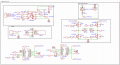
I have encounter a problem when testing the inverter at no-load. A large ringing occurs at the flat tops of my inverter output. At this stage my IGBT's do not get hot when running at no-load, but the ringing does prevent me from pushing higher voltage through my DC bus.
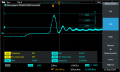
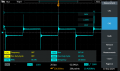
I implemented a C-snubber and found that the ringing went away the larger the capacitor over the emitter and collector of the IGBT's. What i noticed was when the ringing went done, the IGBT's became hotter even at no-load.
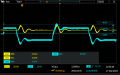
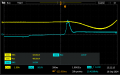
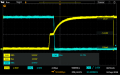
The yellow curve is the current measured through the conductor between my DC supply and the DC bus terminals on my inverter PCB. The blue again is my inverter output at no load. The yellow is a bit concerning seeing that no load is attached. I have significant amount of deadtime also implemented through my stm32. After presenting this problem to my study leader, he suggested that I implement a diode between my DC supply and DC bus on the inverter. I implemented it and found that the ringing at the my flattops disappeared.
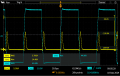
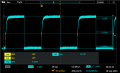
Now my IGBT's get hot and the diode also starts to heat up. I don't want to push the DC voltage to much because the current increases with it(see yellow curve). I am lost as to what can be the cause for these losses being generated by the IGBT's. For additional information below is my gate to emitter voltage waveform and looks like there is no shoot through between the two complementary signals from the IR2110 and the optocoupler.
Any suggestions will be appreciated.
Thank you in advance.
I am doing my final electrical engineering project. I am building an induction furnace using a full bridge IGBT inverter. I am using an IR2110 high/low driver as well as dual channel optocoupler for isolation purposes.
I have encounter a problem when testing the inverter at no-load. A large ringing occurs at the flat tops of my inverter output. At this stage my IGBT's do not get hot when running at no-load, but the ringing does prevent me from pushing higher voltage through my DC bus.
I implemented a C-snubber and found that the ringing went away the larger the capacitor over the emitter and collector of the IGBT's. What i noticed was when the ringing went done, the IGBT's became hotter even at no-load.
The yellow curve is the current measured through the conductor between my DC supply and the DC bus terminals on my inverter PCB. The blue again is my inverter output at no load. The yellow is a bit concerning seeing that no load is attached. I have significant amount of deadtime also implemented through my stm32. After presenting this problem to my study leader, he suggested that I implement a diode between my DC supply and DC bus on the inverter. I implemented it and found that the ringing at the my flattops disappeared.
Now my IGBT's get hot and the diode also starts to heat up. I don't want to push the DC voltage to much because the current increases with it(see yellow curve). I am lost as to what can be the cause for these losses being generated by the IGBT's. For additional information below is my gate to emitter voltage waveform and looks like there is no shoot through between the two complementary signals from the IR2110 and the optocoupler.
Any suggestions will be appreciated.
Thank you in advance.