Identifying transistor whether genuine or fake

Thread Starter

Thurgajohn

Joined Mar 12, 2019
16
Hello, I just bought a discontuniued old transistor.The seller told me
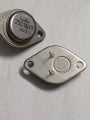
that these are nos(new old stock) and original. But there is a circle at the bottom of the transistor, that made me highly suspiscius about these transistors. Can anyone please identify whether these are genuine or fake? The brand is Sanken and transistor are 2sc1619. I attached the photo here,and thank you at advance for your help.
 

Attachments

Thread Starter

Thurgajohn

Joined Mar 12, 2019
16
I want to fix those transistors in a selfmade vintage amplifier so , l desperately need to know whether these are genuine or not , tq.
 

dl324

Joined Mar 30, 2015
18,219
Can anyone please identify whether these are genuine or fake?
Your picture doesn't have sufficient detail to tell if there are any signs of counterfeiting. I have some Toshiba transistors that have a circle, but it's not as deep as in your picture. Maybe that's a feature of Japanese power transistors because I've never seen it on 2N devices.

The only way you can confirm that they are what they claim to be is to test them against datasheet parameters. Don't test the breakdown voltage of the base-emitter junction. That will destroy the beta.

A curve tracer is the easiest way to test, but power transistors require high power curve tracers.

EDIT: Examples
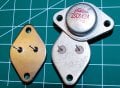
TO-3Bottom2SCvs2N.jpg
The transistor on the left is an RCA 2N3055. I was surprised at how much taller the 2SC642A is.

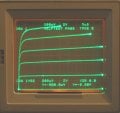
EDIT 2: Curve tracer example. I just figured out how to use my 7D20 in X-Y mode...
curveTracerGeneralPurpNPN.jpg
 
Last edited:

Thread Starter

Thurgajohn

Joined Mar 12, 2019
16
Thank you to all for the replies, I dont know how do /use curve tracer
so today when I have time I am going to open one of the transistor and
see inside construction. If have any better way to test please tell me .
I cant find much about this number transistor on net. Tq.
 

WBahn

Joined Mar 31, 2012
32,703
Thank you to all for the replies, I dont know how do /use curve tracer
so today when I have time I am going to open one of the transistor and
see inside construction. If have any better way to test please tell me .
I cant find much about this number transistor on net. Tq.
And do you know enough about the internal construction of power transistors, in particular Sanken power transistors, to know whether it is fake or not?
 

dl324

Joined Mar 30, 2015
18,219
when I have time I am going to open one of the transistor and
see inside construction. If have any better way to test please tell me .
I'd only do that as a last resort.

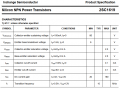
Bias it for saturation mode and see if it'll handle 4A. At that current, it could dissipate as much as 4W, so put a heatsink on it. Datasheet says to use a beta of 10, so base current = 400mA.

1698898297878.png

If it dies, it's a counterfeit.

BTW, I found a Toshiba MJ2955 and it had the circle on the bottom. Maybe it's a Toshiba/Japanese thing.
 

Attachments

WBahn

Joined Mar 31, 2012
32,703
Note that the Vcesat spec has a max of 2 V under those test conditions, so that as much as 8 W of power dissipation, just from the collector current. Then the Vbesat can be as high as 2.5 V under those same conditions, adding another watt. So it can be dissipating 9 W and be in spec. Better heat sink it for at least 20 W.

While it's heat sunk, also test the DC current gain by setting the Vce to 4 V and measuring the base current that is needed to achieve a collector current of 3 A. If that doesn't work out to a gain of between 20 and 180, it's at the very least an out-of-spec part.

Even if it passes these tests, it may still be counterfeit. In fact, even if it meets every single spec, that's not a guarantee that it is a genuine part.
 

MrSoftware

Joined Oct 29, 2013
2,273
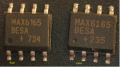
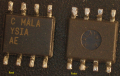
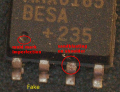
The low hanging fruit is get some very good pictures of a real part, or better yet get your hands on a real part and compare. Next would be checking specs as described above. I recently acquired some fake chips myself. These are voltage reference chips, not transistors, but maybe this will help you determine. My first hint was about 30% did not meet output spec under ideal conditions, but the the other 70% appeared to give proper spec output under ideal conditions. That's an extraordinarily high failure rate for the real part, so I started looking closer. Most gave less stable output with variable input compared to the real part, and 100% failed the low voltage drop-out spec. The key take-away here is you have to check more than one parameter against spec, and you have to check multiple parts as some are better than others. At this point I started removing parts and taking pictures, see below. The left is the real part and the right is the fake part. The fakes aren't obviously fake unless you know what the real part is supposed to look like. This is why you must get verified real parts to compare against.


1698927527104.png
1698927729692.png
 

SamR

Joined Mar 19, 2019
5,470
What typically gets faked are very popular high-volume components and older less available chips that are in high demand and can be counterfeited for high profit. Usually in a TO-92, TO-220, or DIP chip case. As to TO-3 components, I see very few offered for sale on AliX if that tells you anything... I'd put my money on genuine. FWIW Since you already have them, use them.
 

dl324

Joined Mar 30, 2015
18,219
The left is the real part and the right is the fake part. The fakes aren't obviously fake unless you know what the real part is supposed to look like.
The part on the right would be suspicious even without a good part for reference. The shoulders on the leads look like they've been sandblasted and the pin 1 mold mark isn't "clean". Since it's a mold mark, there shouldn't be irregularities.

You can also compare the top and bottom of the package. They should have the same texture. Most times, you can see where blacktopping was applied by looking at the side of the part.
I recently acquired some fake chips myself.
Did these come from a reputable source?
 

KeithWalker

Joined Jul 10, 2017
3,603
Does it really matter if the component is counterfeit? It is not going into a new product, It's just fixing an old one. I would use it if it meets all the specs.
 

SamR

Joined Mar 19, 2019
5,470
Saw a rather surprising article recently comparing new "Fake" 555 timers to real ones. The surprising part was that the "Fakes" had less overshoot and wobble at the top of the square waves leading edge than the originals! Not only that but the rise rate for the leading edge was considerably faster as well. You just never know... The surmise was that the new "Fakes" were in fact using CMOS technology and had an even lower dropout voltage.
 

bassbindevil

Joined Jan 23, 2014
918
Fakes are sometimes real components that have been salvaged from scrap equipment and remarked as a more valuable component. Giveaways can be clipped leads, different package styles with the same date code, and a higher than normal percentage of DOA.
 

michael8

Joined Jan 11, 2015
472
Just meeting the specs may not be enough for a part to work in a particular circuit. Even if the specs
haven't changed, the real, non-fake parts may have!

An example from Pease's Troubleshooting Analog Circuits is his comments on the 2N3771. It's had
a process change and while the new process meets the original specs, it's current-gain-bandwidth
is like 10 to 20 times higher.
 

MrSoftware

Joined Oct 29, 2013
2,273
The part on the right would be suspicious even without a good part for reference. The shoulders on the leads look like they've been sandblasted and the pin 1 mold mark isn't "clean". Since it's a mold mark, there shouldn't be irregularities.

You can also compare the top and bottom of the package. They should have the same texture. Most times, you can see where blacktopping was applied by looking at the side of the part.
Did these come from a reputable source?
They were both removed from boards via hot air so some of what you see on the pins is solder. Those both came from my board builder (who I've used many times without issue) several months apart. On this latest batch they got duped by their supplier. To their credit, they're working with me and covering the loss. The board builder is in China, because having boards made there is less than 1/3 the cost of having them made in the US. For whatever reason that chip is in short supply and very expensive in China, which is probably why there are fakes. They're readily available and reasonably priced here. There's a big tariff to import them to China, but next batch of boards I'll likely buy them here myself and ship them over to the board builder just to be sure. :)
 

SamR

Joined Mar 19, 2019
5,470
I received an order of 2N5484 N channel JFET RF amps that when I tested them turned out to be NPN BJTs. Clearly Laser etched parts, not simply stamped. You just never know what AliX will send you...
 

BobaMosfet

Joined Jul 1, 2009
2,211
Something to bear in mind- for all electronic components- usually they are designed to work ideally within the test parameters shown on the datasheet. Not the extreme edges. If a fake can operate in the test parameter for the same length of time as an original, then... is it a problem?
 
Top