Identifying and replacing a small DC motor

Thread Starter

ryancparadiso

Joined Feb 26, 2025
7
Hi all

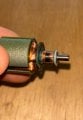
I am looking to source a specific mini DC motor for a paper collator tower. I have removed the motor, and attached pictures of it. The motor runs intermittently when in test mode, but sometimes sputters (turns a little, stops, tries to turn a little...), which trips the error system. When testing its wires for continuity, I consistently get a reading of 10-15, so it seems like there is some resistance. And, when I turn the spindle manually, it seems to get 'stuck' / find patches of physical resistance, though I'm not familiar with motors and so am not sure if this is normal or not.

All of the information I have about it, which is also on the picture, is:

DC Motor
Type SP
No. FM-36E
China | Fuji Micro
(and on the other side, a sort of serial(?) number: ID24 JSP)

measurements:
- body: 1.5 in diameter, 2 in. length
- spindle: 5/32 in. diameter, 1 in length

The company no longer supports this machine, and does not have any replacement motors. I have not been able to locate it online, and don't know enough about it to know what sort of new motor might work. Any help would be appreciated! Thank you so much~~
 

Attachments

LowQCab

Joined Nov 6, 2012
5,101
( great pictures )
Carefully disassemble the Motor
and polish the Commutator with very fine sandpaper ( greater than ~400-grit ),
reassemble.

It should work just fine, for a while anyway.
If the Brushes are worn-out in the Motor, replace the whole machine.
.
.
.
 

KeithWalker

Joined Jul 10, 2017
3,604
( great pictures )
Carefully disassemble the Motor
and polish the Commutator with very fine sandpaper ( greater than ~400-grit ),
reassemble.

It should work just fine, for a while anyway.
If the Brushes are worn-out in the Motor, replace the whole machine.
.
.
.
.... and check that the bearings are free. If they have dried out, a little bit of light machine oil will help. Keep the oil well away from the brushes and commutator.
 

Thread Starter

ryancparadiso

Joined Feb 26, 2025
7
( great pictures )
Carefully disassemble the Motor
and polish the Commutator with very fine sandpaper ( greater than ~400-grit ),
reassemble.

It should work just fine, for a while anyway.
If the Brushes are worn-out in the Motor, replace the whole machine.
.
.
.

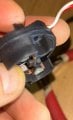
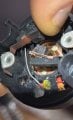
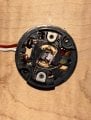
I've taken apart the motor, here are some images. It looks like the commutator could use cleaning. I'm a little concerned about how the brushes are worn down, sort of unevenly—I'm sorry that pictures are a little difficult to see. Does this look concerning?
 

Attachments

Thread Starter

ryancparadiso

Joined Feb 26, 2025
7
That's a relatively low pole count motor!
The com is not that bad ?
Is the brush spring pressure the same for both sides?

The spring pressure seems to be the same—I can't feel much different, and they seem to meet in the center. However, I do notice that one is more worn down than the other, which could indicate a difference in spring pressure?
 

Attachments

Thread Starter

ryancparadiso

Joined Feb 26, 2025
7
That pic is clearer for the brush wear and I don't see all that much of a difference?

Yeah, any difference is pretty minimal, I'm just not sure what kind of margins we're dealing with so wanted to be thorough. The spring pressure seems to be similar on both sides, but that's just me pulling it back with my finger and feeling for resistance.

I suppose the next step would be to give it a good clean, put it back together & test it?
 

Thread Starter

ryancparadiso

Joined Feb 26, 2025
7
Hi all, just want to revive this thread with some updates.

So, I sourced a few motors, none of which were perfect, but good enough to at least test with. I also cleaned and reassembled the original motor.

I tested the original and new motors via the machine's motor maintenance mode, and all of the motors reacted in the same way: they will run at full speed for 1-2 seconds, then drop down to a fraction of the speed for 1-2 seconds, then cut completely. And after that, I can't get them to start up again.

Does anyone have a theory as to what might cause this sort of motor behavior?

It seems that something upstream of the motor is the issue. The maintenance manual says, at this point, to check the conductance of the wires, and then replace the entire circuit board (which would cost more than I paid for the entire machine in the first place...). I've removed the circuit board and am going to go over it with a magnifying glass to check for any cracked solders etc, and then maybe go through the entire machine and clean every single wire connector I can find and re-seat them. Any other ideas?

Thank you all so much, you've been a huge help~~
 

MaxHeadRoom

Joined Jul 18, 2013
30,593
The first thing would be to see what is happening to the DC at the motor? is it still present or dropped out entirely, I suspect the latter!
 

Thread Starter

ryancparadiso

Joined Feb 26, 2025
7
Monitor the input terminals at the motor and check for any voltage change etc when motor cuts out.
So I've tested the motor as such.

Re current, there is an initial reading of 1.09-1.11 A, which lasts for ~1.5 seconds, while the motor spins. The voltage then cuts out completely, and the motor stops. I guess this would be expected. Notably, after the motor stops, I am not able to get it to run again (nor the main motor, a separate system, which I am typically able to test and test repeatedly without fail), and need to restart the machine.

Re voltage, I was not able to get the motor to run when I attached the multimeter and set it to test DC voltage.
 

LowQCab

Joined Nov 6, 2012
5,101
I'm starting to suspect that, considering the age of the Machine,
that the Heat-Sink for whatever device is controlling the Motor,
has dried-up or gotten loose and is no longer functional.
This, ( or something similar ),
could be allowing the controlling-device to quickly over-heat and cause a shut-down.
This could also mean that the device is in the "process of failing",
but hasn't reached the point of complete-failure just yet.
.
.
.
 

MaxHeadRoom

Joined Jul 18, 2013
30,593
Test the motor resistance when it cuts out and the source voltage, test the motor across a 12v automotive versions which should run it continuous!.
 
Last edited:
Top