I want to make a powerbank

Thread Starter

imnevernormal

Joined Jan 28, 2024
12
Okay let’s start.

Any battery has a specific amount of energy it can deliver over its lifetime. That amount is given as a capacity in Amp hours.

One Amp hour (Ah) means the battery can deliver one Amp for one hour. But in reality, it cannot. When you pull a large current from a battery more energy is wasted than when you pull a smaller current. Or, equivalently, the total energy you get out of a battery is less when you do so quickly than it is when you extract the energy over a longer period of time.

So the rating of the battery is given when it is used for a specific period of time, typically 10 or 20 hours.

Now, Amp hours is not a measure of energy, because a 15V battery with 1Ah has 10 times the energy of a 1.5V battery with 1Ah. So we convert to Watt hours, by multiplying by the voltage.

So the 1.5V battery has 1.5Wh and the 10V has 15Wh.

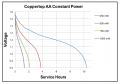
An AA alkaline battery has a capacity of about 2.5 Wh. You can see this in the chart posted earlier. When discharged at a rate of 250mW (1/4 W) it lasts about 10 hours. To get the capacity you multiply the power (in Watts) by the time in hours. So 250mW (.25 A) x 10 is 2.5 Wh of capacity.

And a cell phone battery is 3.7V and about 2000 mAh or about 7.4Wh.

So your project is doomed from the start. Even if you could slow the charging to take 10 hours, you would have to replace the AA twice just to charge your phone once!
I appreciate this, immensely actually.
 

Thread Starter

imnevernormal

Joined Jan 28, 2024
12
My (strong) suggestion is to abandon the idea of a mechanical solution*, and build a LiFePO₄ battery and use a pre-existing, good quality power bank module with PD and Type-C input and output.

The LiFePO₄ cells will be the safest option, not being vulnerable to thermal runaway fires like other lithium chemistries. They aren’t quite as power dense (they won’t have as much capacity for their size) but the trade-off is worth it. They will also cost more.

View attachment 313794
LiFePO₄ cells in the 32700 format—φ32mm x 70mm
Four of these in a 4S configuration would make a 12.8V 7Ah battery

If the price is a problem, you can certainly build a safe and reliable system using LiPo pouch cells, but you will have to be more vigilant about the safety parts of the device—this is just a practical problem and it would still work.

One easier way to do this is to buy a prebuilt battery with balancing already connected. the higher voltage of the LiPo cells (3.7V compared to the LiFePO₄ 3.2V) means the battery voltage will be higher, this doesn’t matter since you will be using a buck converter that is part os a USB PD (Power Delivery) module to reduce the voltage as required.

View attachment 313796
A battery designed for RC cars has the advantage of being assembled for you,
with connectors for the output and balancing in place, and with this one
there is a hard housing for mechanical protection The battery performance
will be very good with a very high discharge rate possible for cases that need it.

The electronics of the device will need to serve two purposes: control charging and discharging of the internal battery. While you could design and build something to do this, a much more practical approach is to choose one or more modules which are already designed and built to manage the various functions.

Charging the battery will required a BMS (Battery Management System) to handle the critical job of protecting against over-charging and over-discharging, including current limiting while the pack is operating and cut offs are high and low voltages.

View attachment 313795
A relatively compact BMS with balancing
The actual choice of BMS will depend on battery
specifics like wiring scheme and chemistry

It will also do the balancing of the battery, that is, ensuring that the various cells making up your battery are charged to matching voltages. If they aren’t, the higher voltage cells will spend time charging the lower voltage cells. Over time, this will lead to a sever imbalance, reduction in cell life, and, through various mechanisms, the risk of fire.

Finally, you need a module that will provide the USB PD functionality. Power Delivery allows a charger to communicate with a device and provide up to 100W of power. In this case I am selecting components that would max out at 60W (12V@5A) which is surely more than enough for your purposes. The default output would be 5V with current limited but negotiable by the device for fast charging according various standards.

Here is an example though probably not the final choice—though it could be.

To do this “right”, you will need to learn about several battery specific areas and basic electronics. Even though you will not necessarily be designing any circuits, things like Ohm’s Law and other basic electrical calculations will probably come up. Learning to deal with these for yourself will definitely make you a better electronics hobbyist.


*I would expect this to be obnoxiously noisy as well as utterly inefficient and misguided.
Thank you!!
 

Alec_t

Joined Sep 17, 2013
15,149
You may find it is cheaper to buy an off-the-shelf power bank than to build one. Admittedly, this won't provide much of a learning opportunity.
 

Ya’akov

Joined Jan 27, 2019
10,278
Correct. I am trying to learn. Isn't that what we're all here to do?

I'm not trying the be the next big thing. I am attempting to learn.

Also, Windows depreciates features all the time, faxing is outdated even though some places still require it. Emailing should suffice in most cases save for a few legal requirements.

We all have simple questions that have simple answers at some point or another.
First thing to understand is the capacity of electrical power sources, and the differences among the ideas of voltage, current, power, and capacity.

  • Voltage (V, or Volts) is very roughly how hard the electricity will try to get through a conductor, something like but not identical to pressure.

  • Current (A, or Amps) is the amount of electrical current that moves in a certain time. 1A is 1 Coulomb (a quantity of charge) moving past a certain point in a conductor in 1 second.

  • Power (W, or Watts) is a measure of how much work the combination of voltage and current can do. In fact, calculating power is simply a matter of \( W(atts) = V(olts) \times A(amps) \). So a source that can provide 10V at 1A has the same power as one that can provide 1V at 10A.

  • Capacity (mAh, of Ah) is a measure of how much charge is stored by a cell (single) or battery (multiple). mAh is “milliAmp hours”, and Ah is “Amp hours“ (1000mAh = 1Ah). If you say a cell can produce 1Ah at a 1A discharge rate (cells/batteries are Ah specified according to a particular rate), it is saying the cell can produce 1A for 1h(our). It’s that simple. 2Ah for the same cell would mean the cell could produce 1A for 2h since we have a specified rate of 1A. If we instead tried to use 2A it wouldn’t last for an hour but somewhat less for this 1A capable cell.

    This lets you know how long you can expect a battery to power something based on how much power it needs to run. You will also see mWh or Wh which are “milliWatt hours” and “Watt hours, respectively. A little thinking will show you why that could be the case if you consider the relationship of current to power.

So, given the above, let’s look at your problem. You want to provide power to charge the phone. You have a power source but need to use a DC to DC conversion of some sort to increase the voltage. Your power source will have a maximum power and a capacity.

WIth batteries, discharge rate, that is, how much current (in mA or A) you draw from them affects how the capacity (mAh, or Ah). The faster you try to get power out the less they will ultimately provide. So, lets’ look at your AA cell.

1706450191954.png
As reproduced in my post above, this graph shows
the service time of a Duracell MN1500 AA cell depending
on how much power is drawn from it. As you can see, the
more you use at once, the shorter the lifetime of the cell.
This is all in line with the formula for
power.
Your original proposal suggested you would get 5V@3A from the DC to DC converter connected to the motor. This would be:

\[ W = V \times A, or\ W=5V \times 3A, or\ 15W \]
The input to the system, the single AA cell, can usefully produce about 1A and if we are unrealistically generous, do this at 1.5V (in practice, the voltage would never be that high with so much current draw, but that’s not important for the point). So, we have:

\[ W = V \times A, or\ W=1.5V \times 1A, or\ 1.5W \]
A tenth of the power needed to do what you want even if we considered the system 100% efficient—and impossibility. One fact that should always be foremost in your mind when thinking about things like this is:

You can never get back more than you put in.
In fact, you can’t even get back what you put in! There are always losses. These losses are in the form of heat. The more heat you make the less power you have to do your work*. So, as @Papabravo pointed out, a good rule of thumb for DC-DC conversion is 80% efficiency. Efficiency is a measure of how much of the input ends up doing work for you.

But that 80% is based on electronic methods. The proposed motor-generator method will be far more lossy, so your measly 1.5W of power is just not going to do much for you. We can calculate just how much since the formulas work in any direction. If you need 5V, then 1.5W of power would get you:

\[ A = \frac{W}{V}, or\ A = \frac{1.5W}{5V}, or\ 300mA \]
300 milliamps is just 1/10 of the 3A you hoped for, and this should be no surprise since we already worked out that the power was 1/10 of the 15W. So this idea is a key to the beginning of understanding—when you are dealing with power, the laws of thermodynamics are in force and you have to have enough power in that when you take into account whatever losses the system will introduce, the output is enough to get your work done.

This is true for machines and mechanical systems, and electrical systems alike. You can always look at the in and out and get a quick and realistic idea of whether things are feasible or not.

*The exception to this—sort of—is electric heating. The people who sell it like to say it is “100% efficient“ because all you want is heat, so the losses seem absent. This is not true, but the losses occur in a different domain, so they get to say it…

EDITED to add information about the meaning of Ah which I had intended to talk about below the bullet points but omitted–I was reminded by @BobTPH post, thank you for that.
 
Last edited:

Ya’akov

Joined Jan 27, 2019
10,278
You may find it is cheaper to buy an off-the-shelf power bank than to build one. Admittedly, this won't provide much of a learning opportunity.
I didn’t recommend just buying a finished device specifically because the TS mentioned wanting to learn. I did recommend buying pre-assembled elements because selecting and connecting them properly will be a genuine learning opportunity and possibly a chance to make something unique and personally appropriate.
 
Top