I want to make a powerbank

Thread Starter

imnevernormal

Joined Jan 28, 2024
12
I should have everything labeled. But I want to design a device that I can use 1 double A battery to run a motor which will spin a DC generator, step down to 5v 3A then go straight to USB-A. I will have a meter running on the USB end so as to not fry my phone, but I am unsure if my math is correct as I am amateur at best. The only thing I have figured out is safety, honestly that is the easy part. I think.

These are my parts, I will have this all in an acrylic box, most likely lined with silicone or rubber inside.

[https://a.co/d/fufpXOe](https://a.co/d/fufpXOe) \- brushless DC generator

I already own the 1.5V motor, and the specs are from another one I found online.

[https://a.co/d/cB74Mat](https://a.co/d/cB74Mat) \- DC 8-35V to 5V 3A 15W Voltage Regulator

I am thinking 12 AWG wire, but that is subject to your suggestion.

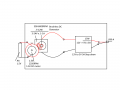
this link brings up the image below. charger diagram.png
 

Alec_t

Joined Sep 17, 2013
15,103
Welcome to AAC!
One AA battery (if the common alkaline type) is never going to provide 15W, which implies a current of 10A, even if the voltage conversion could achieve 100% efficiency.
 

Ya’akov

Joined Jan 27, 2019
10,226
Welcome to AAC.

Could you explain why you are doing this?

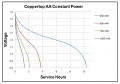
Your proposed output is 5V@3A which is 15W (15000mW), a typical high quality AA cell—using a Duracell MN1500 as an example—will not even come close to producing that much power for more than a few seconds. Even if you reduce your expectations for output, look at this chart from the MN1500 datasheet:

1706443982303.png
At 1000mW (1W, or 0.067 of the proposed output), the cell service life is about 1.5h in a best case scenario. And, you can’t even use the entire 1W as output from your device.

As with all real world systems, there will be losses—and in your case substantial ones. There will be frictional losses in the mechanical system and electrical losses in the electronics. You will be using a good part of the 1W heating the room instead of powering your phone.

So, I have to ask, what is the goal?
 

Thread Starter

imnevernormal

Joined Jan 28, 2024
12
I appreciate you. Any suggestions on changes I can make?

My initial idea was to minimize battery usage, which is why I wanted the generator with gears to help increase torque.
 

Thread Starter

imnevernormal

Joined Jan 28, 2024
12
So, my phone (galaxy note 20) has an issue with most chargers I use. Plus, when I'm at work, chargers are difficult to use or come by, so I want something portable.

Overall, this is a passion project to learn this subject with a goal in mind for direction.

A tourniquet solution for band-aid problem, if you will.
 

Papabravo

Joined Feb 24, 2006
22,058
For planning purposes, you should start with 80% as an efficiency estimate for a DC-DC conversion process. I most cases you will be able to do better than 80%, but you'll never get to 100%. So, to get 15 Watts of output power you'll need 18.75 watts of input power. Your mechanical efficiency from motor to generator may not be as good as 80% so that battery is going to have a job of work to do. If I were in your shoes, I would consider a 12V Marine Deep Cycle SLA (Sealed Lead Acid) rechargeable battery as a primary power source.

ETA: I missed the part about portability, but a motor and a generator hardly fit in the portable category.
 

Papabravo

Joined Feb 24, 2006
22,058
A more practical situation might involve rechargeable batteries in series and parallel combined with a DC-DC converter to 5V. Say 7.2V of battery to 5V out of a USB port.
 

Thread Starter

imnevernormal

Joined Jan 28, 2024
12
A more practical situation might involve rechargeable batteries in series and parallel combined with a DC-DC converter to 5V. Say 7.2V of battery to 5V out of a USB port.
I'm sorry, I'm very self educated in this. What does this mean?

5 AA rechargeable batteries in a line to start the chain?
 

Jon Chandler

Joined Jun 12, 2008
1,560
Power out is ALWAYS less than power in. ALWAYS, unless you're talking about a heat pump. There's no magic to get around this anymore than alchemists can turn lead into gold.

What you're trying to do is not possible. No matter how much you want it to be or what scheme you "invent" that nobody has thought of before (they have), no matter that it uses magnets, crystals or magic beans, it can't work.
 

Thread Starter

imnevernormal

Joined Jan 28, 2024
12
Power out is ALWAYS less than power in. ALWAYS, unless you're talking about a heat pump. There's no magic to get around this anymore than alchemists can turn lead into gold.

What you're trying to do is not possible. No matter how much you want it to be or what scheme you "invent" that nobody has thought of before (they have), no matter that it uses magnets, crystals or magic beans, it can't work.
I have been made aware of this by the other replies
 

Papabravo

Joined Feb 24, 2006
22,058
I'm sorry, I'm very self educated in this. What does this mean?

5 AA rechargeable batteries in a line to start the chain?
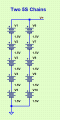
That would be 5 batteries in series. Make two of those "chains" and connect '-' to '-' and '+' to '+'. So that would be two chains of 5 batteries in series. The batteries in each chain are in series. The two chains are in parallel.

Like this:
1706446510061.png
 

Papabravo

Joined Feb 24, 2006
22,058
Thank you
In the event you decide to work with rechargeable batteries be careful about trying to recharge them all as once in that configuration. At this point it would be safer if you recharged them separately then reinstalled them in whatever holder you plan to use. Checkout Battery University for more information on rechargeable batteries.

Battery University Homepage
 
Last edited:

Thread Starter

imnevernormal

Joined Jan 28, 2024
12
Ahhhh, based on your continued comments, others indeed have told you, but you still don't understand.
Correct. I am trying to learn. Isn't that what we're all here to do?

I'm not trying the be the next big thing. I am attempting to learn.

Also, Windows depreciates features all the time, faxing is outdated even though some places still require it. Emailing should suffice in most cases save for a few legal requirements.

We all have simple questions that have simple answers at some point or another.
 

Ya’akov

Joined Jan 27, 2019
10,226
I'm sorry, I'm very self educated in this. What does this mean?

5 AA rechargeable batteries in a line to start the chain?
My (strong) suggestion is to abandon the idea of a mechanical solution*, and build a LiFePO₄ battery and use a pre-existing, good quality power bank module with PD and Type-C input and output.

The LiFePO₄ cells will be the safest option, not being vulnerable to thermal runaway fires like other lithium chemistries. They aren’t quite as power dense (they won’t have as much capacity for their size) but the trade-off is worth it. They will also cost more.

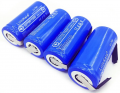
1706446953940.png
LiFePO₄ cells in the 32700 format—φ32mm x 70mm
Four of these in a 4S configuration would make a 12.8V 7Ah battery

If the price is a problem, you can certainly build a safe and reliable system using LiPo pouch cells, but you will have to be more vigilant about the safety parts of the device—this is just a practical problem and it would still work.

One easier way to do this is to buy a prebuilt battery with balancing already connected. the higher voltage of the LiPo cells (3.7V compared to the LiFePO₄ 3.2V) means the battery voltage will be higher, this doesn’t matter since you will be using a buck converter that is part os a USB PD (Power Delivery) module to reduce the voltage as required.

1706448315823.png
A battery designed for RC cars has the advantage of being assembled for you,
with connectors for the output and balancing in place, and with this one
there is a hard housing for mechanical protection The battery performance
will be very good with a very high discharge rate possible for cases that need it.

The electronics of the device will need to serve two purposes: control charging and discharging of the internal battery. While you could design and build something to do this, a much more practical approach is to choose one or more modules which are already designed and built to manage the various functions.

Charging the battery will required a BMS (Battery Management System) to handle the critical job of protecting against over-charging and over-discharging, including current limiting while the pack is operating and cut offs are high and low voltages.

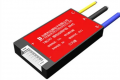
1706447498688.png
A relatively compact BMS with balancing
The actual choice of BMS will depend on battery
specifics like wiring scheme and chemistry

It will also do the balancing of the battery, that is, ensuring that the various cells making up your battery are charged to matching voltages. If they aren’t, the higher voltage cells will spend time charging the lower voltage cells. Over time, this will lead to a sever imbalance, reduction in cell life, and, through various mechanisms, the risk of fire.

Finally, you need a module that will provide the USB PD functionality. Power Delivery allows a charger to communicate with a device and provide up to 100W of power. In this case I am selecting components that would max out at 60W (12V@5A) which is surely more than enough for your purposes. The default output would be 5V with current limited but negotiable by the device for fast charging according various standards.

Here is an example though probably not the final choice—though it could be.

To do this “right”, you will need to learn about several battery specific areas and basic electronics. Even though you will not necessarily be designing any circuits, things like Ohm’s Law and other basic electrical calculations will probably come up. Learning to deal with these for yourself will definitely make you a better electronics hobbyist.


*I would expect this to be obnoxiously noisy as well as utterly inefficient and misguided.
 

BobTPH

Joined Jun 5, 2013
11,463
Correct. I am trying to learn. Isn't that what we're all here to do?
Okay let’s start.

Any battery has a specific amount of energy it can deliver over its lifetime. That amount is given as a capacity in Amp hours.

One Amp hour (Ah) means the battery can deliver one Amp for one hour. But in reality, it cannot. When you pull a large current from a battery more energy is wasted than when you pull a smaller current. Or, equivalently, the total energy you get out of a battery is less when you do so quickly than it is when you extract the energy over a longer period of time.

So the rating of the battery is given when it is used for a specific period of time, typically 10 or 20 hours.

Now, Amp hours is not a measure of energy, because a 15V battery with 1Ah has 10 times the energy of a 1.5V battery with 1Ah. So we convert to Watt hours, by multiplying by the voltage.

So the 1.5V battery has 1.5Wh and the 10V has 15Wh.

An AA alkaline battery has a capacity of about 2.5 Wh. You can see this in the chart posted earlier. When discharged at a rate of 250mW (1/4 W) it lasts about 10 hours. To get the capacity you multiply the power (in Watts) by the time in hours. So 250mW (.25 A) x 10 is 2.5 Wh of capacity.

And a cell phone battery is 3.7V and about 2000 mAh or about 7.4Wh.

So your project is doomed from the start. Even if you could slow the charging to take 10 hours, you would have to replace the AA twice just to charge your phone once!
 
Top