There is no functional difference between a PNP and an NPN transistor.
What is different is the polarity of collector-emitter and base-emitter voltages.
For the transistor to conduct, the base-emitter junction must be forward biased.
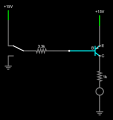
Set the switch to GND and the PNP transistor will be forward biased. Current will flow from emitter to base.
It seems to me that when the switch is flipped so that the base resistor is grounded you should be nearly the full 15 volts on the collector, indicating (15V-VLED)/1k ma of collector current flowing.
If the LED is in backwards, it may be blocking the voltage. The LED's cathode should be grounded.
There is no functional difference between a PNP and an NPN transistor.
What is different is the polarity of collector-emitter and base-emitter voltages.
For the transistor to conduct, the base-emitter junction must be forward biased.
Set the switch to GND and the PNP transistor will be forward biased. Current will flow from emitter to base.
I mean why is the Base Emitter junction not forward biased while the 15V supply is connected instead of ground. There is a 0.7V drop between base and emitter then the potential at base w.r.t ground is 14.3V, so the current flows through the 3.3k (15-14.3=0.7V drop)ohm resistor towards the base then finally the LED. If I'm wrong please correct me with mentioning the voltage drops at relevant places.
I mean why is the Base Emitter junction not forward biased while the 15V supply is connected instead of ground. There is a 0.7V drop between base and emitter then the potential at base w.r.t ground is 14.3V,
You don't seem to understand how voltage drops occur.
The base-emitter doesn't generate that voltage, it only drops that voltage when a current is flowing.
And since the base resistor is connected to 15V and the emitter is connected to 15V, then there can be no voltage drop across the resistor or base-emitter junction since there is no voltage difference to generate a current.
If the resistor is connected to ground, then base-emitter current will flow, turning on the transistor and thus the LED, and there will be an approximate 0.7V drop across the junction.
I'm sorry to get it wrong. So what you're sayingis that no matter the path if the net potential drop across the path is zero then no current flows through. Thank you for explaining.
You don't seem to understand how voltage drops occur.
The base-emitter doesn't generate that voltage, it only drops that voltage when a current is flowing.
And since the base resistor is connected to 15V and the emitter is connected to 15V, then there can be no voltage drop across the resistor or base-emitter junction since there is no voltage difference to generate a current.
If the resistor is connected to ground, then base-emitter current will flow, turning on the transistor and thus the LED, and there will be an approximate 0.7V drop across the junction.
I'm sorry to get it wrong. So what you're sayingis that no matter the path if the net potential drop across the path is zero then no current flows through. Thank you for explaining.
I'm sorry to get it wrong. So what you're sayingis that no matter the path if the net potential drop across the path is zero then no current flows through. Thank you for explaining.
This is not a true statement in general. Consider a 12 V battery connected to a resistor. The net potential drop around any complete path in that circuit will have zero net potential across it, yet there is current flowing.
In contrast, now break one of the wires in that circuit. There is a potential difference of 12 V across the break, yet no current is flowing.
For a (silicon) diode (or for the base-emitter junction of a bipolar transistor) to be forward biased, there must be a forward voltage drop across the junction that is consistent with current flowing forward through the junction.
In your case, if you assume that the emitter-base junction of your PNP is forward biased, then the collector is at 15 V while the base is at 14.3 V. But this also requires that current be flowing into the emitter and out the base.
However, your resistor then has 15 V on the left side and 14.3 V on the right side, which requires that current be flowing through it from left to right and INTO the base of the transistor. The is inconsistent with the assumption that the emitter-base junction of the transistor is forward biased, and therefore this assumption must be wrong.
The alternative is that the emitter-base junction is NOT forward biased and that there is no current flowing in it. If no current is flowing in it, that means that there is no current flowing in the base resistor, and therefore no voltage drop across it. Since the left side is at 15 V, that means the right side, which is also the transistor base, must also be at 15 V, and since the collector is at 15 V, that means that the forward voltage across the emitter-base junction is 0 V and this is consistent with the junction not being forward biased, so this assumption is correct.
This is not a true statement in general. Consider a 12 V battery connected to a resistor. The net potential drop around any complete path in that circuit will have zero net potential across it, yet there is current flowing.
In contrast, now break one of the wires in that circuit. There is a potential difference of 12 V across the break, yet no current is flowing.
For a (silicon) diode (or for the base-emitter junction of a bipolar transistor) to be forward biased, there must be a forward voltage drop across the junction that is consistent with current flowing forward through the junction.
In your case, if you assume that the emitter-base junction of your PNP is forward biased, then the collector is at 15 V while the base is at 14.3 V. But this also requires that current be flowing into the emitter and out the base.
However, your resistor then has 15 V on the left side and 14.3 V on the right side, which requires that current be flowing through it from left to right and INTO the base of the transistor. The is inconsistent with the assumption that the emitter-base junction of the transistor is forward biased, and therefore this assumption must be wrong.
The alternative is that the emitter-base junction is NOT forward biased and that there is no current flowing in it. If no current is flowing in it, that means that there is no current flowing in the base resistor, and therefore no voltage drop across it. Since the left side is at 15 V, that means the right side, which is also the transistor base, must also be at 15 V, and since the collector is at 15 V, that means that the forward voltage across the emitter-base junction is 0 V and this is consistent with the junction not being forward biased, so this assumption is correct.
so what you're saying is that if the emitter-base junction is forward biased then current flowing through it must then flow from the base terminal to the left of the 3.3k ohm resistor and not vice versa because that's how a pnp transistor is supposed to work in the saturation mode?
Your PNP transistor is cut-off because you have the emitter at +15V and the base at the +15V as well. Thus, now the current will flow.
To Turn-ON the PNP transistor, the base terminal needs to be connected to the lower potential. The base current can only flow out of the base terminal and "tries to find the path to GND".
so what you're saying is that if the emitter-base junction is forward biased then current flowing through it must then flow from the base terminal to the left of the 3.3k ohm resistor and not vice versa because that's how a pnp transistor is supposed to work in the saturation mode?
It does not matter if it is a PNP or an NPN transistor.
In order for the transistor to turn on, the emitter-base junction must be forward biased with an applied voltage that exceeds 0.6V. The purpose of the resistor is to limit the emitter-base current to a safe value.
It does not matter if it is a PNP or an NPN transistor.
In order for the transistor to turn on, the emitter-base junction must be forward biased with an applied voltage that exceeds 0.6V. The purpose of the resistor is to limit the emitter-base current to a safe value.

 Facebook
 Google
 GitHub
 Linkedin