I could use some help with a 12.25 dcv switch

Thread Starter

GDS61

Joined May 10, 2020
9
Good morning all, I came across this forum and hope I can find some help.

Problem, The problem is simple, I have house batteries in my RV that never last but a couple of years. This is because is always plugged in and the deep cycle batteries need to be ran down to around 50% and then charged back up. I have a good quality smart charger but it will not let it run down much at all before it tops them off.

Solution, What I need is to turn the 110 volts to the charger off till the batteries hit 12.25 volts (half charge). Then turn the 110 back on say for 24 hours and start over.

I have been looking for something pre built but am having trouble.

Thanks for any help you can give me.
 

Tonyr1084

Joined Sep 24, 2015
9,744
Welcome to AAC.

I have no experience with AGM (deep cycle) batteries. But from what I've seen there are conflicting statements out there on the internet. One I saw said they should be kept topped off while another said they should be cycled. Deeper is better up to a limit. So in all honesty, I don't know about AGM's.

If you want a circuit that turns on when the battery reaches a preset level, say at 50% charge and shuts off when it reaches a full charge you would need a couple comparators. One to switch the charger on when battery voltage drops to a certain level and then the other to shut the charger off when it reaches full charge.

From what I saw I gathered that AGM's are charged to 14.8 volts then cut back to 13.8 to complete charging. So my recommendation would be to get or build a unit that starts the charge cycle when low voltage is sensed, then it charges for a specific time (hours or days - whatever) then shut off.

Do you have electronics circuitry design experience? What's your level of competency with building circuits? Wish I could be more helpful, but hopefully this will spark an idea in you or in others.

Again, welcome. And don't forget Mother's Day.
 

crutschow

Joined Mar 14, 2008
38,503
What I need is to turn the 110 volts to the charger off till the batteries hit 12.25 volts (half charge). Then turn the 110 back on say for 24 hours and start over.
Unless you have a load on the battery, it may take months before it drops to 12.25V.

You could put a timer on the charger and just leave it off for a given number of days.

But I suspect, if your battery is only lasting a couple years, that the charger is not properly maintaining the battery.
Have you monitored the battery voltage when it is on the charger?
 
Last edited:

Thread Starter

GDS61

Joined May 10, 2020
9
I have a checked voltage a couple of times and at that time it seemed correct about 13.2 volts.

The charger is about 20 years old but as far as I can tell the only difference it and the closes model of today is mine is a 55 amp and the new one would be 60 amp. Its a Inteli Power PD9155 built by Progressive Dynamics with the Battery Wizard attachment. It seems to get great reviews. I have an email to their service to see what they have to say.

I agree with the load on the battery. I have a leased spot at the lake so it stays here plug in as there is food in the frig. When I'm gone the only thing using DC would be the controls to the frig. I have thought of using a timer that's programable by days and maybe have it turn on 1 day a week or something like that.

I figured that if I could come up with something that would let the battery run down and automatically come back on would work great for the battery. When I'm here, there are lights, fan and water heater controls on so I would think in a couple of days it would pull it down and I wouldn't have to remember to turn the charger off and on.

The part I need the help on is switching at 12.25 to 12.30. If I could build that part, it could run an off delay timer. I could set the timer for 12 to 24 hours ever how long it takes to fully charge back up.
 

MisterBill2

Joined Jan 23, 2018
27,504
Most of the RV chargers that I have seen are really intended to substitute for the battery, with charging it being a second thought. So switch off that high powered non-regulated power supply and charge your battery with a small float charger . You can switch on the RV power converter when you will be using other 12 volt items, such as the jack and the slide-out drive, and possibly the water pump, if you are not connected to the water system. In my trailer only the furnace and the water pump and a few lights use 12 volts. When the ammonia cycle refrigerator that did use propane to run failed I replaced it with a regular mains powered one for less than a quarter of the price of a duplicate replacement. Current gas operated refrigerators do need 12 volts for the controls functions, gas valve, and the ignitor.
 
I think 13.2V is too low. I've only seen that spec for Exide gel-cells.
Flooded (Trojan, Magnavolt) are 13.5V or 13.7V at 20°C, most use 13.8V for float voltage.
So this would be why you need to force equalization (top up) charges.
edit: Intellipower "the nominal output voltage is 13.6 volts +/- 3%"

The batteries can be on (proper) float charge 24/7, I can't see the occasional discharge being useful as it just gives another sulphate crystal buildup event. Everytime you cycle the battery, the plate's pores get sulphate build up- this is why they have a cycle life i.e. 500 cycles in the first place.

A "smart" charger doesn't mean much because each battery manufacturer will have different specifications for the float voltage, chemistries are different with lead, antimony, calcium etc.
Another problem is the smart chargers are not temperature compensated, so you can be undervoltaged in winter and overvoltaged in summer.

I would first calibrate the charger's voltage to be precise and closer to the batteries needs. I have found smart chargers are all over the place for voltages and they are not all good enough for constant use.
 
Last edited:

Thread Starter

GDS61

Joined May 10, 2020
9
Most of the RV chargers that I have seen are really intended to substitute for the battery, with charging it being a second thought. So switch off that high powered non-regulated power supply and charge your battery with a small float charger . You can switch on the RV power converter when you will be using other 12 volt items, such as the jack and the slide-out drive, and possibly the water pump, if you are not connected to the water system. In my trailer only the furnace and the water pump and a few lights use 12 volts. When the ammonia cycle refrigerator that did use propane to run failed I replaced it with a regular mains powered one for less than a quarter of the price of a duplicate replacement. Current gas operated refrigerators do need 12 volts for the controls functions, gas valve, and the ignitor.
My frig controls work off DC. That way it will switch to propane if I 110 power goes out.
 

Thread Starter

GDS61

Joined May 10, 2020
9
I think 13.2V is too low. I've only seen that spec for Exide gel-cells.
Flooded (Trojan, Magnavolt) are 13.5V or 13.7V at 20°C, most use 13.8V for float voltage.
So this would be why you need to force equalization (top up) charges.
edit: Intellipower "the nominal output voltage is 13.6 volts +/- 3%"

The batteries can be on (proper) float charge 24/7, I can't see the occasional discharge being useful as it just gives another sulphate crystal buildup event. Everytime you cycle the battery, the plate's pores get sulphate build up- this is why they have a cycle life i.e. 500 cycles in the first place.

A "smart" charger doesn't mean much because each battery manufacturer will have different specifications for the float voltage, chemistries are different with lead, antimony, calcium etc.
Another problem is the smart chargers are not temperature compensated, so you can be undervoltaged in winter and overvoltaged in summer.

I would first calibrate the charger's voltage to be precise and closer to the batteries needs. I have found smart chargers are all over the place for voltages and they are not all good enough for constant use.
Most deep cycle batteries say that you will double the life if you run power down to about half and charge back up to full vs keeping it full the time. This is why around 12.25 that is about half power on a 12 volt AMG deep cycle battery.

Now as far as the charger goes it seems to be dead on what it's calling for. Progressive has been building chargers for RV's for a very long time and are known for great quality and control. I think the real problem is I never really use the batteries. I could simply disconnect the batteries and let the charger run but I can go several weeks with out going to camp. The camp is out far enough that they can lose power sometimes. My frig and freezer is full. So I want the back up with batteries.

If power goes out the frig will switch to propane as long as it still has control power but that is DC.

I guess one more thing to add is m y RV uses and average of 8KW of power per day. Since I moved it to this camp I can see my hourly usage per day. Thats a lot of power for an rv size frig that no one is opening and the battery charger. So I disconnected one bank of batteries while I'm working on this issue. I normally run 4 6 volt batteries, so now I'm running on 2.
 

Thread Starter

GDS61

Joined May 10, 2020
9
Welcome to AAC.

I have no experience with AGM (deep cycle) batteries. But from what I've seen there are conflicting statements out there on the internet. One I saw said they should be kept topped off while another said they should be cycled. Deeper is better up to a limit. So in all honesty, I don't know about AGM's.

If you want a circuit that turns on when the battery reaches a preset level, say at 50% charge and shuts off when it reaches a full charge you would need a couple comparators. One to switch the charger on when battery voltage drops to a certain level and then the other to shut the charger off when it reaches full charge.

From what I saw I gathered that AGM's are charged to 14.8 volts then cut back to 13.8 to complete charging. So my recommendation would be to get or build a unit that starts the charge cycle when low voltage is sensed, then it charges for a specific time (hours or days - whatever) then shut off.

Do you have electronics circuitry design experience? What's your level of competency with building circuits? Wish I could be more helpful, but hopefully this will spark an idea in you or in others.

Again, welcome. And don't forget Mother's Day.
I have been a field service tech for an industrial microwave company for 25 years. Our smallest is 75KW and the largest is 1MEG. This would all be 915MHZ. I can build most anything needed but as far as engineering something like this, I haven't since school and that was a long time ago. So that's what I need the help with. All I need is the switch. I can use a programable off delay relay after that. I'm sure I have a couple around.
 

Thread Starter

GDS61

Joined May 10, 2020
9
They can be modified, what voltage do you need?
I looked on ebay and found the one I needed. Thank you for your help. It will cost about 400 to replace batteries so a 11 buck protector is an easy decision.

Once it comes in and I have new batteries I'll post how its works for me. The relay on the unit says 10A @ 125volts. My charger is 55 amps so I'm guessing it pulls about 7 amps on the 110 side. I believe the charger was rated at 80%
 

boostbuck

Joined Oct 5, 2017
1,043
I think you have your facts regarding effect of DOD on Battery life the wrong way round. A regular 50% discharge is going to HALVE the battery life compared to light discharge. Have a google round. A modern intelligent charger is going to get your batteries to float state as fast as possible and hold it there indefinitely.
 

MisterBill2

Joined Jan 23, 2018
27,504
Most deep cycle batteries say that you will double the life if you run power down to about half and charge back up to full vs keeping it full the time. This is why around 12.25 that is about half power on a 12 volt AMG deep cycle battery.

Now as far as the charger goes it seems to be dead on what it's calling for. Progressive has been building chargers for RV's for a very long time and are known for great quality and control. I think the real problem is I never really use the batteries. I could simply disconnect the batteries and let the charger run but I can go several weeks with out going to camp. The camp is out far enough that they can lose power sometimes. My frig and freezer is full. So I want the back up with batteries.

If power goes out the frig will switch to propane as long as it still has control power but that is DC.

I guess one more thing to add is m y RV uses and average of 8KW of power per day. Since I moved it to this camp I can see my hourly usage per day. Thats a lot of power for an rv size frig that no one is opening and the battery charger. So I disconnected one bank of batteries while I'm working on this issue. I normally run 4 6 volt batteries, so now I'm running on 2.
It certainly IS a lot of power for one RV refrigerator an what else? If your lights are not on a timer and the draw is constant, that it 330watts burning constantly, for 24 hours. If your charger/power converter can deliver 55 amp, that says it can supply 660 watts. That tells me that it is burning a fair amount of power just sitting there waiting. If the charger is drawing 7 amps constantly, at 110 volts that is 770 watts. That is a whole lot of power turning into heat some place.
So I am suggesting that you consider the number of amp hours that your battery pack can deliver from a full charge and compare that to the power that your refrigerator uses when running on 12volts.I also suggest that you measure the current that the charger is pumping in to those batteries. Clearly something is not right, and the short battery life you mentioned proves that. Two things kill batteries to soon: Running them deadflat, and overcharging them all the time.
The solution that I suggest is a pair of diodes, so that one diode allows the batteries to support all of the 12 volt appliances in the RV, and the other diode allows the power converter to supply all of the them when the power is on. The best part of that arrangement is that the changeover is instant, automatic, totally silent, and nothing wears out to cause a failure. Then you can have a current-limited voltage regulator charging the battery array at the correct voltage and current. And I do suggest getting an ammeter and shunt so that you can see just what is going in and coming out of the battery system. And it may be that a separate float charger, set up to the battery manufacturers specifications, would save you enough on your electric bill to pay for itself in one season.
 

MisterBill2

Joined Jan 23, 2018
27,504
Most deep cycle batteries say that you will double the life if you run power down to about half and charge back up to full vs keeping it full the time. This is why around 12.25 that is about half power on a 12 volt AMG deep cycle battery.

Now as far as the charger goes it seems to be dead on what it's calling for. Progressive has been building chargers for RV's for a very long time and are known for great quality and control. I think the real problem is I never really use the batteries. I could simply disconnect the batteries and let the charger run but I can go several weeks with out going to camp. The camp is out far enough that they can lose power sometimes. My frig and freezer is full. So I want the back up with batteries.

If power goes out the frig will switch to propane as long as it still has control power but that is DC.

I guess one more thing to add is m y RV uses and average of 8KW of power per day. Since I moved it to this camp I can see my hourly usage per day. Thats a lot of power for an rv size frig that no one is opening and the battery charger. So I disconnected one bank of batteries while I'm working on this issue. I normally run 4 6 volt batteries, so now I'm running on 2.
It certainly IS a lot of power for one RV refrigerator an what else? If your lights are not on a timer and the draw is constant, that it 330watts burning constantly, for 24 hours. If your charger/power converter can deliver 55 amp, that says it can supply 660 watts. That tells me that it is burning a fair amount of power just sitting there waiting. If the charger is drawing 7 amps constantly, at 110 volts that is 770 watts. That is a whole lot of power turning into heat some place.
So I am suggesting that you consider the number of amp hours that your battery pack can deliver from a full charge and compare that to the power that your refrigerator uses when running on 12volts.I also suggest that you measure the current that the charger is pumping in to those batteries. Clearly something is not right, and the short battery life you mentioned proves that. Two things kill batteries to soon: Running them deadflat, and overcharging them all the time.
The solution that I suggest is a pair of diodes, so that one diode allows the batteries to support all of the 12 volt appliances in the RV, and the other diode allows the power converter to supply all of the them when the power is on. The best part of that arrangement is that the changeover is instant, automatic, totally silent, and nothing wears out to cause a failure. Then you can have a current-limited voltage regulator charging the battery array at the correct voltage and current. And I do suggest getting an ammeter and shunt so that you can see just what is going in and coming out of the battery system. And it may be that a separate float charger, set up to the battery manufacturers specifications, would save you enough on your electric bill to pay for itself in one season.
The down side is that the batteries might last so long that you forget how to change them.
 
I agree that it's a myth the occasional discharge is good for lead-acid batteries. All it will do is put a smart charger into bulk charge mode and then top off, which ends up doing an equalization charge.

But the Inteli-Power is a constant voltage (only) charger, the manual has no mention of bulk/absorption or equalization modes or temperature compensation. So it cannot get maximum battery life. Putting a battery on constant 13.6V misses the top-off portion and I've seen batteries actually suffer, the water levels mismatch badly and a top-off charge to the cycle-use high of 15V then fixes them for many months, they get more capacity afterwards.

My experience is from large flooded battery installations in power plants and substations, they're always on float charge and these are easily $30,000 worth of batteries in a bank. All the chargers have an "equalization charge" pushbutton which is pressed after adding water during monthly maintenance. You can also check specific gravity to really know how the cells are doing.
 

Thread Starter

GDS61

Joined May 10, 2020
9
I agree that it's a myth the occasional discharge is good for lead-acid batteries. All it will do is put a smart charger into bulk charge mode and then top off, which ends up doing an equalization charge.

But the Inteli-Power is a constant voltage (only) charger, the manual has no mention of bulk/absorption or equalization modes or temperature compensation. So it cannot get maximum battery life. Putting a battery on constant 13.6V misses the top-off portion and I've seen batteries actually suffer, the water levels mismatch badly and a top-off charge to the cycle-use high of 15V then fixes them for many months, they get more capacity afterwards.

My experience is from large flooded battery installations in power plants and substations, they're always on float charge and these are easily $30,000 worth of batteries in a bank. All the chargers have an "equalization charge" pushbutton which is pressed after adding water during monthly maintenance. You can also check specific gravity to really know how the cells are doing.
What you didn't look at was the charger Wizard that is an option that I have. It gives you 3 voltage steps 14.2, 13.6 and 13.2 for the float. It doesn't have the equalization mode and I'm not sure the money would be worth that one step. How ever if I need to replace the charging system, then I'll look into it.

I hope to hear back from the manufacturer today.
 
The problem is lead-acid battery care and charging can be a religious issue. Everybody claims to have the greatest charging technology, despite 100 years of research.

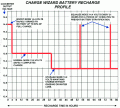
I looked at the "Charge Wizard" and its two U.S. patents 5,982,643 and 6,184,649 which claim to increase battery life 2-3x. It's unfortunate you have to pay extra for the feature- which still has problems. I say it's chronically undercharging.
1. It doesn't know which battery chemistry (PbCa, AGM, SLA, antimony etc) and who would assume every lead-acid battery is exactly the same?
2. It doesn't compensate charging voltage over temperature, which is a problem if your RV is outdoors, as they tend to be.

All they do is have a low float charge voltage of 13.2V then jump up every 21 hours for 15 minutes. It's still a dumb charger because it doesn't know when or what load the battery experiences and the charger will get stuck in the float state. It's all setup to power up and charge a battery that is not connected to anything else, then float forever.

Example Trojan 24TMX RV deep-cycle flooded battery: float charge 13.50V, bulk charge 14.82V, equalization charge 16.20V - which are far above the "Charge Wizard" setpoints.

charge_wiz_profile.gif
 

Thread Starter

GDS61

Joined May 10, 2020
9
Thanks for the information. Luckily the wizard is 12 bucks but still like you said it has problems. I have my auto shut off built and will be installing it this week. As of now I have it set to turn on 120 volts to the charger when the battery is at 12.3 volts. It then fires a off delay relay set for 24 hours. then it it will shut off until it reaches 12.3 again.
 
Top