I am finally joining the microcontroller cult after decades of resisting (no pun intended)

camerart

Joined Feb 25, 2013
3,828
I have been a die-hard analog electronics hobbyist my whole life. Old-school, draw the op-amps and discrete logic chips on a piece of graph paper, Forrest Mims kind of guy. But I have finally given in and joined the microcontroller cult. I have been absorbed. Wish me luck!
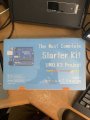

View attachment 317727
Hi B,
I enjoy microcontrollers too, but I use PICs.
The Arduino, route is more user friendly, as they use libraries, but I like the rawness of PICs, where you need to figure things ot more.
These forums are great, and I've learnt lots from them, even though I'm very slow.
Camerart.
 

nsaspook

Joined Aug 27, 2009
16,249
I have been a die-hard analog electronics hobbyist my whole life. Old-school, draw the op-amps and discrete logic chips on a piece of graph paper, Forrest Mims kind of guy. But I have finally given in and joined the microcontroller cult. I have been absorbed. Wish me luck!


View attachment 317727
You will find your analog experience invaluable as many microcontroller programming tasks are analog circuits in digital time domain form. Don't listen to classical programmers about how to program embedded systems. Visit and stay in the embedded programming world for a while. Think hardware when writing software with a language like C.

IMO, the thing that's usually hardest is the conversion from the analog continuous systems mental image to a time domain, stepped sequence problem solving mental image. Programming and coding is the easy part once you frame the problem in a compatible manner.

 
Last edited:

KeithWalker

Joined Jul 10, 2017
3,603
Welcome to the world of Arduino. I have been using the Atmel microcontrollers in the Arduino programming environment for quite a few years now. The learning curve is a little steep at the beginning, but there is lots of reference information and examples available online. I found that it opened up a vast new way to satisfy my creativity. Have lots of fun.
 

ronsimpson

Joined Oct 7, 2019
4,645
There are many example programs on the internet (forums).
I would start out by following the guide. If no guide start out with a program to blink one LED. That program will show you how to make a pin an output, set it high or low, how do delay 1 second. and loop. Then modify and see what happens when you change the delay, add more LEDs, move to a different pin, etc. To find programs already built search for "Arduino blink LED".
I find the first program is had so pick a simple one. Then learn what each command does and play with it.
 

Thread Starter

brockrwood

Joined Oct 23, 2016
89
Welcome to the world of Arduino. I have been using the Atmel microcontrollers in the Arduino programming environment for quite a few years now. The learning curve is a little steep at the beginning, but there is lots of reference information and examples available online. I found that it opened up a vast new way to satisfy my creativity. Have lots of fun.
I am hoping that Arduino replaces some of the complicated analog circuitry I am forced to create to make a circuit that has more steps than simply "sense something and then do something". Using an analog approach, with transistors, op-amps, comparators, logic chips, etc., can easily get so complicated I cannot follow it. Once you get just a little bit complicated, such as "sense this this voltage level on this wire, wait this amount of time, sense the voltage level again, if it has not gone down, send a signal to turn on (or off) a MOSFET", etc., using a universal device I can simply arbitrarily program to make those decisions becomes very appealing.

It also makes me REALLY appreciate the cleverness of older circuits where a microcontroller was not available and the circuit designer had to dream up an analog and/or discrete logic chip solution to the problem.
 

Thread Starter

brockrwood

Joined Oct 23, 2016
89
There are many example programs on the internet (forums).
I would start out by following the guide. If no guide start out with a program to blink one LED. That program will show you how to make a pin an output, set it high or low, how do delay 1 second. and loop. Then modify and see what happens when you change the delay, add more LEDs, move to a different pin, etc. To find programs already built search for "Arduino blink LED".
I find the first program is had so pick a simple one. Then learn what each command does and play with it.
One reason I picked this starter kit is that the reviews on Amazon say that the tutorial that comes with the kit is well-written in excellent English. We shall soon find out if the reviews are accurate.
 

dl324

Joined Mar 30, 2015
18,216
But I have finally given in and joined the microcontroller cult. I have been absorbed. Wish me luck!
Congrats!

I missed out on the Raspberry Pi introduction because I didn't have the bandwidth to pick up something new. I passed on Arduino for a lot of years because I felt it was too limited.

I started my "adventure" with a new microcontroller called C.H.I.P. that was a Kickstarter project. Fortunately, it was a project that met its initial goals. It was ARM based, and for $9, you got 4GB of flash (mine were all 8GB), 256MB memory, WiFi, Bluetooth, composite video, a bunch of I/O's and a low resolution ADC (which I wish Rpi had). The company got too ambitious and folded before they ever gave us the capability to make our own images. After updates stopped and the ability to burn images went away, I switched to RPi.

RPi is 3.3V (so was C.H.I.P.) and I found it tiresome to interface with my projects which tended to be 5V, so I bit the bullet and started using Arduino. It's too bad the Arduino forums are full of high post members who are so full of themselves and they like to pick on new members. I didn't even get to 100 posts before I left.

I'm still more inclined to use RPi because they can multitask and $15 gets you a quad core Pi Zero 2 W. The problem with it, Pi Zero, and Pi Zero W is that you can only buy one at a time. The Zero W is also up to $15 and I buy one whenever I buy a 2 W (if they're in stock).

I've got a box of other microcontrollers that I haven't even touched yet. A local guy got cancer and was passing on some of his treasures before he passed.
 
Last edited:

Sensacell

Joined Jun 19, 2012
3,767
I have been a die-hard analog electronics hobbyist my whole life. Old-school, draw the op-amps and discrete logic chips on a piece of graph paper, Forrest Mims kind of guy. But I have finally given in and joined the microcontroller cult. I have been absorbed. Wish me luck!


View attachment 317727

You will find that having analog chops gives you a head start when it comes to actually doing a practical project.
I am so often torn by the lack of basic electronics knowledge people employ while attempting to cobble together very complex projects, mostly using "modules"

All the code in the world cannot help you if you cannot power the devices correctly, or provide a decent signal into your ADC.
 

k1ng 1337

Joined Sep 11, 2020
1,038
Congrats!

I missed out on the Raspberry Pi introduction because I didn't have the bandwidth to pick up something new. I passed on Arduino for a lot of years because I felt it was too limited.

I started my "adventure" with a new microcontroller called C.H.I.P. that was a Kickstarter project. Fortunately, it was a project that met its initial goals. It was ARM based, and for $9, you got 4GB of flash (mine were all 8GB), 256MB memory, WiFi, Bluetooth, composite video, a bunch of I/O's and a low resolution ADC (which I wish Rpi had). The company got too ambitious and folded before they ever gave us the capability to make our own images. After updates stopped and the ability to burn images went away, I switched to RPi.

RPi is 3.3V (so was C.H.I.P.) and I found it tiresome to interface with my projects which tended to be 5V, so I bit the bullet and started using Arduino. It's too bad the Arduino forums are full of high post members who are so full of themselves and they like to pick on new members. I didn't even get to 100 posts before I left.

I'm still more inclined to use RPi because they can multitask and $15 gets you a quad core Pi Zero 2 W. The problem with it, Pi Zero, and Pi Zero W is that you can only buy one at a time. The Zero W is also up to $15 and I buy one whenever I buy a 2 W (if they're in stock).

I've got a box of other microcontrollers that I haven't even touched yet. A local guy got cancer and was passing on some of his treasures before he passed.
I like Raspberry Pi because you get a lot out of the box. Within an hour you can have an OS going with minimal programming skills and there is plenty you can do. Web servers, analog interfacing and home automation are a few examples. Well worth $100 for a basic kit.
 

crutschow

Joined Mar 14, 2008
38,314
I have been a die-hard analog electronics hobbyist my whole life. Old-school, draw the op-amps and discrete logic chips on a piece of graph paper, Forrest Mims kind of guy. But I have finally given in and joined the microcontroller cult.
Sorry to hear you turned to the dark side. ;)
I'm staying a diehard analog guy until the end (although I did relapse once and use a microprocessors for a small project :eek:).

But welcome and enjoy.
 

cmartinez

Joined Jan 17, 2007
8,722
Sorry to hear you turned to the dark side. ;)
I'm staying a diehard analog guy until the end (although I did relapse once and use a microprocessors for a small project :eek:).

But welcome and enjoy.
You make it sound as if there were a conspiracy for an analog apartheid :eek:
 

Thread Starter

brockrwood

Joined Oct 23, 2016
89
I like Raspberry Pi because you get a lot out of the box. Within an hour you can have an OS going with minimal programming skills and there is plenty you can do. Web servers, analog interfacing and home automation are a few examples. Well worth $100 for a basic kit.
Sounds neat! What’s the OS?
 

k1ng 1337

Joined Sep 11, 2020
1,038
Sounds neat! What’s the OS?
The "desktop" version of Ubuntu Linux is a good place to start. You can use it as a regular computer or connect remotely with VNC Viewer. No need to buy the latest board either. The RPi 3B is powerful and sells new for around $50. A beginner won't see much performance difference compared to the current version so beware the hype.
 

Ian0

Joined Aug 7, 2020
13,097
I would recommend choosing something with an ARM processor (I think there's an arduino). ARM is probably the most useful processor to know (some may disagree) It's a very simple processor - the only difficulty is that most manufacturers supply it equipped with a bunch of really complicated peripherals.
 
Top