Hydraulic Engineering question: Which plan is better?

cmartinez

Joined Jan 17, 2007
8,854
Word of advice, do not underestimate the diameter and placement of the breathing/vent pipe. A proper installation results in a dramatically improved flow performance.

Down here there are a lot of people of of scarce resources that have water tanks installed atop the roof of their houses, with no electrical equipment or pumps whatsoever. They have to rely on gravity alone to pull the water down into their showers and toilets.

This is the recommended installation for a pump-less rooftop water tank:
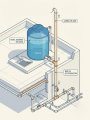
1788634223559.png
Notice how the breathing pipe is installed vertically inline with the main output pipe, and has a diameter at least equal to the main distribution pipe.
 
Last edited:

cmartinez

Joined Jan 17, 2007
8,854
Here's another diagram. It has an obvious mistake in its main title. It reads "How to obtain more pressure from your water tank?", when it should actually read "How to obtain more FLOW from your water tank"

1788634832083.png
 

Thread Starter

B-JoJo-S

Joined Jan 3, 2026
503
Just got done unloading the truck with the supplies.
This is the recommended installation for a pump-less rooftop water tank:
My roof is 4/12 pitch. And it wasn't engineered to have a water tank on top of it. My tanks are mostly for use in the garden. If an emergency should arise - I have a few gallons I could filter and boil. The kind of disaster that will be catastrophic is an asteroid strike or a super volcano erupts. Anak Krakatoa, they say, has been growing 12 feet per year. That suggests pressure is building up inside. When the crust cracks that's when 200 extra gallons of water isn't going to make much of a difference. When that thing blows it's going to change life for a whole lot of people. Those who survive will have a struggle. I won't survive. Even with a thousand gallons of water on hand.
 

Thread Starter

B-JoJo-S

Joined Jan 3, 2026
503
55 gallons of water is 456 1/2 pounds. I wouldn't want to put that up on the roof and have the roof collapse in just so I could save a little rain water.

Farmers used to have water tanks high above their land. They pumped water into it from a stream and a ram pump. If you've never seen a ram pump - it's pretty ingenious!
 

cmartinez

Joined Jan 17, 2007
8,854
I wasn’t suggesting that you put the tanks above ground. I was pointing out that a well-placed breathing pipe is important to obtain a decent flow out of them when the time comes.
 

Thread Starter

B-JoJo-S

Joined Jan 3, 2026
503
My downspouts are 2 x 3" sq. That's 6 square inches. A 2 inch pipe has 3 1/8ths square inches. OK, yeah, a heavy rain will be a problem. 3" piping would be 7 square inches. Good observation. Either that or make allowance for overflow.
One reason for using 2" piping is because the bungs of the barrels are made for 2" pipe.
 

Ya’akov

Joined Jan 27, 2019
10,294
One simple way is to just bring the water into the bottom of the bottom barrel by putting a tee connection with the spout. The connect the top of the bottom barrel to the bottom of the top barrel. Done.
I am not clear about whether this would actually fill the top barrel given that gravity is the only impetus at work. My intuition is that the idea is sound but it should be reversed:

source –-> top of top barrel –> bottom of top barrel to top of bottom barrel

This way the incoming flow never fights the weight of the collected water.
 

WBahn

Joined Mar 31, 2012
33,135
I am not clear about whether this would actually fill the top barrel given that gravity is the only impetus at work. My intuition is that the idea is sound but it should be reversed:

source –-> top of top barrel –> bottom of top barrel to top of bottom barrel

This way the incoming flow never fights the weight of the collected water.
But then you are having to vent through not one, but two fill pipes at the same time that you are trying to fill through those same pipes. For low flow rates, that's not a problem. But at low flow rates, it's all a moot point. The questions is what happens at max flow rates when the fill pipe was enough water flowing into it to completely fill it. Now it starts building back-pressure in the barrel, which slows the flow rate, until you get a chug and that has to propagate up the fill pipe, competing with the water trying to come down. While this is happening, you will have water overflowing that otherwise could have gone done the pipe.

Gravity isn't a problem here. The level in the fill pipe will be the same as the level in the barrels (which, if you use a clear or translucent pipe for this section, means you have a level gauge as well. Add a cup of water to the fill pipe, and a cup of water will flow into the barrels with no problem. It's far more important to keep unimpeded flow and no (higher-than-ambient) air pressure in the barrels.
 

Ya’akov

Joined Jan 27, 2019
10,294
But then you are having to vent through not one, but two fill pipes at the same time that you are trying to fill through those same pipes. For low flow rates, that's not a problem. But at low flow rates, it's all a moot point. The questions is what happens at max flow rates when the fill pipe was enough water flowing into it to completely fill it. Now it starts building back-pressure in the barrel, which slows the flow rate, until you get a chug and that has to propagate up the fill pipe, competing with the water trying to come down. While this is happening, you will have water overflowing that otherwise could have gone done the pipe.

Gravity isn't a problem here. The level in the fill pipe will be the same as the level in the barrels (which, if you use a clear or translucent pipe for this section, means you have a level gauge as well. Add a cup of water to the fill pipe, and a cup of water will flow into the barrels with no problem. It's far more important to keep unimpeded flow and no (higher-than-ambient) air pressure in the barrels.
I understand what you are saying but I am still uncertain. And, yes, you would have to vent both barrels, the bottom vent reaching above the top barrel. I really cant quite visualize the behavior so I defer to your certainty.
 

WBahn

Joined Mar 31, 2012
33,135
I understand what you are saying but I am still uncertain. And, yes, you would have to vent both barrels, the bottom vent reaching above the top barrel. I really cant quite visualize the behavior so I defer to your certainty.
To get some idea of the effect, fill a two-liter pop bottle with water and turn it upside down. See how the water chugs out of it. The same thing happens with a water cooler. Now swish the bottle in a circle to create a vortex and now you have a air channel that is coaxial with an outer water channel and the bottle drains very fast. It actually wouldn't be too difficult to make a fill pipe with an inner vent tube, especially for the primary fill pipe, but getting the bottom one to work well is a bit trickier.
 

Thread Starter

B-JoJo-S

Joined Jan 3, 2026
503
I am not clear about whether this would actually fill the top barrel given that gravity is the only impetus at work. My intuition is that the idea is sound but it should be reversed:

source –-> top of top barrel –> bottom of top barrel to top of bottom barrel

This way the incoming flow never fights the weight of the collected water.
A valid point. A nearly full barrel set would have a very low flow. I'm learning a lot from these conversations, and it's appreciated. I've already purchased the materials for the last drawing and have already begun cutting the saddles for the barrels. But I will give this even more thought as to exactly what design is best. Perhaps moving the diverter Tee higher and increasing the height of the vent will better serve the goal.
To get some idea of the effect, fill a two-liter pop bottle with water and turn it upside down. See how the water chugs out of it. • • • Now swish the bottle in a circle to create a vortex and now you have an air channel that is coaxial with an outer water channel and the bottle drains very fast. It actually wouldn't be too difficult to make a fill pipe with an inner vent tube, especially for the primary fill pipe, but getting the bottom one to work well is a bit trickier.
This is also something I'm familiar with - the pop bottle. I've done that, and yes, you can drain a 2L bottle quite rapidly. But engineering something that will rapidly allow air to escape as the tanks fill - that's going to take some consideration. At least on my part it will.

The current configuration (single barrel standing upright) has no vent. The syphon does not vent air. Still, it fills. I'll take a picture of the rig later this morning. Apparently the chugging of air coming out while water is going in has not presented itself as much of a problem. Of course, I have not stood out there in the pouring rain to observe the functionality of the system. But Ya’akov's point on gravitational fill when the barrels approach full is well taken and deserves consideration.
 

Thread Starter

B-JoJo-S

Joined Jan 3, 2026
503
Remember; this whole thing needs to be able to be disassembled for cleaning. Even though there's a separation system (weeping pipe) to redirect any dirty water, there's still going to be accumulation inside the barrels. Cleaning them out at the end of the rainy season will be necessary. At the diversion Tee there's also a valve that gets shut off for the winter. This prevents water from accumulating in the system, thus prevents freezing which could damage the plumbing.
 

Thread Starter

B-JoJo-S

Joined Jan 3, 2026
503
Perhaps by raising the overflow Tee higher it will increase the gravitational pressure to fill the barrels. Thoughts?

Meanwhile I found this:

Screenshot 2026-09-09 at 6.38.18 AM.png
Raising the overflow 2 1/2 feet higher (practical but close to my limit) would increase the pressure a mere 1.08 pounds of pressure. Don't know if that would be enough.

EDIT: I think AI got the pressure "decrease" thing backwards. For every foot of elevation pressure increases by 0.433 PSI.
https://calculator.academy/water-pressure-elevation-calculator/
END EDIT.
 

wayneh

Joined Sep 9, 2010
18,153
I think AI got the pressure "decrease" thing backwards. For every foot of elevation pressure increases by 0.433 PSI.
First, you don't need an AI to get that number. Picture a cubic foot of water, one foot of depth with its entire weight sitting on a one square foot, or 144 square inches. A cubic foot of water is 7.481 gallons and each gallon weighs 8.33 pounds (at 20°C), so the total weight is 62.3 lbs and the pressure is 62.3lbs/144sq. in. = 0.433psi per foot of depth. That number is a bit larger in salty or colder (denser) water.

The hydraulic pressure is expressed as the pressure you would measure at depth, for instance the pressure experienced by a scuba diver at different depths of water. With this reference, "elevation" is the opposite of "depth". Static head pressure obviously increases with the head height.

Not sure it helps your thinking but chemical engineers distinguish the static head from the dynamic pressure drop due to flow. In your shower you experience both. My water tank is in the basement, two floors below my shower. So 50psi (provided by the well pump) at the tank drops to about 40psi at the shower's valve. When the valve is opened, there's probably another few pounds of loss in all the piping, so maybe 35psi at the shower head. Most of the total pressure drop during use should occur across the shower head, to ensure a good spray and at least some pressure at nearby faucets.

At low flows, your system can be analyzed mostly as a static system. Dynamic pressure drops are very low. At high flow, dynamic pressure drop also comes into play.
 
Last edited:

Thread Starter

B-JoJo-S

Joined Jan 3, 2026
503
there's probably another few pounds of loss in all the piping
First, thanks for your reply. Second, my home had 36 elbows between the supply line and the first (kitchen) sink. It's not a drop in pressure it's a drop in flow.

Now, regarding where I put the overflow drain pipe: Moving it 2 1/2 feet higher in elevation would add 1.08 pounds of head pressure. The barrels are approximately 23 1/2 inches in diameter. The saddles are adding an additional height of 3 inches. So to the full level of the barrels would be just over 4 feet. With 7 feet of head pressure, when empty there should be (obviously) 7 feet of head pressure dropping to merely 3 feet when full. So it looks like there would be 3.03 pounds of weight influencing flow into the barrels when empty and drop to just over 1 pound when full. Very little change in flow rate, with which I have no means of measuring. My comment was that I don't think that's going to make much difference at all. But since I wanted to buy 8' lengths of pipe but could only find 10' lengths, I have an extra 2 feet of pipe to do something with. Many of the pieces are short and come from a collection of leftovers. Adjusting the height of that overflow shouldn't be difficult, but I haven't run the numbers for those changes. Also, I don't want the valve so high I need a ladder to reach it, so a max height of about 7' above ground might be the best I can do for gaining head pressure.
 

wayneh

Joined Sep 9, 2010
18,153
I know it's late in the design process but if I were doing this project - and I've considered it many times - I'd use a tote, also known as an IBC (intermediate bulk container). For those unaware, it's a plastic cube that holds about 1,000L (like 5 x 50 gal drums), with a metal frame for support, a valve at the bottom and a fill-hole on top. It may or may not have an integral pallet built into the bottom for easy handling with a forklift.

You can get them for free if you're in the right place at the right time. They're popular for aquaculture, raising fish.
 

WBahn

Joined Mar 31, 2012
33,135
I know it's late in the design process but if I were doing this project - and I've considered it many times - I'd use a tote, also known as an IBC (intermediate bulk container). For those unaware, it's a plastic cube that holds about 1,000L (like 5 x 50 gal drums), with a metal frame for support, a valve at the bottom and a fill-hole on top. It may or may not have an integral pallet built into the bottom for easy handling with a forklift.

You can get them for free if you're in the right place at the right time. They're popular for aquaculture, raising fish.
Unfortunately, that would require registration where he's at. He's limited to two containers, neither of which can exceed 100 gal.
 

Thread Starter

B-JoJo-S

Joined Jan 3, 2026
503
I'd use a tote, also known as an IBC
That has already been considered. But unfortunately the location where the barrels are going, putting an IBC there instead would block the walkway nearly completely. There's only 5 feet between the back of the garage and the fence. Also, I'm unaware of where they might be found for free, or even at low cost.

Finally, considering the IBC versus the blue barrels, I've heard concern about algae growth in barrels (not IBC's) that are not blue barrels. I don't know about black barrels but I've heard white barrels will grow algae if not protected from direct sunlight.

If I were to build a house from scratch, assuming money were no object, which it IS; I'd have the main house, a detached garage big enough to house a motorhome and two cars and a bay for lifting a car off the ground for servicing. There would also be a power house where solar and wind power would be directed into a large bank of batteries along with an emergency generator for those times when long nights and cloudy days aren't enough to supply the homes power. I'd also have a head pump air conditioner / heater with an in-ground thermal exchange coil so cold winters won't need supplemental heat and hot summer days won't affect the ability to cool the house. If money were no object - that is.

There would be underground water storage along with a secondary storage to collect as much legal water sequestration and a water purifier to make that water usable directly from the tank. All that if money were no object. But I'm constricted by both financial considerations and space concerning my rainwater collection. My plan is to have four barrels total. I have a fifth barrel and am considering how I'm going to use that one. It's likely I may use it to hold potable water. 50 gallons is not much so I may UP that amount to maybe as much as 250 gallons of potable water (not rain water). But that's a future project. One involving filtration and purification. Perhaps a UV clarifier and charcoal filters.
 

wayneh

Joined Sep 9, 2010
18,153
...my home had 36 elbows between the supply line and the first (kitchen) sink. It's not a drop in pressure it's a drop in flow.
That's the same conundrum in electronics, "it's not a drop in voltage it's a drop in current".

It reminds me of a standard exam question in an entry level class in chemical engineering, electrical engineering, or differential equations. The pressure drop caused by each bend, joint, length of pipe and so on, is a function of the flow rate past that obstacle. (The voltage drop at every resistor is a function of the current flowing through that resistor).) The overall flow rate (current) is a function of the overall pressure (voltage) drop.
 
Top