Facebook
 Google
 GitHub
 Linkedin

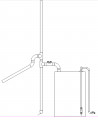
I'm planning on capturing rain water in these barrels. There will be four barrels in all, each in groups of two. The drawing shows two rain barrels supported one above the other. At the top are the rain gutter downspouts. At first rainfall water flows into the weeping tube. That tube has a number of weep holes that allow the water to drain out. This catches the dirtiest of the water coming from the roof. The pipe diameter is 2 inch. I may have to upgrade the weeping pipe to something big enough to collect more dirty water before the water starts flowing into the barrels. • • • As the weeping pipe fills, water begins to flow past the valve and is directed into the two barrels. The bottom barrel does not have a vent, so air will want to flow back against the falling rain water. I don't imagine - and here's the reason for my question - trapped air - I believe - will seek to flow up into the upper barrel. Once the bottom barrel has filled to capacity the upper barrel, which may already have some water in it, begins to fill to capacity. Once both barrels are full and all the air has bled out of the barrels any further rainfall will go down the overflow pipe.
MY QUESTION(s): Will having two vents (right drawing) work better? Or will the left barrels be sufficient to fill them? I'm just not sure air will be able to exit quickly enough to allow the bottom barrel to fill while the rain continues to fall.

As for the vents, they will be stuffed with copper mesh to keep bugs out. If I have left over PVC I'll make longer bug filters.
This water is not intended for drinking. Although in times of emergency, water can be filtered and boiled before consuming.
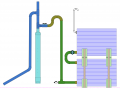
I have only two barrels set up at present. They stand on end. To get water out I have to start a siphon. Once flowing the water flows somewhat slowly, but it flows. I can empty a barrel in about 10 to 15 minutes just using a siphon flow. You can ignore the stands, it was easier to screen grab them along with the barrels than it would have been to crop them out. Finally, at the bottom of the bottom barrel is a small hose bib so I can attach a hose to it. I don't have a pump yet but I intend to. Having the barrels on their side makes getting water out easy.
The construction is some pipes are glued together, others are fit together and held in place using self tapping screws. There's two Unions so the pipes can be disassembled and the barrels removed for cleaning.
MY QUESTION(s): Will having two vents (right drawing) work better? Or will the left barrels be sufficient to fill them? I'm just not sure air will be able to exit quickly enough to allow the bottom barrel to fill while the rain continues to fall.
As for the vents, they will be stuffed with copper mesh to keep bugs out. If I have left over PVC I'll make longer bug filters.
This water is not intended for drinking. Although in times of emergency, water can be filtered and boiled before consuming.
I have only two barrels set up at present. They stand on end. To get water out I have to start a siphon. Once flowing the water flows somewhat slowly, but it flows. I can empty a barrel in about 10 to 15 minutes just using a siphon flow. You can ignore the stands, it was easier to screen grab them along with the barrels than it would have been to crop them out. Finally, at the bottom of the bottom barrel is a small hose bib so I can attach a hose to it. I don't have a pump yet but I intend to. Having the barrels on their side makes getting water out easy.
The construction is some pipes are glued together, others are fit together and held in place using self tapping screws. There's two Unions so the pipes can be disassembled and the barrels removed for cleaning.