Hydraulic Engineering question: Which plan is better?

Thread Starter

B-JoJo-S

Joined Jan 3, 2026
493
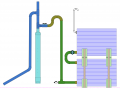
I'm planning on capturing rain water in these barrels. There will be four barrels in all, each in groups of two. The drawing shows two rain barrels supported one above the other. At the top are the rain gutter downspouts. At first rainfall water flows into the weeping tube. That tube has a number of weep holes that allow the water to drain out. This catches the dirtiest of the water coming from the roof. The pipe diameter is 2 inch. I may have to upgrade the weeping pipe to something big enough to collect more dirty water before the water starts flowing into the barrels. • • • As the weeping pipe fills, water begins to flow past the valve and is directed into the two barrels. The bottom barrel does not have a vent, so air will want to flow back against the falling rain water. I don't imagine - and here's the reason for my question - trapped air - I believe - will seek to flow up into the upper barrel. Once the bottom barrel has filled to capacity the upper barrel, which may already have some water in it, begins to fill to capacity. Once both barrels are full and all the air has bled out of the barrels any further rainfall will go down the overflow pipe.

MY QUESTION(s): Will having two vents (right drawing) work better? Or will the left barrels be sufficient to fill them? I'm just not sure air will be able to exit quickly enough to allow the bottom barrel to fill while the rain continues to fall.
Screenshot 2026-09-03 at 2.30.53 PM.png
As for the vents, they will be stuffed with copper mesh to keep bugs out. If I have left over PVC I'll make longer bug filters.

This water is not intended for drinking. Although in times of emergency, water can be filtered and boiled before consuming.

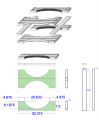
I have only two barrels set up at present. They stand on end. To get water out I have to start a siphon. Once flowing the water flows somewhat slowly, but it flows. I can empty a barrel in about 10 to 15 minutes just using a siphon flow. You can ignore the stands, it was easier to screen grab them along with the barrels than it would have been to crop them out. Finally, at the bottom of the bottom barrel is a small hose bib so I can attach a hose to it. I don't have a pump yet but I intend to. Having the barrels on their side makes getting water out easy.

The construction is some pipes are glued together, others are fit together and held in place using self tapping screws. There's two Unions so the pipes can be disassembled and the barrels removed for cleaning.
 

Thread Starter

B-JoJo-S

Joined Jan 3, 2026
493
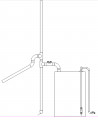
Current configuration:
Screenshot 2026-09-03 at 2.46.01 PM.png
At the bottom of the weeping pipe is a cap with weep holes. That's the arrow at the bottom.
The Tee at the top of the 3/4" pipe gets a plug. When I remove the plug I can pour water into the pipe, thus filling the whole assembly with water. Plug off the top and the 3/4" pipe is ready to siphon. At the bottom of the pipe inside the barrel is a one way check valve. It HAD a spring in it but I had to remove that so the water could flow. That's probably a fairly big part of the reason why it takes 10 to 15 minutes to empty the barrel; the water flow is restricted somewhat.

EDIT: BTW; the drawings are dimensionally correct.
 
Last edited:
I think you need a vent at the top of the storage tank like in post #1. The air needs a way out or the tank will not fill fast. For every drop of water going in needs that much air to exit. If the water going in and the air going out are in the same pipe there will be a fight. Then as you pull water out the tank needs a source of air to fill the tank.

I do not know if you need a second vert like on post #1 right.
 

Thread Starter

B-JoJo-S

Joined Jan 3, 2026
493
Thanks Ron. The current configuration seems to work well enough. One good rainstorm can fill that barrel in a few hours. It's not vented, so apparently air is still able to escape while the barrel fills. I just hadn't thought about it before now, hence, the reason for asking which might be better. The cost difference is a savings of one 2" Tee and replacing it with one 90˚ sweep elbow. Sweep elbow is as drawn whereas a standard elbow is a much sharper 90.
 

wayneh

Joined Sep 9, 2010
18,136
I don't think you really need piping for the topmost vent hole, although a bug/debris trap is a good idea. Since only air should be passing, the pipe can be much lower diameter.

Anyway my thought is that the incoming green pipe could enter the lower drum at any point, and the air could be piped separately out the top and into the upper drum, much as you have it drawn now. You'd have to make another hole in the lower drum for the water entry, and that's a downside, but I think separating the exiting air from the incoming water is a big plus.

Instead of a weeping pipe, I'd consider a screen or some other method to catch whatever debris you have. That would allow you to capture some water in even a slow rain, instead of losing it all out the weeping pipe. Success of separation technologies always depends on the nature of the debris. Something that works great for asphalt gravel might be useless against maple leaves. If it's working, go with it.
 

WBahn

Joined Mar 31, 2012
33,094
One simple way is to just bring the water into the bottom of the bottom barrel by putting a tee connection with the spout. The connect the top of the bottom barrel to the bottom of the top barrel. Done.

Also, be sure that you look into the laws regarding rainwater capture. If you live in an arid or semi-arid region, there are often water rights involved that results in some rather non-intuitive laws. These laws often place odd constraints one how the water can be collected, how much can be stored, and how it can be used. For instance, your system would require registration in Utah, because it consists of more than two barrels, you also can't store more than 100 gallons. Another common constraint is that collected rainwater must be used on the parcel where it was collected. In Colorado, the rainwater must be collected from the roof of the primary residence (it can't be collected from the roof of a shed or detached garage, or from a free-standing system), it cannot be used for drinking or any indoor use.
 

Thread Starter

B-JoJo-S

Joined Jan 3, 2026
493
be sure that you look into the laws regarding rainwater capture.
Local law: I can have up to two rain barrels without registering them. I could have more barrels, up to 250 gallons but they have to be registered. There is no charge for this but it must be registered if more than 2 barrels are used or if a 250 gallon container is utilized.
One simple way is to just bring the water into the bottom of the bottom barrel by putting a tee connection with the spout. The connect the top of the bottom barrel to the bottom of the top barrel. Done.
I will have to draw that to see how it looks. But thinking about it now - I think it should be better than anything I've considered so far. Thank you.
 

WBahn

Joined Mar 31, 2012
33,094
Local law: I can have up to two rain barrels without registering them. I could have more barrels, up to 250 gallons but they have to be registered. There is no charge for this but it must be registered if more than 2 barrels are used or if a 250 gallon container is utilized.
Are you in Utah? If so, I'm pretty sure that registered systems are allowed an aggregate of 2500 gallons.

But your system, per your original post, consists of four barrels. You should check with the authority in question whether two permanently interconnected barrels can be considered a single container. The rules are very arcane, so don't rely one what makes sense, because the rules seldom make much sense. For instance, in Colorado, what is the rationale for why I can collect water from the roof of an attached garage, but not from an unattached one?
 

Thread Starter

B-JoJo-S

Joined Jan 3, 2026
493
OK, here's a redraw:

Screenshot 2026-09-04 at 3.07.29 PM.png
I've upped the weeping pipe to 4". It will gather four more times the dirty water before clean(er) water flows into the barrels. The bottom of the weeping pipe is a threaded connection to facilitate clean-out. I've also reduced the size of the vent pipe, since air moves more easily than water - as per @wayneh's comment:
Since only air should be passing, the pipe can be much lower diameter.
I'll still put a bug screen in it. I have lots of copper mesh. Bought it back when Covid 19 was the latest and greatest scare. Was putting mesh into masks for a while.

If you're wondering why the Union between the two barrels it's because there's no way to separate the barrels if everything has been glued (except for threaded parts). The Union allows barrels to be disassembled.

As for the thought of considering two barrels together being thought of as one barrel - nah, if you know politicians - I'd be lucky if they didn't consider it 55 barrels (not gallons).

EDIT: The inverted P-trap at the top of the green pipe is to prevent dirty water from splashing into the Tee and going down into the barrels.
END EDIT.
 

wayneh

Joined Sep 9, 2010
18,136
Ah, I'm glad you understood my comments. Nice changes.

Now my only remaining concern is whether the whole arrangement can handle the complete flow typical of a strong thunderstorm. Now that I think about it, once the drums are full the overflow pipe alone has to handle it all. My downspouts sometimes gush at 5 to 20? gpm. That's maybe only once or twice a year but it's impressive when it happens.
 
Last edited:

Thread Starter

B-JoJo-S

Joined Jan 3, 2026
493
The inverted P-trap at the top of the green pipe is to prevent dirty water from splashing into the Tee.
My downspouts sometimes gush at 5 to 20? gpm.
My downspouts are 2 x 3" sq. That's 6 square inches. A 2 inch pipe has 3 1/8ths square inches. OK, yeah, a heavy rain will be a problem. 3" piping would be 7 square inches. Good observation. Either that or make allowance for overflow.
 
Top