Howland current source related question

Thread Starter

Iamma

Joined May 13, 2022
15
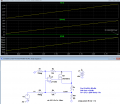
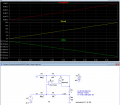
I want to use a howland current source to generate a current that which passes through a load resistor would give me 30V on it.

For this I am simulating the circuit in the picture, theoretically I generate a current from 3mA-30mA current that when passing through the 1k resistor would be a voltage drop from 3V to 30V.

Does someone know why this is happening, and if its solvable?

1742310441517.png1742310498034.png
 

crutschow

Joined Mar 14, 2008
38,321
... theoretically I generate a current from 3mA-30mA current that when passing through the 1k resistor would be a voltage drop from 3V to 30V.
Does someone know why this is happening, and if its solvable?
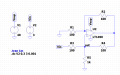
The equations for a theoretical ideal-circuit work fine with ideal components, but you have ignored the practical limits of a real circuit component:
  • The load voltage needs to be 30V, so the op amp output voltage needs to be near 60V for that circuit, which obviously it can't do.
  • The op amp can't provide 30mA of output current (look at its datasheet).
Look at the various node voltages and resistor currents in the simulation and you will see the problems.

Below is a modified Howland circuit with an N-MOSFET source-follower buffer output to provide the 30mA current, with an added output sense resistor (Rs) and high feedback resistor values to allow a 30V output voltage to the load with an op amp output voltage <40V:
Note that the output current is proportional to the input voltage, and identical for Rld load values of 1Ω and 1kΩ.

1742319529486.png

Edit: Below with constant input voltage and varying load resistance:

1742332959379.png
 
Last edited:

0ri0n

Joined Jan 7, 2025
160
Does someone know why this is happening, and if its solvable?

The op amp cannot drive 30 mA, let alone more than 600 mA through R1/R2 and R3/R4 at the 30 V max. voltage across the 1 kOhm load. Furthermore 30 V across the load would only be possible with a supply voltage exceeding 60 V. With the given 40 V supply voltage you would have to use the improved Howland current source which only needs one additional feedback resistor. Leave the 100 Ohm sense resistor as is, increase all feedback resistors to at least 100 kOhm and use a more appropriate op amp.
 

Thread Starter

Iamma

Joined May 13, 2022
15
The equations for a theoretical ideal-circuit work fine with ideal components, but you have ignored the practical limits of a real circuit component:
  • The load voltage needs to be 30V, so the op amp output voltage needs to be near 60V for that circuit, which obviously it can't do.
  • The op amp can't provide 30mA of output current (look at its datasheet).
Look at the various node voltages and resistor currents in the simulation and you will see the problems.

Below is a modified Howland circuit with an N-MOSFET source-follower buffer output to provide the 30mA current, with an added output sense resistor (Rs) and high feedback resistor values to allow a 30V output voltage to the load with an op amp output voltage <40V:
Note that the output current is proportional to the input voltage, and identical for Rld load values of 1Ω and 1kΩ.

View attachment 344860

Edit: Below with constant input voltage and varying load resistance:

View attachment 344882
Thank you for this design, I implemented it in simulation too and its perfect for what I need, but I have one more question.

Why do we need Rs?
 

crutschow

Joined Mar 14, 2008
38,321
Why do we need Rs?
Rs is a simple modification to the standard Howland circuit, which acts as a sense (shunt) resistor to determine the current (as shown by the formula on the schematic).
(Here's a paper on that.)
The op amp differential circuit function keeps the voltage across Rs constant, independent of the load voltage, thus keeping the load current constant independent of its resistance (until the op amp saturates of course).
The advantage is that the load current no longer flows through the feedback resistor as in the basic Howland circuit, so you can have high load currents without requiring low feedback resistor values, eliminating the voltage and power losses in the feedback resistors that would otherwise occur.
 
Last edited:

Thread Starter

Iamma

Joined May 13, 2022
15
Thanks a lot! :D
Rs is a simple modification to the standard Howland circuit, which acts as a sense (shunt) resistor to determine the current (as shown by the formula on the schematic).
(Here's a paper on that.)
The op amp differential circuit function keeps the voltage across Rs constant, independent of the load voltage, thus keeping the load current constant independent of its resistance (until the op amp saturates of course).
The advantage is that the load current no longer flows through the feedback resistor as in the basic Howland circuit, so you can have high load currents without requiring low feedback resistor values, eliminating the voltage and power losses in the feedback resistors that would otherwise occur.
 
Top