How would you answer this question???

WBahn

Joined Mar 31, 2012
32,852
I'm a teacher and my students were presented with this as a constructed response on a district test.
(A question they need to answer). I'm exasperated b/c I feel like this is way above their level of knowledge and understanding. We studied basic electromagnets and made one in class already with a D Battery or AA or 1 9V. But they were never taught about putting 2 batteries together so I didn't think it was a fair question for them to have to answer but they tried their best.


THE QUESTION:
Given the following supplies:

  • 2 9V Batteries,
  • 21G Copper wire,
  • an iron Bolt
  • wire cutters
    How would you set this up as an ELECTROMAGNET giving it the ability to pick up the most paperclips?

Background Knowledge:
In class they had only ever made a regular electromagnet using a D battery or a AA battery.
How would you put it together. ???
How any of us would put it together isn't terribly germane.

Nor, frankly, is what they were actually shown or actually did in class -- the real question is what were they supposed to be shown in class.

The fairness of the question needs to be assessed in the light of what they were supposed to be taught. If the lesson plan that was supposed to be used included anything about what changes could be make to increase the strength of the magnet, then it's a fair question and it's the instructional delivery that is putting them at a disadvantage, not the test. On the other hand, if the lesson plans don't touch on any of that, then it's not a fair question and the two (test and lesson plan) need to be brought into agreement.

Now, it's also important to keep in mind that some questions (I don't know about these particular tests) are often designed to see if students have the ability to take what they've learned and extrapolate new knowledge from it in the face of situations different from what they've been exposed to. That kind of question would be more appropriate at a 10th grade level than at a 4th grade level.
 

MrChips

Joined Oct 2, 2009
34,817
Here is the catch.

The internal resistance of a 9V PP3 alkaline battery could be anywhere between 1Ω and 10Ω depending on the condition of the battery.

If the resistance of the coil is lower than that of the battery, then you want the batteries in parallel.
If the resistance of the coil is greater than that of two batteries, then you want the batteries in series.

How is the student (or any person for that matter) supposed to have all this information about the experiment?
 

BobTPH

Joined Jun 5, 2013
11,517
The true genius student would bend the bolt into a U shape, wind as many turns as possible and try the batteries both ways.
 

sghioto

Joined Dec 31, 2017
8,634
If everyone would reread the original post it was mentioned that an electromagnet was made using a D and or AA batteries.
The question is simply how to use two 9 volt batteries to power the magnet not how to build it.
 

MrChips

Joined Oct 2, 2009
34,817
If everyone would reread the original post it was mentioned that an electromagnet was made using a D and or AA batteries.
The question is simply how to use two 9 volt batteries to power the magnet not how to build it.
How would you answer that?
 

Thread Starter

tleblanc72

Joined Jan 24, 2024
6
What is 21G copper wire?
21 guage

Just as a matter of curiosity, how would YOU put it together?
I'm asking this group obviously because I'm unsure. But If I had the 2 9v batteries I'd imagine I'd first stand the two batteries up like poles across from each other, join the negatives together with wire...... tightly coil around the bolt.... then lead the wire to the 2 positive poles and tightly wrap. Making sure to first use a little sandpaper on both ends of the wire.

OR maybe use them separately with two separate lengths of wire. Obviously negative leading to positive making a closed circuit.

I'm guessing 21 AWG copper wire. It is rare, but not unheard of.
Agree I only have 22 guage in supply closet so I was thinking someone just randomly made up the question.
They were asking them to pick up paperclips.

Interesting question.
What is the school subject and the school grade (or age of students)?
Can you show a diagram using only one of the two batteries?

As the previous poster asked, what is 21G copper wire?
6th Grade -- Science

Interesting question.
What is the school subject and the school grade (or age of students)?
Can you show a diagram using only one of the two batteries?

As the previous poster asked, what is 21G copper wire?
1706192025863.png
 

Thread Starter

tleblanc72

Joined Jan 24, 2024
6
Since you already made one with a 9 volt battery connect the batteries in series or in parallel and compare which has a stronger pull.
Like this:
View attachment 313513
We were not provided with these little tabs you have on the poles of the battery. Nor this type of wire.
we had a spool of 22 awg copper wire. (in class) . The question however listed the supplies the kids had to work with so they were left with only that. NOW... if a kid added in that he would use one of these I wouldn't take away b/c they're supposed to be adding in their "background knowledge" to their constructed response and I would give him kudos for knowing they exist. :0
 

Thread Starter

tleblanc72

Joined Jan 24, 2024
6
Without hearing the answers I will give you my thoughts.

You can do this as an experiment from just about any age, from about 10-15 years.
To gain an understanding of the principles involved, this is usually covered in a Physics class on Electricity & Magnetism for students 16-18 years. This is also covered in more detail at 1st and 2nd year university level in a Physics program.

If you have not been taught about the effects of batteries connected in series and parallel then it would be an unfair question to ask anyone.

To appreciate a bit more about this experiment, here are the important parameters.

1) The total number of turns wound around the iron bar is important, the more turns, the stronger the magnet.

2) Since you want to wrap as many turns as possible, you want the smallest diameter wire (up to a limit). Wire size is given a number such as 20 AWG (AWG = American Wire Gauge). The smaller wire has a higher number. 20 AWG is too fat for this experiment. 26 AWG to 32 AWG would be preferred. If it is too fine it will break easily as well as have other problems. (We never use the notation 20G to represent wire size.)

3) The higher the battery voltage, the more current will flow. Two 9V batteries in series will add to give 18V. Post #8 shows how to wire two 9V batteries in series as well as in parallel.

4) Even then, this is trick question. Even a professor teaching this stuff at university level could get the answer wrong. (I know because I have witnessed this myself.) The strength of the electromagnet thus created depends on the current flowing, not the voltage. Two 1.5V D-cells wired in series will likely create a stronger magnet than two 9V PP3 batteries wired in series or parallel. That is because the current capability of the battery needs to be taken into consideration.

In conclusion, the person who set the question needs to stick to what they know. It is obvious that Physics and how batteries work is not their forte.
Thank you so much. This response is so validating.
 

SamR

Joined Mar 19, 2019
5,491
The crux of the question is whether they know to wind the wire around the bolt and connect the wires to the battery. They are NOT asked to do a circuit analysis. The real question is why they included wire cutters in the question other than for obfuscation... Do the batteries need to be parallel or serial.
 
Last edited:

Audioguru again

Joined Oct 21, 2019
6,826
I never tried shorting a 9V battery with some wire wrapped around a nail.
The students "studied" doing it but we were not told if the resulting electromagnet worked and picked up a paperclip.
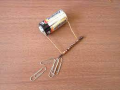
The photo shows a huge D cell putting a lot of current into the electromagnet and picking up a few paperclips.
 

MrChips

Joined Oct 2, 2009
34,817
Nothing beats a real experiment.

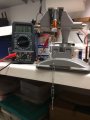
electromagnet.jpg

10 ft (3m) 28 AWG magnet wire (enameled copper wire)
90 turns wrapped around 2" long 3/8" bolt
Resistance of coil measured 0.7 ohms
10A ammeter in series to measure current

One 9V battery, 1.2A
Two 9V batteries in series, 1.6A
Two 9V batteries in parallel, 2.5A
(Current readings are appoximates since the current dropped very quickly.)

I did not count the number of paper clips suspended below the head of the bolt. It would require an extra pair of hands to hold the paper clips while pressing on the push button. The proper way to do this would be with a sensitive spring balance which I do have but could not be bothered to set up.

NOTE: The batteries got very hot and the current dropped very rapidly. It is important that the electromagnet be energized for the shortest possible time.

Another observation is that the bolt retains some magnetism even after power is removed.
 

Thread Starter

tleblanc72

Joined Jan 24, 2024
6
The crux of the question is whether they know to wind the wire around the bolt and connect the wires to the battery. They are NOT asked to do a circuit analysis. The real question is why they included wire cutters in the question other than for obfuscation... Do the batteries need to be parallel or serial.
They were in the question b/c one of the supplies was a spool of wire so they would have needed to cut it once they had enough wrapped around the bolt and the poles of the batteries.
 

Thread Starter

tleblanc72

Joined Jan 24, 2024
6
Ok, this is a simple question. Without trying to re-derive Biot-Savart or get lost in the minutiae, focus on the simple practical answer. I'm assuming that this is for an elementary level or junior high level student.

  • Wrap the wire around the bolt as many times as possible leaving a couple of short ends (enough to connect to the batteries).
  • Connect the ends of the wire to the two 9-volt batteries, one end of the wire to both positive terminals and one end of the wire to both negative terminals.
  • That produces the strongest magnet because the current is limited by the battery source resistance not the length of wire. It basically doubles the available current.
  • Paralleling the batteries (as opposed to putting them in series) will produce more current, hence a greater magnetic field, hence more paperclips.

The OP didn't ask how strong the magnetic field was.
Thank you for your response. These students are 6th grade and it was a unit on Magnetism and Electromagnetism.
Your explanation is basically how I thought it should be put together. The depth of the question stops here with putting it together. The kids (6th Grade) just needed to be able to explain how they would construct the electromagnet. Being sure to mention the whole (-) / (+) component in their description.

Interestingly, this was the "exemplar" we were presented with to compare their answers to but my partner and I disagreed with its structure. I'd like to hear your critique.

"First you have to wrap the wire around the nail and leave a little off to be able to connect to the batteries. Make loops at both ends of the wire on the nail. Then arrange the batteries where the negative end of one battery is close to the positive end of the other battery. Have the copper wire touch the positive (+) of one battery and the negative (-) of the other battery. The end of the copper wire exposed must touch the positive (+) of one end of the battery and the negative (-) of the other battery. Use the nail to pick up paper clips. The nail attached to the batteries and wire will act as an electromagnet. The nail will pick up metal items because of the creation of magnetic force."
 

WBahn

Joined Mar 31, 2012
32,852
Thank you for your response. These students are 6th grade and it was a unit on Magnetism and Electromagnetism.
Your explanation is basically how I thought it should be put together. The depth of the question stops here with putting it together. The kids (6th Grade) just needed to be able to explain how they would construct the electromagnet. Being sure to mention the whole (-) / (+) component in their description.

Interestingly, this was the "exemplar" we were presented with to compare their answers to but my partner and I disagreed with its structure. I'd like to hear your critique.

"First you have to wrap the wire around the nail and leave a little off to be able to connect to the batteries. Make loops at both ends of the wire on the nail. Then arrange the batteries where the negative end of one battery is close to the positive end of the other battery. Have the copper wire touch the positive (+) of one battery and the negative (-) of the other battery. The end of the copper wire exposed must touch the positive (+) of one end of the battery and the negative (-) of the other battery. Use the nail to pick up paper clips. The nail attached to the batteries and wire will act as an electromagnet. The nail will pick up metal items because of the creation of magnetic force."
I would stay that not much effort went into writing that answer, even just from an English standpoint. It is extremely poorly written.

Just some of the things that jump out:

It only tells them to "arrange the batteries where the negative end of one battery is close to the positive end of the other battery." It never tells them to actually connect the negative end of one battery to the positive end of the other. So the students are left with an open circuit, having followed the directions explicitly.

What is the point of telling then to have the wire touch the terminals in one sentence and then tell them in the next sentence to basically tell them the same thing.

It says, "The end of the copper wire exposed must touch the positive (+) of one end of the battery and the negative (-) of the other battery." What end of the copper wire exposed? One of the ends that the loops were made at? A separate piece of wire? Which ends of the batteries? The same ends that were put close together? The other ends? Totally confusing to someone that doesn't already know what they should do/

The sentence "Make loops at both ends of the wire on the nail," is awkward.

It tells them, "wrap the wire around the nail and leave a little off to be able to connect to the batteries." What does it mean to "leave a little off"? To not wrap the wire all the way to the end, leaving some of it sticking out? From both ends? From just one?

If this is the quality if the materials you are being provided to teach the students, it's not surprising that the assessment instruments are poorly aligned to what is being taught.
 

WBahn

Joined Mar 31, 2012
32,852
They were in the question b/c one of the supplies was a spool of wire so they would have needed to cut it once they had enough wrapped around the bolt and the poles of the batteries.
If they need wire to connect the two batteries in series, then they need to be able to cut off a short piece of wire to do that. Whether or not that is needed, versus just touching the batteries together is arguable. That "exemplar" answer seems like it might be suggesting do that -- but it is so poorly written that it's hard to tell.

Another possibility that some students might consider is to make multiple windings around the bolt, thinking that they can get about the same current in each winding (perhaps even think they can get twice as much current in each winding if each winding is only half as long, and thus get twice the ampere-turns (though they probably have not been exposed to that concept)). This neglects the dominating effect of the internal resistance of the batteries, but they probably have not been introduced to that concept, either.
 
Top