Schematics are easier to read when component values are on the schematic. Whoever wrote this question must not know that...
It's bad enough that they give you busy work with values that don't let you do the math in your head.
There are more than one way to do this.
Collect data and see what we know.
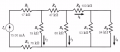
I wrote on my schematic what I know. Put the resistance by each resistor. Put down the current you know.
Is = 15mA = I1=I5. Knowing I1 and I5 probably does not help but put it down.
I4 = I3+I8
I8=I6+I7 You might be able to solve this.
Another thought is to solve for (R4, R3, R8, R7, R6) That is easy. Start with R6//R7. (//=parallel)
Then R8 + (R6//R7)
Now do it again with R2// answer from above.
Now add R4.
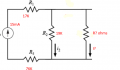
Knowing the total of all the resistors you can simplify to this below. Is = 15mA = I1=I5. You can see that I2 + I?=15mA and the current divides based on 19K and ?K ohms. (if 19k//19k then I2 is 1/2 if 15mA) and (if 19K//190k for example then most of the current will be in the 19k and only a small amount in the 190k).
Think on these things and give it a try.
Schematics are easier to read when component values are on the schematic. Whoever wrote this question must not know that... View attachment 331967
It's bad enough that they give you busy work with values that don't let you do the math in your head.
No, it's a question from an online assignment generator and whoever set up the question made it so that the platform could use the same schematic (and, hence, circuit topology) for each student, but generate different values for each person taking it.
It would have been nice, however, had they configured it to generate random standard value from, say, the E12 or E24 series, between 10 kΩ and 100 kΩ. At these they used reasonably scaled units, instead of the too-common single-digit A and Ω values.
Just posting your homework and expecting people to do your work for you doesn't cut it here.
You need to show your best attempt to work your problem as far as you can.
That way, we have some idea as to what concept you are stumbling over. We also have no idea what techniques you have been taught and that this problem is intended to be focused on.

 Facebook
 Google
 GitHub
 Linkedin