How to wire AC cable to DC cable

Thread Starter

2Pringles

Joined Apr 9, 2022
38
I have two devices which take the following DC output
2.5A - 12V
1A - 5v

They both have DC plugs which plug into my UK AC 240v wall outlet.
As the plugs are bulky they cause alot of inconvience in my small place.

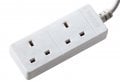
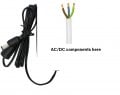
If I cut both the plug sockets off an AC extention lead and the DC plugs from the DC cable, How can I wire these directly to the cable?

Or is there another way for example maybe buying a USB-C hub and wiring the DC cable to USB-C cable and plugging into port

Open to your thoughts
 

dl324

Joined Mar 30, 2015
18,220
Welcome to AAC!
As the plugs are bulky they cause alot of inconvience in my small place.

If I cut both the plug sockets off an AC extention lead and the DC plugs from the DC cable, How can I wire these directly to the cable?
This is one of those cases where a picture would be helpful.

Since your complaint is that the parts that plug into the AC outlet are bulky, I assume they're the wall wart type of adapter and that what you're talking about cutting is the DC outputs. If that's the case, you can't do what you're proposing.
 

crutschow

Joined Mar 14, 2008
38,321
You certainly can extend the DC output by simply connecting a two-wire extension.
Obviously you need two-wires for each DC voltage.

The wire doesn't care (or know) whether there's AC or DC going through it.
 

Thread Starter

2Pringles

Joined Apr 9, 2022
38
Welcome to AAC!
This is one of those cases where a picture would be helpful.

Since your complaint is that the parts that plug into the AC outlet are bulky, I assume they're the wall wart type of adapter and that what you're talking about cutting is the DC outputs. If that's the case, you can't do what you're proposing.
Hello

Correct, dc plugs with bulky adapter housing.
I assume there is a component(s) inside the bulky DC plug that takes 240v AC and converts it into 12v 2.5A DC...

There must be more expensive smaller versions of these components that I could then wire directly to my 240V AC cable so that I can

1) eliminate plug sockets.
2) eliminate DC plug housing.

This would reduce alot of taken up space.
 

dl324

Joined Mar 30, 2015
18,220
Correct, dc plugs with bulky adapter housing.
I assume there is a component(s) inside the bulky DC plug that takes 240v AC and converts it into 12v 2.5A DC...

There must be more expensive smaller versions of these components that I could then wire directly to my 240V AC cable so that I can

1) eliminate plug sockets.
2) eliminate DC plug housing.
You aren't using standard terminology, so it would be helpful if you posted pictures

Wall warts can be of two types. The older variants used relatively bulky step down transformers and some form of voltage regulation. The newer ones use a smaller transformer, or none at all, so they can be smaller.

Plug sockets would refer to the receptacle you plug the adapters into. Plugs are typically male and AC receptacles are typically female. I think the "DC plug housing" you're referring to is actually the AC plug plus the converter to DC. The DC output could be a plug (male), but they're more likely to be female (sockets).
acAdapter.jpg
1649520044227.png
EDIT: Photos courtesy Jameco.com.
 
Last edited:

Thread Starter

2Pringles

Joined Apr 9, 2022
38
You aren't using standard terminology, so it would be helpful if you posted pictures

Wall warts can be of two types. The older variants used relatively bulky step down transformers and some form of voltage regulation. The newer ones use a smaller transformer, or none at all, so they can be smaller.

Plug sockets would refer to the receptacle you plug the adapters into. Plugs are typically male and AC receptacles are typically female. I think the "DC plug housing" you're referring to is actually the AC plug plus the converter to DC. The DC output could be a plug (male), but they're more likely to be female (sockets).
I have two of these below, which I refer to as DC plugs. one which outputs 12v, other outputs 5v

plug.jpg

Along with one of these.

download.jpg

I would like to source the component(s) inside the two plugs, cut the sockets off the extention lead, so that I can wire direct(with components needed inbetween)
 

dl324

Joined Mar 30, 2015
18,220
2.5A - 12V
1A - 5v
I would like to source the component(s) inside the two plugs, cut the sockets off the extention lead, so that I can wire direct(with components needed inbetween)
Does the 12V device actually use 2.5A continuously? Ditto for the 5V device.

You could buy a 12V adapter that could provide 3A or more and build your own 5V stepdown circuit. How close are the two device you want to power? Or you could use a surplus laptop adapter and use it to generate 12V and 5V. There are many options.

Is something like this, but for your region, a possibility?
1649520463312.png
 

Thread Starter

2Pringles

Joined Apr 9, 2022
38
Does the 12V device actually use 2.5A continuously? Ditto for the 5V device.

You could buy a 12V adapter that could provide 3A or more and build your own 5V stepdown circuit. How close are the two device you want to power? Or you could use a surplus laptop adapter and use it to generate 12V and 5V. There are many options.

Is something like this, but for your region, a possibility?
View attachment 264656
This is getting closer to what im looking for yes.

So the devices are very close to each other. Ideally I would also like to elimiate plugs and sockets... so its just wires.
 

MrChips

Joined Oct 2, 2009
34,628
We now understand what you mean by AC and DC plugs.
We don’t refer them as “plugs”.
We call them AC to DC wall or power adapters.

The metal ends themselves are the plugs.
The large black box that plugs into the wall contains the electronics that convert the AC voltage to DC voltage.
 

LesJones

Joined Jan 8, 2017
4,511
You can get inline power supplies instead of ones that plug directly into the mains socket. You need the power supply to convert the 240 volts AC mains into the low voltage DC that you require. The only way to not have external power supplies is to buy products with the power supply part inside the product itself.
This is one example of an inline power supply.
 

dl324

Joined Mar 30, 2015
18,220
Ideally I would also like to elimiate plugs and sockets... so its just wires.
You can't get there with your experience level. Converting 240VAC to DC isn't a safe project for a novice.

Safer options:
  1. Buy a 12V adapter that has a current rating high enough to satisfy the requirements for both devices. Add a 5V regulator with connector for the 5V device. You can use the existing 12V adapter if current requirements for both devices are low enough.
  2. Source a surplus laptop adapter and add regulators and connectors for both voltages.
 

Thread Starter

2Pringles

Joined Apr 9, 2022
38
We now understand what you mean by AC and DC plugs.
We don’t refer them as “plugs”.
We call them AC to DC wall or power adapters.

The metal ends themselves are the plugs.
The large black box that plugs into the wall contains the electronics that convert the AC voltage to DC voltage.
Ok thanks ml234 and MrChips, and sorry for wrong terminology.

So if this is the case. I simply need two converters, one that does 240VAC to 12VDC, other 240VAC to 5VDC.

The ampage is left alone for the devices to decide what they need? Correct?
 

MaxHeadRoom

Joined Jul 18, 2013
30,561
I have two devices which take the following DC output
2.5A - 12V
1A - 5v
Do these have to be separate circuits, or can they be combined?
If the current for both is actually <2.5a total. you could drop the 12v to 5v for the other circuit.
Some details of the end-use circuits would help.
 

Thread Starter

2Pringles

Joined Apr 9, 2022
38
You can't get there with your experience level. Converting 240VAC to DC isn't a safe project for a novice.

Safer options:
  1. Buy a 12V adapter that has a current rating high enough to satisfy the requirements for both devices. Add a 5V regulator with connector for the 5V device. You can use the existing 12V adapter if current requirements for both devices are low enough.
  2. Source a surplus laptop adapter and add regulators and connectors for both voltages.
another thought, what about the Wall Sockets which come with USB points?

If I sourced a wall socket with 12V USB, and removed the housing, and then got 2 dc leads with USB one end DC plug the other end, that should work?
 

Thread Starter

2Pringles

Joined Apr 9, 2022
38
Do these have to be separate circuits, or can they be combined?
If the current for both is actually <2.5a total. you could drop the 12v to 5v for the other circuit.
Some details of the end-use circuits would help.
They are 2 separate devices, one a router, other a shaver.

1 AC adapter reads : Output 12V DC 2.5A
1 AC adapter reads : Output 5V DC 1A

I think dl234 sounds right in that, if we had 240VAC to 12VDC transformer as main cable, then 12v device can feed/draw from that, then run a cable from it with a 5v downward converter somhow then 5v device can feed/draw from that cable?
 

Thread Starter

2Pringles

Joined Apr 9, 2022
38
Yes. The power requirements specified for a device are usually worst case. Power ratings on AC adapters might be conservative or might not.
So what we need to achieve here is just 240VAC to 12VDC, and 240VAC to 5VDC.
the ampage we dont worry about?

Sorry if this is repetitive, just want to make 100% sure.
 

dl324

Joined Mar 30, 2015
18,220
If I sourced a wall socket with 12V USB, and removed the housing, and then got 2 dc leads with USB one end DC plug the other end, that should work?
USB3 or earlier were only 5V. USB C will likely be 20V, so you might be able to get one that could provide more than 35W and add two step down voltage regulators.
 
Top