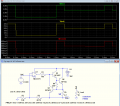
Below is the LTspice simulation of a simple circuit that should do what you want:
It uses a low cost, high voltage (44V), single-supply op amp to drive an NPN Darlington follower output.
The gain is 7.5 so a 4V input gives a 30V output.
The gain can be changed to match your DAC output by selecting a different R2 and/or R3 (gain= 1 + R2/R3).
The maximum power dissipated in Q2 occurs at a Vout equal to 1/2 the supply voltage (16V), where it dissipates 5.12W (with the 50Ω load), so Q2 will need to be on a good sized heat-sink using thermal paste (thermal resistance to air of ≤10°C/W).
Q3 provides an output current limit to protect against accidental shorts to ground.
The limit is about 0.65V / R5 so R5=0.7Ω gives about a 0.9A limit.
(Note that the short circuit dissipation of Q2 is about 30W so a long term short will zap the transistor unless it's on a heat-sink that can dissipate that power.)
It would most likely also work with a logic-level FET, in which case we are almost back to where the TS started.
I think that the source follower would be more likely to be stable than the TS's common-source P-channel circuit.
It's also because the Gate-source capacitance is bootstrapped on the source-follower circuit, but appears as a capacitive load on the op-amp in the common-source circuit, putting a pole inside the feedback loop at a much lower frequency.
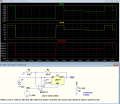
Although my first simulation with an LM317 operating open-loop did not give the desired response, just for grins I decided to try it again in a closed-loop configuration with the op amp.
To my surprise, the simulation looks essentially the same as the circuit in post #23, so here it is below:
The LM317 is nearly bullet-proof with internal current limiting and thermal shutdown, so it needs no further protection, but it will dissipate up to 5W so must be on a heat-sink.
The short-circuit dissipation is not a concern since, if the device gets too warm from the added dissipation, the thermal shutdown will keep if from failing.
Since the LM317 is inside the feedback loop, any variation in its internal 1.25V reference (unit-to-unit or from temperature) will have little effect on the output voltage.
Note that the LM317 does need a minimum 10mA load to maintain regulation.
The caveat is that it is just a simulation, so there's a possibility a real device may not behave as good, depending upon how well the LM317 model emulates the real device.
It would need to be built to know for sure.
The circuit in my post #23 with a discrete parts output is probably more likely to operate closer to the simulated results with real devices, but the simplicity and robustness of this circuit is compelling.

 Facebook
 Google
 GitHub
 Linkedin