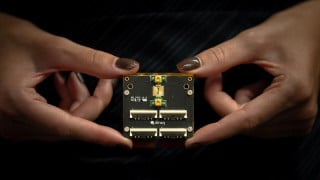
How to use a LED with this device/circuit

Thread Starter

pbd

Joined Aug 5, 2019
4
Beforehand thank you for any help with this. Please break down Barnie style as I am pretty novice in electronics.

I am trying to connect an LED or some other output to this device below just to light up when it receives a signal. I have the output 1 (purple wire) and the ground located. But not sure where to attach it properly as per this circuit. Don't want to start connecting incorrectly. Do I need and external power source? Should I use the NPN or PNP setup and how?
Thanks!
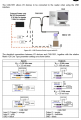
upload_2019-8-5_15-57-38.png
 

dl324

Joined Mar 30, 2015
18,326
Welcome to AAC!

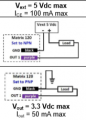
If you set the output to PNP, you don't need an external power source. What color LED were you planning to use? The PNP output only provides 3.3V.

If you use an external supply, it claims you can only use a 5V supply, so the NPN transistor must have a low breakdown voltage.
 

Thread Starter

pbd

Joined Aug 5, 2019
4
Thanks for your quick reply!

I was hoping to use a red LED or maybe a couple red ones. I am assuming the color will dictate the output needed?

Does the physical connection differ between PNP and NPN? or is that just a setting I would change?
 

dl324

Joined Mar 30, 2015
18,326
I was hoping to use a red LED or maybe a couple red ones. I am assuming the color will dictate the output needed?
Using NPN output with a 5V supply would support up to 2 (maybe 3) red LEDs in series. With PNP output, you might be able to get 2.
Does the physical connection differ between PNP and NPN? or is that just a setting I would change?
The connections are different and as shown in the diagram you posted:
upload_2019-8-6_6-52-46.png
With NPN output, the device switches ground for your load. With PNP, it switches power.
 

dl324

Joined Mar 30, 2015
18,326
Would you recommend using a resistor with this circuit?
Resistors are always used in conservative designs. Once you know the forward voltage of your LEDs and your desired operating current, you can calculate resistor values using Ohm's Law.
 
Top