Facebook
 Google
 GitHub
 Linkedin
Hello everyone and thank you for all of the great ideas and suggestions you have provided me and many thanks to “sghioto” for the great circuit designs. How ever I have apparently upset some of you and ruffled your feathers and I am deeply sorry ;<(.
So for all of you who need to know all of the details, here goes.i
I am into 3D printing and have a couple of Bambu printers and one of them is the A1 printer with a AMS lite which is a multicolor automatic filament system. This system will automatically switch color of filament in that part of the print. Each color change requires the filament that is being used is pulled back and then the next color is feed into the extruder. This is how a AMS system works. As part of the changing from one roll to another the system requires the filament to be pulled back from the extruder and in doing so the AMS lite does not have a rewind feature instead it uses the stored mechanical energy and when the filament needs to be pulled back a spring int the spool will make the filament rewind as the feeder motor pull back the filament about 70mm. It’s a nice system when it works properly but they are prone to stick and not keep the slack out allowing the filament to get tangled and stop the print. Also the AMS lite does not have a dry box to house the rolls of filament. The filament is very prone to moisture and needs a dry box, that is what I am making and want to get away from the mechanical retract. Hence the circuit I’m needing and with this circuit I’ve made it using relays and work quite well, but bulky and too big.
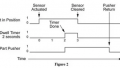
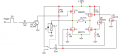
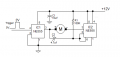
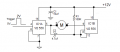
This is how I want it to work, when it time to change roll colors the AMS pull the filament back with the feed motor and this feeb motor runs on 2 to 2.2 volts to pull it back and this action takes about 3 to 5 seconds and this is the 2volt trigger for my circuit. When the two volt is present it will turn my retract motor it also activates a simple timer . When the 2volt goes away the timer shoots a 12 volt pulse for about 1/2 second.
The reason for this very short reverse is to disengage the drive gear from the motor to the spool roller. This gear disengagement is a drive gear mounted to a swinging arm that drives a satellite gear and the drive gear has a little drag making the satellite gear rotate to engage the spindle gear. Once this gear is in the drive position when everything is stopped the gear stays engaged locking the spindle which will not allow the spindle to turn the other way and that is why I need the very short reverse, to pull the gear back out of the way.
I hope this gives you the information you needed and again so sorry I did not say all of this In the beginning and did not intend to make this a game.
Thank you, Ron
So for all of you who need to know all of the details, here goes.i
I am into 3D printing and have a couple of Bambu printers and one of them is the A1 printer with a AMS lite which is a multicolor automatic filament system. This system will automatically switch color of filament in that part of the print. Each color change requires the filament that is being used is pulled back and then the next color is feed into the extruder. This is how a AMS system works. As part of the changing from one roll to another the system requires the filament to be pulled back from the extruder and in doing so the AMS lite does not have a rewind feature instead it uses the stored mechanical energy and when the filament needs to be pulled back a spring int the spool will make the filament rewind as the feeder motor pull back the filament about 70mm. It’s a nice system when it works properly but they are prone to stick and not keep the slack out allowing the filament to get tangled and stop the print. Also the AMS lite does not have a dry box to house the rolls of filament. The filament is very prone to moisture and needs a dry box, that is what I am making and want to get away from the mechanical retract. Hence the circuit I’m needing and with this circuit I’ve made it using relays and work quite well, but bulky and too big.
This is how I want it to work, when it time to change roll colors the AMS pull the filament back with the feed motor and this feeb motor runs on 2 to 2.2 volts to pull it back and this action takes about 3 to 5 seconds and this is the 2volt trigger for my circuit. When the two volt is present it will turn my retract motor it also activates a simple timer . When the 2volt goes away the timer shoots a 12 volt pulse for about 1/2 second.
The reason for this very short reverse is to disengage the drive gear from the motor to the spool roller. This gear disengagement is a drive gear mounted to a swinging arm that drives a satellite gear and the drive gear has a little drag making the satellite gear rotate to engage the spindle gear. Once this gear is in the drive position when everything is stopped the gear stays engaged locking the spindle which will not allow the spindle to turn the other way and that is why I need the very short reverse, to pull the gear back out of the way.
I hope this gives you the information you needed and again so sorry I did not say all of this In the beginning and did not intend to make this a game.
Thank you, Ron

 Version 3: