How to read current scale on analog meter

Kermit2

Joined Feb 5, 2010
4,162
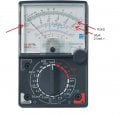
the set of numbers and scale marks(in black) which are close to, and right below the uppermost ohms scale will apply to all dc amp readings. your meter selection switch indicates which of the three sets of numbers to use. in your case the scale ending in 25 will be used for all settings except the 50 microamp position.
the red scale line would be read from if measuring AC. notice that your selector switch has all AC settings printed in red? also notice that the printed words on the scale at either extreme which point to triple stacked number region between the downward pointing black scale and upward pointing red scale.
 

ErnieM

Joined Apr 24, 2011
8,415
Good question, there is a lot going on in that scale.

On the left side it shows what scales go with what readings. The very top is for resistance, below is DC volts (DCV) and amps (A), and the AC Volts (ACV).

The meaning of the tick marks is defined on the right side. The ticks go 0 to 100% (marked 0 thru 10), so for the 50 uA scale you read the ticks from the 50 scale, and for the 2.5 mA, 25mA and 2.5A you use the 250 scale and mentally place the decimal point where needed.

The mirror is to remove parallax which happens when you look at the needle at an angle. Move your eye till the pointer covers it's reflection and you have no parallax, so take the reading you see that way. I close one eye for this.


Attachments

crutschow

Joined Mar 14, 2008
38,407
The 10V AC range has its own (red) scale to compensate for the error form the diode drop of the internal rectifier. The error is so small for the higher ranges that the same scale can be used for AC or DC.
 

ian field

Joined Oct 27, 2012
6,536
The 10V AC range has its own (red) scale to compensate for the error form the diode drop of the internal rectifier. The error is so small for the higher ranges that the same scale can be used for AC or DC.
Analogue meters are best for fast moving values when the prevailing amplitude trend is more important than the absolute value when the pointer slows down long enough to see where its at.

A DMM wins when a precise value needs to be read - unless its a rapidly changing value that makes the numbers spin like the wheels in a fruit machine.
 

Thread Starter

Circuits123

Joined Dec 7, 2012
105
so for the 50 uA scale you read the ticks from the 50 scale, and for the 2.5 mA, 25mA and 2.5A you use the 250 scale and mentally place the decimal point where needed.
Thanks. That helps. But I'm still a little confused about the range settings. They go: 50uA, 2.5mA, 25mA, 0.25A

Am I correct that in decimals that would be .000005A, .0025A, .025A, and .25A ?

So say like the needle is pointing to the 250.... Sorry, I don't get the last part "mentally place the decimal...."
 

ian field

Joined Oct 27, 2012
6,536
Thanks. That helps. But I'm still a little confused about the range settings. They go: 50uA, 2.5mA, 25mA, 0.25A

Am I correct that in decimals that would be .000005A, .0025A, .025A, and .25A ?

So say like the needle is pointing to the 250.... Sorry, I don't get the last part "mentally place the decimal...."
A mA is 1/1000 of an A, so the decimal point moves over 3 places - from mA to uA it moves the same amount again.

There are multiplier charts that can be found online for capacitor values, they can be a handy guide for mA & uA too.
 

bertus

Joined Apr 5, 2008
22,909
Hello,

The "mirror" between the scales is there to avoid reading errors.
Take a view at the following video to learn more about it:


Bertus
 

ErnieM

Joined Apr 24, 2011
8,415
Thanks. That helps. But I'm still a little confused about the range settings. They go: 50uA, 2.5mA, 25mA, 0.25A

Am I correct that in decimals that would be .000005A, .0025A, .025A, and .25A ?

So say like the needle is pointing to the 250.... Sorry, I don't get the last part "mentally place the decimal...."
Correct... except the last is 2.5A not .25. I suspect a typo.

Say you were measuring a current of 1A. On the 2.5A scale the needle would point to the tick labeled "10". Now you know the max on that scale is 2.5 not 250, so you mentally shift the decimal point so 10 becomes 1.0.

Also, the better (less destructive on your meter) is to set to the highest (2.5A) scale before connecting. Then you can move the switch to the lower (more sensitive) ranges till the pointer is not off to one side.

(Sorry for the late reply: I lost your post!)
 

studiot

Joined Nov 9, 2007
4,998
That's a good reply from ernieM (and some others), just a couple of extra points.

All the scales, except the resistance read from left to right.

The resistance scales read the other way (right to left).

You should try to choose a range that places the pointer in the upper half of the scale.

But always start with a high range and work down, analog meters can be easy to damage.
So to measure on the 50 micro amp range, start with the meter set to the 0.25 amp range before connection
Connect to the circuit (or switch it on)
then switch the meter down through the ranges until the pointer is reading in the upper half.

Always return the meter to the off position or the volts postition after use.
This will prevent the meter being inadvertently misconnected and burning out on next use.

The socket labelled output has a capacitor in series with the AC meter to measure dB on the dB range, it does not say but these are usually 0dB= 1V RMS into 600 ohms.
 
Top