Since this is Homework Help and not Homework Done For You, you need to show YOUR best attempt to work YOUR homework. That will give US a starting point from which to HELP you find where you are struggling and how to move forward from there.
You might start with the definitions relating total energy to power and the relationship between power and voltage and current.
Since this is Homework Help and not Homework Done For You, you need to show YOUR best attempt to work YOUR homework. That will give US a starting point from which to HELP you find where you are struggling and how to move forward from there.
You might start with the definitions relating total energy to power and the relationship between power and voltage and current.
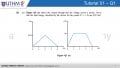
Ok I already find the area under the curve and get this Pt=Vt*It. Then it will get VIt^2 so I divide it by 4 since time is 4. Next is I get E=Pt but I don’t get the answer
Ok I already find the area under the curve and get this Pt=Vt*It. Then it will get VIt^2 so I divide it by 4 since time is 4. Next is I get E=Pt but I don’t get the answer
What part of "SHOW your best attempt" was unclear?
You obviously did something wrong. But that's as far as we can possibly narrow it down until you SHOW your work. How can we possibly tell where you made your mistake unless you SHOW the work where the mistake was made?
This is pretty much what I thought you might be doing.
You don't multiply the area under one curve by the area under the other. You find the area under the product of the two curves.
To see that the approach you are using will not work, image a current curve that is non-zero from t = 0 seconds to t = 2 seconds (and zero everywhere else) and has an area of 500 A·s. Now imagine a voltage curve that is non-zero from t = 3 seconds to t = 4 seconds (and zero everywhere else) and has an area of 300 V·s. If you just multiply the two areas together you get 150,000 A·V·s², which has units of J·s and not joules. So there MUST be something wrong. Furthermore, since the current is zero when the voltage is not and the voltage is zero when the current is not, the instantaneous power is everywhere zero and so the total energy is zero.
So plot the instantaneous power as a function of time and then integrate that to get total energy.
You have units on your two areas, but then you stop tracking them and just tack on the units onto the final answer that you would like to have instead of the units that your work demands that it have.
Always, always, ALWAYS track your units through the work -- they will give you a very good idea of whether you have a chance of being right. Specifically, as soon as the units don't work out -- STOP! You've done something wrong and any further work from that point on will be wasted effort. The units are trying desperately to tell you something. LISTEN! Don't just put your fingers in your years and have your hands to make the units magically transform into what you would like them to be.
To get the ENERGY you need to integrate the POWER. The power is given by
p(t) = v(t)·i(t)
Figure out expressions for v(t) and i(t) -- they will be piecewise linear -- and then multiply them together to get a piecewise linear equation for p(t). Then integrate it.

 Facebook
 Google
 GitHub
 Linkedin