Most cars have an Accessories position on the ignition switch that will power the radio and cigarette lighter, but not the motor. Have you tried that?
Otherwise, you can add another cig lighter socket that is powered all the time.
The way you do this will depend upon the car, usually there is a powered fuse position available, else a cable run from the battery, via an appropriate fuse can be added. If you don't know how to do it, i reckon you need to get a qualified auto electrician to install one for you in the interests of not breaking (or burning) something.
You can buy an automotive DC to AC inverter that plugs into your cigarette lighter for $12-$20 US. Plug your laptop power supply into it to use with your laptop..
Oh, I misunderstood, sorry.
You probably need something like this... http://www.ebay.com.au/itm/New-96W-...681403?hash=item3f72a9f83b:g:5vQAAOSw44BYacnq
I don't vouch for the quality of this one but it is a start to look for!
Make sure the volts is set to the laptop requirement and the power rating is enough. That info will be on your laptop power supply.
Dendad has the right approach. Either switch the ACC on (accessory) or permanently wire in a live socket. Be sure to use a fuse rated to protect the laptop and to protect the wiring gauge. You don't want a 15 amp fuse on an 18 gauge wire.
So run wires from your passenger rear brake light to the laptop. Strip the ends only 1/16th of an inch then tape together with an offset of 1/4" with the positive being longest. Curl back the negative over itself and the tape. Now you have a 11.2-12 volt (low voltage/amp) connection you can moderate with your brake pedal.... lol If that doesn't work then watch the Red Green show for help
So run wires from your passenger rear brake light to the laptop. Strip the ends only 1/16th of an inch then tape together with an offset of 1/4" with the positive being longest. Curl back the negative over itself and the tape. Now you have a 11.2-12 volt (low voltage/amp) connection you can moderate with your brake pedal.... lol If that doesn't work then watch the Red Green show for help
Exactly how long do you plan on staying in your car?
Figure out how many amps you need to start your car. Note the number of amp hours your battery can supply (assuming it is new) Figure out how many amps your laptop consumes. You have your answer.
I have never understood why cars don't have a small "house" battery for accessories. Many boats have one or more and it works great. You can run down the house battery and still be able to start your engine.
You can buy an automotive DC to AC inverter that plugs into your cigarette lighter for $12-$20 US. Plug your laptop power supply into it to use with your laptop..
No buy a laptop that can be powered by 12V. A cheap inverter will likely consume more power than the laptop would alone. A tablet can be powered by a 5V usb adapter.
Back in the 70's I had a Ford Country Squire LTD Station Wagon. A friend of mine had virtually the same car but with a rusted and cracked frame. He GAVE me the car. I scrapped out several things his wagon had that mine didn't. Also, being such an enormous vehicle I had room under the hood for a second battery. The engine starter was controlled by a solenoid mounted on the inner fender. So I took the battery, battery box and that extra solenoid and mounted them into my car. Ran a heavy gauge wire from positive to positive through the solenoid. So only when I activated the solenoid did I have a second battery for starting the car. Across the solenoid I put a 30 amp diode so that the second battery would always be charged. Only when I activated the solenoid did the second battery come into play. That way - the theory was - I could use the accessories in the car without fear of not being able to start the car. I also upgraded to the heavier duty alternator because of the second battery AND the rear window defroster his car had that mine didn't have before swapping out the back glass.
I found this setup to be handy when I lived in Texas. Many foggy morning drives to work meant running the headlights. And as we all have probably done, I forgot to turn off my headlights on occasion. The second battery meant I didn't have to get a jump start. That must have been hard on my alternator, recharging the dead battery, but if you've got the room for any kind of second battery you can keep it charged through a diode.
OR if you need, you can put a second battery in your car and hook it up so that when the car is running a relay keeps the second battery charged, but when the car is off, any drain on battery #2 will not drain the main battery. Then and only then are you limited in time to running your laptop by the capacity of the battery you install. Could be a gel-cell battery kept in the trunk. Should be of sufficient size to run your laptop for the duration you intend.
A second battery is a great idea. Just remember, that over discharging a lead/acid or GelCell kills them pretty quickly. Keep an eye on the battery volts or have an auto cutout to prevent discharging fully.
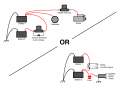
Note that in the upper half of my drawing Battery 2 is being charged through a diode; which means it's dropping about 7/10 of a volt. So a car battery, under normal operating conditions, charges to 14.4 volts initially and drops back to a float voltage of about 13.6 volts. Battery 2 is going to be nearly a volt below that. So at best it's going to see 13.7 volts (depending on the diode specs) after the engine is started, and when the alternator drops down to 13.6 volts, B2 will be around 12.9 volts. It will certainly keep B2 charged, but there are chances the battery plates of B2 could develop sulfate clogging.
In the lower drawing, when the relay is on B2 is connected to B1. However, in the case B1 should be discharged, B2 will try to push starting amperage through a small wire and relay, and likely burn out the relay or the wire - or both. Mine is not a perfect system. If you go with a smaller second battery and keep it charged through a relay you might want to put a buck converter on it in order to keep it properly charged. And possibly consider a diode between the two batteries so that if B1 is discharged B2 won't try to start the car.
OR maybe use a MOSFET to conduct power in one direction only. Depending on which you use you won't see such a drop in B2 voltage when the engine is running. I'm no engineer on this kind of stuff. I usually build and learn. Learn when smoke leaks out. Maybe I'm a "Smoke Engineer".
A low-cost DC/AC inverter driving a low-cost AC/DC power supply is very inefficient. About 50% of the battery power for this setup will go up as heat, significantly reducing your operating time.
As an alternative, a DC/DC boost converter module from ebay should get the system efficiency above 80%.
Lighter plug with built-in fuse
cable to boost converter
Boost converter set to 19.5 V
cable with a plug that matches the laptop power input jack.
I wouldn't want to drain the battery below 12 volts. Don't know if others have a different opinion (or knowledge). If so, consider their take as well.
Here's what I know for sure: A good 12 volt battery fully charged and resting (not being used in at least 24 hours) should be 12.6 volts. That's a fully charged battery at top capacity. When charging (engine running) it should see up to 14.4 volts initially, then drop back down to 13.6 volts but not below that. If it's going below that while the engine is running then your alternator (or something else) is not functioning properly, be it a bad alternator or a slipping belt. With all electrics on the car running, voltage should not drop below 13.6 volts.
When the engine is not running, the battery should not be allowed to go below 12.0 volts (my opinion). I've seen batteries as low as 10.8 volts still start the car - but that can be an iffy moment. I still like the 12 volt limit, but again, this is just my opinion - not "knowledge".
I would assume that running your laptop from a cigarette lighter (or accessory port) would drain the battery below that point somewhat quickly - depending on how much current the laptop is drawing. If you DO go with a second battery I think I'd go with a deep cycle marine battery simply because they're designed to handle the deep discharge. Of course I have no experience with marine batteries so I can't even begin to guess how low a voltage you're safe to go down to. Research is going to need to be done on your part.

 Facebook
 Google
 GitHub
 Linkedin