Facebook
 Google
 GitHub
 Linkedin

I'm currently trying to get the output and state equation for a Elevator FSM. This is the bubble diagram corresponding FSM
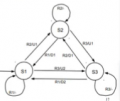
1. States
| State | Code (2 bits) | Meaning |
| :---- | :-----------: | :------------- |
| S1 | 00 | Floor 1 (low) |
| S2 | 01 | Floor 2 (mid) |
| S3 | 10 | Floor 3 (high) |
Note: Here I used "binary encoding" taking account that there are only three states.
2. Inputs (floor requests)
| Signal | Code (2 bits) | Meaning |
| :----- | :-----------: | :-------------------- |
| R1 | 01 | Request for 1st floor |
| R2 | 10 | Request for 2nd floor |
| R3 | 11 | Request for 3rd floor |
3. Outputs (elevator actions)
| Signal | Code (3 bits) | Meaning |
| :----- | :-----------: | :--------------- |
| U1 | 100 | Go up 1 floor |
| U2 | 101 | Go up 2 floors |
| D1 | 001 | Go down 1 floor |
| D2 | 010 | Go down 2 floors |
| NoGo | 111 | Stay in place |
4. State-Transition Descriptions
This is a Mealy machine, so outputs depend on the current state and the input:
1. From S1 (00) – Floor 1
R1 (01) → stays in **S1 (00); Output = NoGo (111)
Already on floor 1 and floor 1 is requested; no movement.”
R2 (10) → goes to S2 (01); Output = U1 (100)
On floor 1 and floor 2 is requested; go up 1 floor.”
R3 (11) → goes to S3 (10); Output = U2 (101)
On floor 1 and floor 3 is requested; go up 2 floors.
2. From S2 (01) – Floor 2
R1 (01) → goes to S1 (00); Output = D1 (001)
“On floor 2 and floor 1 is requested; go down 1 floor.”
R2 (10) → stays in S2 (01); Output = NoGo (111)
“On floor 2 and floor 2 is requested; no movement.”
R3 (11) → goes to S3 (10); Output = U1 (100)
“On floor 2 and floor 3 is requested; go up 1 floor.”
3. From S3 (10) – Floor 3
R1 (01) → goes to S1 (00); Output = D2 (010)
“On floor 3 and floor 1 is requested; go down 2 floors.”
R2 (10) → goes to **S2 (01)**; **Output = D1 (001)
“On floor 3 and floor 2 is requested; go down 1 floor.”
R3 (11) → stays in S3 (10); Output = NoGo (111)
“On floor 3 and floor 3 is requested; no movement.”
This is the state table that I've made:
| Present State (Q₁ Q₀) | Input | Next State (Q₁′ Q₀′) | Output |
| :-------------------: | :-----------: | :------------------: | :---------------: |
| **S₁** (00) | **R₁** (01) | **S₁** (00) | NO\_GO (111) |
| **S₁** (00) | **R₂** (10) | **S₂** (01) | U₁ (011) |
| **S₁** (00) | **R₃** (11) | **S₃** (10) | U₂ (100) |
| **S₂** (01) | **R₁** (01) | **S₁** (00) | D₁ (001) |
| **S₂** (01) | **R₂** (10) | **S₂** (01) | NO\_GO (111) |
| **S₂** (01) | **R₃** (11) | **S₃** (10) | U₁ (011) |
| **S₃** (10) | **R₁** (01) | **S₁** (00) | U₁ (011) |
| **S₃** (10) | **R₂** (10) | **S₂** (01) | D₂ (010) |
| **S₃** (10) | **R₃** (11) | **S₃** (10) | NO\_GO (111) |
But my main doubt is how I get the output equation from the table?
One thing that came to mind is go down the table and look for each entry where NOGO is the output, and make a sum of product boolean expression out of the inputs and state. For example:
For NOGO:
| State (Q1Q0) | Input | Next State (Q1⁺Q0⁺) | Output (3 bits) | Transition |
| :----------: | :----------: | :-----------------: | :-------------: | :-------------------------------------: |
| 00 (**S1**) | 01 (**R1**) | 01 (**S2**) | 011 (**U1**) | Moves up from S1 to S2 (↑ one floor) |
| 00 (**S1**) | 10 (**R2**) | 00 (**S1**) | 111 (**NoGo**) | Stay in S1
NOGO = Q0' Q1' R2 R2 +...(other NOGO for other states)
That approach is fine?
Also I dont know how to get the next state equations.
1. States
| State | Code (2 bits) | Meaning |
| :---- | :-----------: | :------------- |
| S1 | 00 | Floor 1 (low) |
| S2 | 01 | Floor 2 (mid) |
| S3 | 10 | Floor 3 (high) |
Note: Here I used "binary encoding" taking account that there are only three states.
2. Inputs (floor requests)
| Signal | Code (2 bits) | Meaning |
| :----- | :-----------: | :-------------------- |
| R1 | 01 | Request for 1st floor |
| R2 | 10 | Request for 2nd floor |
| R3 | 11 | Request for 3rd floor |
3. Outputs (elevator actions)
| Signal | Code (3 bits) | Meaning |
| :----- | :-----------: | :--------------- |
| U1 | 100 | Go up 1 floor |
| U2 | 101 | Go up 2 floors |
| D1 | 001 | Go down 1 floor |
| D2 | 010 | Go down 2 floors |
| NoGo | 111 | Stay in place |
4. State-Transition Descriptions
This is a Mealy machine, so outputs depend on the current state and the input:
1. From S1 (00) – Floor 1
R1 (01) → stays in **S1 (00); Output = NoGo (111)
Already on floor 1 and floor 1 is requested; no movement.”
R2 (10) → goes to S2 (01); Output = U1 (100)
On floor 1 and floor 2 is requested; go up 1 floor.”
R3 (11) → goes to S3 (10); Output = U2 (101)
On floor 1 and floor 3 is requested; go up 2 floors.
2. From S2 (01) – Floor 2
R1 (01) → goes to S1 (00); Output = D1 (001)
“On floor 2 and floor 1 is requested; go down 1 floor.”
R2 (10) → stays in S2 (01); Output = NoGo (111)
“On floor 2 and floor 2 is requested; no movement.”
R3 (11) → goes to S3 (10); Output = U1 (100)
“On floor 2 and floor 3 is requested; go up 1 floor.”
3. From S3 (10) – Floor 3
R1 (01) → goes to S1 (00); Output = D2 (010)
“On floor 3 and floor 1 is requested; go down 2 floors.”
R2 (10) → goes to **S2 (01)**; **Output = D1 (001)
“On floor 3 and floor 2 is requested; go down 1 floor.”
R3 (11) → stays in S3 (10); Output = NoGo (111)
“On floor 3 and floor 3 is requested; no movement.”
This is the state table that I've made:
| Present State (Q₁ Q₀) | Input | Next State (Q₁′ Q₀′) | Output |
| :-------------------: | :-----------: | :------------------: | :---------------: |
| **S₁** (00) | **R₁** (01) | **S₁** (00) | NO\_GO (111) |
| **S₁** (00) | **R₂** (10) | **S₂** (01) | U₁ (011) |
| **S₁** (00) | **R₃** (11) | **S₃** (10) | U₂ (100) |
| **S₂** (01) | **R₁** (01) | **S₁** (00) | D₁ (001) |
| **S₂** (01) | **R₂** (10) | **S₂** (01) | NO\_GO (111) |
| **S₂** (01) | **R₃** (11) | **S₃** (10) | U₁ (011) |
| **S₃** (10) | **R₁** (01) | **S₁** (00) | U₁ (011) |
| **S₃** (10) | **R₂** (10) | **S₂** (01) | D₂ (010) |
| **S₃** (10) | **R₃** (11) | **S₃** (10) | NO\_GO (111) |
But my main doubt is how I get the output equation from the table?
One thing that came to mind is go down the table and look for each entry where NOGO is the output, and make a sum of product boolean expression out of the inputs and state. For example:
For NOGO:
| State (Q1Q0) | Input | Next State (Q1⁺Q0⁺) | Output (3 bits) | Transition |
| :----------: | :----------: | :-----------------: | :-------------: | :-------------------------------------: |
| 00 (**S1**) | 01 (**R1**) | 01 (**S2**) | 011 (**U1**) | Moves up from S1 to S2 (↑ one floor) |
| 00 (**S1**) | 10 (**R2**) | 00 (**S1**) | 111 (**NoGo**) | Stay in S1
NOGO = Q0' Q1' R2 R2 +...(other NOGO for other states)
That approach is fine?
Also I dont know how to get the next state equations.
Last edited: