So I believe trying to drive a relay without a ground connection is problematic.
I see no reason not to use a MOSFET instead.
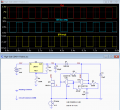
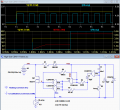
Below is the simulation of the circuit with a low-power CMOS multivibrator, which significantly reduces the required size of the bootstrap capacitor, C3.
(Note that for proper simulation I had to use an alternate COM icon for the circuit (24V) common because CD4011 uses the triangle ground icon for its common.)
The common BUZ11 MOSFET shown dissipates only about 1/4W in operation, so will get just slightly warm in operation.
Be sure and connect all unused CD4011 inputs to the floating common (triangle) node.
So I believe trying to drive a relay without a ground connection is problematic.
I see no reason not to use a MOSFET instead.
Below is the simulation of the circuit with a low-power CMOS multivibrator, which significantly reduces the required size of the bootstrap capacitor, C3.
(Note that for proper simulation I had to use an alternate COM icon for the circuit (24V) common because CD4011 uses the triangle ground icon for its common.)
The common BUZ11 MOSFET shown dissipates only about 1/4W in operation, so will get just slightly warm in operation.
Be sure and connect all unused CD4011 inputs to the floating common (triangle) node.
As intended.
Those are for the 12V steady supply voltage referenced to battery ground as generated by the LM317.
The bootstrapped 12V referenced to the floating common is Vdd at the diode cathode.
Notice how Vdd referenced to the battery ground (blue trace) rises to near 36V when the lamp is on.
As intended.
Those are for the 12V steady supply voltage referenced to battery ground as generated by the LM317.
The bootstrapped 12V referenced to the floating common is Vdd at the diode cathode.
Notice how Vdd referenced to the battery ground (blue trace) rises to near 36V when the lamp is on.
The whole point of the thread was that the TS wanted a two terminal circuit because the battery negative connection was not conveniently available. A circuit that utilized the battery ground connection is simple to produce. The original seemed to be intending to replace the old style thermal current driven two terminal flasher, which was a really good design in that it also gave a warning mode when a turn signal bulb failed.
Clearly the whole application should have been explained in the first posting, but it was not.
And since the 4011 is a quad nor gate all 3 sections in parallel can be used to drive the FET, since the gate is a capacitive load, and since the unused inputs need to be tied someplace no matter what. And this circuit is elegant in it's simplicity.
The "OLD" style blinkers consisted of a can containing a bi-metalic strip (BMS). When powered, current would flow through the strip, through the bulb and to ground. The current would heat a heater element wrapped around the BMS which in turn would deflect the BMS and interrupt the circuit. Thus, the lights would blink.
Years ago I built a CMOS circuit for my car. It was designed to be connected to ignition for power, battery for "Power Sustain" and the brake pedal switch. The circuit could not be turned on unless the car was running. Once running, you could push a button and turn the circuit on. When on it would maintain electrical power to the ignition regardless of the ignition key position. You could then turn the key off, pull it out of the ignition switch, lock the steering wheel and shifter, get out and lock the door. The car would still be running - but locked up. IF someone broke into the car, first, they couldn't shift out of park. Second, they couldn't steer the car. Third - and this was the interesting part and why it was connected to the brake light switch, if you stepped on the brake pedal you'd cancel the circuit and shut the car down. The ONLY way to run the system was to put the key into the ignition and turn it to the on position. Then, as soon as you stepped on the brake pedal the circuit would cancel but with the key on you could drive the car. The problem I had with my burgeoning digital design experience was that CMOS didn't like living in the electronics world of automotive noise. So I rebuilt the circuit using diodes and relays. I wish I still had that schematic, it was pretty sharp. On cold mornings I could start the car and lock it up knowing that nobody could do anything with the car.
The reason why I bring this up is because I think, and could be wrong, the relay would be more dependable in an automotive application than a home built circuit. However, it looks to me like the TS (Thread Starter) is starting off with 24 volts and regulating the control of the lights at 12 volts. Which leads me to ask "Why not just use a 24 volt blinker?" "Is the 'One Second' duty cycle an absolute need?" "Or is it just a thought that happened to be 'One Second'?"
A 24 volt system makes me think this is going on a tractor trailer type vehicle which runs on 24 volts. I'd be interested to hear what the TS is actually working on.
I frequently make the request for more details when a question is asked about how to achieve some specific result. It is the best way to get a focus on a solution instead of a string of guesses.
The 1 second flash rate is quite a bit faster than a normal turn signal, so I do wonder about the application. It may be for a "big truck", as some of them use 24 volt systems, or possibly for a surplus military vehicle. Years ago I did pick up a surplus electronic flasher for 24 volt application, but it was quite a bit larger, about 3 by 5 inches and almost 2 inches high, with a 3 wire MS style connector, fully encapsulated inside a serious aluminum heat sink. It did not work well on 12 volts, though.
Yes, that should work.
The LM317 was overkill anyway, because of the very low current-draw of the circuit.
Below is the simulation:
I added the two unused gates for a gate buffer driver as suggested by MB2.
Now, more than before, I am wondering about the intended application of this circuit. The three-stage flasher from a few posts back was probably for a showy car, I have been considering something similar for turn signal lights on a travel trailer, since I got some unique LED lights a while back. But since I already own a couple of the OEM motorized sequencers that seems like the easy way to do it. All that ai need to do is devise a mounting arrangement that is easy, durable, waterproof, and looks good, and is also cheap. Right!
I see these forums move rather quickly. Is your problem already solved? If not, it should be easily solvable, but it would help to have a slightly better idea of the overall context. Since you indicate a common ground and the drive circuit's logic components in series with the ground in a low voltage situation, one might think you had an automotive application in mind, but seeing as how you indicate 24 VDC supply that would seem to rule that out. I am guessing that the reason you "can't employ a ground" connection must have something to do with lack of available conductors in a remote control situation. My assumption is that formerly you had perhaps a simple 24 V power source and lamp at one end and just a two wire pair running back to a switch and now you want, say, a pulsing control circuit instead of a simple switch, so that the lamp flashes rather than simply being manually turned on or off.
Your main problem is that the control device needs continuous power throughout the duty cycle, so you can't just close the control loop with the relay contacts or else obviously you also lose all voltage drop that would actually power the control logic (including of course the relay coil itself). Several solutions do come to mind. If the lamp load is of quite low current (say 100 mA or less) and slight diming is not an issue then the circuit can be reworked with a pass transistor instead of a relay and maintain say a 5V drop to power the control components continuously. Neglecting lamp filament resistance change versus applied voltage, your dimming effect would be about (19/24)^2 or down to about 63 % of previous brightness. The pass transistor would also experience significant heat dissipation during the ON cycle. I can provide you with a complete circuit for this if it would fit your application.
The suggestion about automotive flashers is "semi" correct: those flashers are voltage supply sensitive and would not likely work well at 24 Volts. However, their operating principle is simple and can be readily adapted for 24 V. Basically a 24 VDC coil relay with low coil current is driven by a feedback circuit off one of its own contacts, that charges a capacitor. The capacitor charges up, voltage on the coil rises until the relay hauls, and the contacts switch. In that activated state the coil and cap are no longer receiving power from the external loop, but the cap holds the relay closed for a few seconds. Most relays are designed to close at about 2/3 rated coil voltage and drop out at a substantially lower level (often as low as 1/3 voltage), so with a suitably sized cap pulsing as slow as about 2 seconds on and 2 seconds off can be achieved. The exact circuit requires a diode and usually a resistor or two to optimize its performance, and selection of the most appropriate relay does depend on the actual load current requirements. Again, with some external application specifications (lamp type mainly, and desired pulse rate) I can provide you with a circuit. We built something along those lines for testing bells in fire alarm systems (instead of driving building occupants nuts with continuous ringing, our simple little pulser causes them to emit very brief little "dings" continuously).
If you no longer need any assistance then bye and best of luck, but in case you do, I'll check this thread again in a day or two. It just came to my attention in AAC's email newsletter today and I thought "this one oughta be easy enough to solve". Cheers ds
Hello
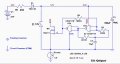
I want to drive the relay in the following circuit.
Here the ground is not directly connected to the circuit.
It is connected to the ground through the lamp and the lamp is connected to the relay output.
But the circuit has a problem.And the irregular relay is disconnected and connected.View attachment 190515
How should I drive this relay?
Are circuits that are not directly connected to the earth have a special name?
I'm surprised to find a 2-terminal flasher for 24 V. I have some experience with truck wiring systems, but limited and didn't realize there were some 24 V ones. Makes sense: if you have to send a lot of power to some serious lighting and accessories you save a lot of copper going to 24 Volts. In my own background (broadcast transmitter plants) we used 24 V control a lot, but I wasn't aware of it in automotive. Good to know. (And thanks for the links which I will add to my products library). Might save me a bit of work some day. Cheers ds
I don't know my f250 power stroke starts on the first click. I'm sure post 31 would blink on the first blink LOL If you think about it
The bulb is not that much above ground and a cap could hold enough power between blinks but cruschow done showed that in post 31
What I don't get if this is going in say truck relay box why is it needing a floating ground most newer are 3 pin flashers
and the older ones had a screw that bolted the block to the frame that was easy place to get a ground.
Then there is relay adapters that you plug in that give you a 2 pin to 3 pin to get grounding.
Oh and this can't be to hard just think flashing blue lights, Then think of all the lights they have flashing. I'm sure there flasher is just a addon too.
You brought up a good point.
The post 31 circuit has over a half-second pause before the blinking starts (not shown) to allow the bootstrap capacitor to charge.
That would be undesirable if this is for a turn signal blinker.
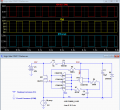
Below is the circuit modified to allow only an 8ms delay (generated by U1a) after applying 24V for the bootstrap capacitor C2 to charge and the blinking to start,, which should be imperceptible:
The bottom expanded plot shows the charging of the capacitor (red trace) after the application of 24V (yellow trace), and the lamp being lit after 8ms (blue trace).
The circuit in post #39 indeed solves the problem, but I see another issue, which may not matter, which is that in the lamp off state there is still 12 volts or so across the load, because of the series string R1, D1, and D2. If the load resistance is much less than 500 ohms that should not matter, but if it is something else then it might be a problem. It seems that here also we are not told enough about the application conditions to do better than a guess.
And folks wonder why I ask so man questions about the applications. At one time I worked for a company that went bankrupt because the sales guy did not get an adequate description of the application for what we delivered. I take failures like that very personally, and so I am very careful about finding the details. I learn from failures.

 Facebook
 Google
 GitHub
 Linkedin