How to design solar charger for 2s 18650 batteries

Thread Starter

quique123

Joined May 15, 2015
405
I need to charge 2x18650's batteries that power a project autonomously.

The 2 batteries are wires in series for 7.4V and I'm buying a 2s bms and I already have a solar panel I was hoping to use.

First I want to determine if my solar panel is powerful enough. If I need to charge the batteries in series do I need a 9V panel or a 6V panel? I'm not familiar enough with how a bms works but I know that I could charge a 3.7V battery just fine with a 6V but I'd need a 9V for a 7.4V. So my first question is about voltage, will I need enough voltage to push into 1 cell (6V) or into both in series (9V)?

Second, as for the amperage, I have yet to measure that with my panel but I believe it's about 0.5 Amp, which seems low but the panel was used to charge 9 of these 18650's inside a solr charger.
 

Audioguru

Joined Dec 20, 2007
11,248
The batteries in series average 7.4V which is 3.7V for each cell. But each cell is 4.2V when fully charged so their total is 8.4V. Then how can you charge them with only 6V unless you separate them? A 2s charger usually charges them balanced and in series. A 9V solar panel is too low, use 12V to power the charger.

An 18650 cell is usually about 3000mAh and charges at up to 1.5A. A current of 0.5A will take 6 hours to charge them if they were low.
 

Thread Starter

quique123

Joined May 15, 2015
405
The batteries in series average 7.4V which is 3.7V for each cell. But each cell is 4.2V when fully charged so their total is 8.4V. Then how can you charge them with only 6V unless you separate them? A 2s charger usually charges them balanced and in series. A 9V solar panel is too low, use 12V to power the charger.

An 18650 cell is usually about 3000mAh and charges at up to 1.5A. A current of 0.5A will take 6 hours to charge them if they were low.
OK l do have a 15v so ill try that.

I have it so that the project can run 2 weeks with those 2 batteries so even if the panel only charges them in 6 hrs it should be enough.

I believe I do have a 30W panel as well but that may be too powerful in terms of amps, I'll have to check. I think it's 12v/2.5A
 

Audioguru

Joined Dec 20, 2007
11,248
Do you have a "low battery" sensor to disconnect the load on the battery when its voltage drops below about 6V?
A Lithium rechargeable battery is ruined and maybe dangerous to charge if its voltage drops below about 3V per cell.
 

Audioguru

Joined Dec 20, 2007
11,248
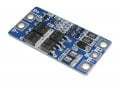
Look in Google for 2S 18650 Protection Module. There are many of them but the features are not clear written in Chinglish.
 

Audioguru

Joined Dec 20, 2007
11,248
The thing you show has one unmarked terminal maybe for the connection between the battery cells, no specs and no instructions.
It might be so cheeeep that it will not work. Try it.
 

Thread Starter

quique123

Joined May 15, 2015
405
Well I'll try it when I get it. Now as for the solar panel, I have a 15V/0.15mA and a 6V/0.5A.

I understand it would take the 0.15mA one 20 hours vs 6 hours for the 0.5A.

Would my best option be:

1. Use 2x 6V panels in series for 12V/0.5A?
2. Use 2x 15V panels in parallel for 15V/0.3A?
3. Use a 12V/2A panel which is considerably larger?

The time difference between 1 & 2 would be 6 vs 10 hours. I believe I've designed the bank to be so large that it shouldn't be a problem.

The size difference is not that big an issue either because 2x of the small (2.5-3W) panels are not as big as a 30W but even the 30W would be fine because it's an outdoor project so I can hang it from a wooden structure.

The two small panels:
15V/0.15A 2.25W
6V/0.5A 3W

are about the size of a 8x11" sheet of paper and about 5mm thick.

The larger 30W panel has an aluminum frame and is about 15x20"
 

Audioguru

Joined Dec 20, 2007
11,248
You found a "protection board", not a charger board. A lithium battery needs special charging to prevent an explosion and fire.
1) A charger measures the cell voltage and if it is lower than about 3V then it tries charging with a low current. If the voltage does not rise then it stops and issues a warning.
2) A charger detects low charging current as a full charge and properly stops charging.

An article on the internet https://github.com/megasaturnv/HX-2...ered_aka-2S-10A-Balance-Li-ion-Protection-PCB discusses that the ebay and AliExpress spec's are missing most information on the datasheets of the parts. The protection board can be used as a charger with uncontrolled output current and its balancing is poor which will result in an explosion.

ebay manufacturers and sellers know nothing about the junk they make and sell.
 

Audioguru

Joined Dec 20, 2007
11,248
The Amazon circuit is a charger for one Lithium cell.
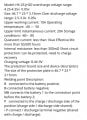
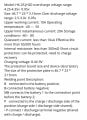
The AliExpress circuit description speaks in Chinglish that I cannot understand. They say it is a protection board that protects the charger, not the battery. Most other protection boards protect the battery.

A laptop has a lithium battery module with a protection board inside it. Its charger circuit is inside the laptop.

All my RC airplanes have a bare 2S Lithium battery with no protection board. The battery charger circuit is 2S balanced and is separate.
The airplane circuit gives a warning that the battery is low then shuts off the powerful motor allowing the airplane to make a controlled glide to land.

You need a charger but I do not know if you need a protection board.
 

Thread Starter

quique123

Joined May 15, 2015
405
My project is a vibrating motor that runs for 10 seconds every hour. The protection I thought was for the battery pack so that it won't overcharge or discharge too much and I thought that is what these protection boards (called bms) did.
 

Audioguru

Joined Dec 20, 2007
11,248
The problems with using a Chinese protection board and/or charger is that the text does not say what happens:
1) If the battery to be charged has a unsafe low voltage. It should make a low charge current to see if the voltage rises.
2) If the charging current is too high. It should have properly limited the charging current to what your batteries need.
3) If the charging voltage becomes too high. It should have limited at 4.20V per cell but the spec's you showed are higher.
4) If the battery becomes fully charged. It should detect low charging current then disconnect the charger and give a fully charged alert.
5) If the discharge current is too high. It should have limited the discharging current but yours limits too high (20A!)
6) If the discharging voltage becomes too low. It should have disconnected the battery from the charger.
 

Audioguru

Joined Dec 20, 2007
11,248
I would buy a charger that has a current suitable for your battery cells from my local hobby store.
I do not know if your project will detect a safe low voltage and shut off.
 
Top