How to design an Audio Amplifier for 3000Hz Square Wave from a 555 Astable Timer with 5V VPP. Given that VCC is 9V.

Thread Starter

Epathitis

Joined Jun 3, 2024
5
Hello! I am a hobbyist. How could I design or what kind of audio amplifier should I use for this circuit? Without an amplifier, my output volume is around 78dB. My goal is to reach around 90dB or a hundred without distorting the 3000Hz signal.

In this project, I am just allowed to use Transistors (BJT), Resistors, and Capacitors only. I have tried simple class A amps and it doesn't work.


[The switches are a part of the conditions for the project.]
CONDITIONS WHERE THE CIRCUIT IS ON:
SWITCH 1 ON
SWITCH 2 ON

SWITCH 1 OFF
SWITCH 2 ON
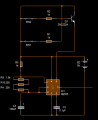
1720583701242.png
 

WBahn

Joined Mar 31, 2012
32,702
You keep saying that you want an amplifier, but it sounds more like you want a tone generator.

You say that your present circuit is able to deliver a volume of 78 dB directly from a 555 timer? That's about the same as a loud vacuum cleaner. Your target of 90 dB is on par with a gas-operated lawnmower. How reasonable is it to expect to produce that from a 5 V device driving a 10 W speaker? I don't know, because you've left some things out.

What is the sensitivity of your speakers?

How directional are your speakers?

At what distance do you want the volume to be at the specified levels?
 

Ian0

Joined Aug 7, 2020
13,097
Given that you cannot increase Vcc, you therefore cannot amplify the output voltage of the 555. All you can do is reduce the drive impedance.
So get a couple of MOSFETs (one N-channel, one P-channel) and connect them to the output.
You're not going to do better than that with the constraints you have set.
TO increase the sound pressure by 12dB you will actually need 4 times the output voltage that you currently have.
 

Ramussons

Joined May 3, 2013
1,567
Hello! I am a hobbyist. How could I design or what kind of audio amplifier should I use for this circuit? Without an amplifier, my output volume is around 78dB. My goal is to reach around 90dB or a hundred without distorting the 3000Hz signal.

In this project, I am just allowed to use Transistors (BJT), Resistors, and Capacitors only. I have tried simple class A amps and it doesn't work.


[The switches are a part of the conditions for the project.]
CONDITIONS WHERE THE CIRCUIT IS ON:
SWITCH 1 ON
SWITCH 2 ON

SWITCH 1 OFF
SWITCH 2 ON

View attachment 326643
You mention 3000 Hz, Audio Amplifier, Speaker.... No Distortion.
All are contradictory.
When you talk of a Speaker and Audio Amplifier, the top frequency is about 20 KHz.
That's just below the 5rd harmonic of your 3000 Hz Square Wave from the 555. This means a Very High Distortion.
I guess what you want is a 3 KHz High Power Oscillator driving a Transducer of some sort.
A car horn tuned to 3 KHz may be the solution.
 

Ian0

Joined Aug 7, 2020
13,097
When you talk of a Speaker and Audio Amplifier, the top frequency is about 20 KHz.
That's just below the 5rd harmonic of your 3000 Hz Square Wave from the 555. This means a Very High Distortion.
That‘s rather a moot point. If you put a signal through a linear network that affects its bandwidth, does that count as distortion?
I‘m of the opinion that it is only distortion if it goes through a non-linear network that generates harmonics that were not previously present.
 

WBahn

Joined Mar 31, 2012
32,702
That‘s rather a moot point. If you put a signal through a linear network that affects its bandwidth, does that count as distortion?
I‘m of the opinion that it is only distortion if it goes through a non-linear network that generates harmonics that were not previously present.
By that definition, a modulator produces nothing but distortion. I guess you could view it that way, but it robs the term of any meaning.

I think a better (and, I think a more intuitive, more useful, and more widely used) definition is that distortion is any deviation of the output signal's waveform from the desired waveform. There are, of course, different kinds of distortion. The kind you are talking about is normally referred to as harmonic distortion.
 

Alec_t

Joined Sep 17, 2013
15,101
It could be argued that any change to a signal, including amplitude, amounts to distortion. Context is important.
 

crutschow

Joined Mar 14, 2008
38,316
You can generate a speaker voltage of near 18Vpp by using an H-bridge to drive the speaker.
That's assuming the 9V supply can provide that much current into the speaker load, which a 9V rectangular battery won't.
 

Ramussons

Joined May 3, 2013
1,567
That‘s rather a moot point. If you put a signal through a linear network that affects its bandwidth, does that count as distortion?
I‘m of the opinion that it is only distortion if it goes through a non-linear network that generates harmonics that were not previously present.
I believe that any network that alters the waveform is distortion. Some forms of distortion are Pleasant, some Tolerable, others unpleasant.
In this case, the term "no distortion" is, perhaps, a wrong term used.
 
Hello! I am a hobbyist. How could I design or what kind of audio amplifier should I use for this circuit? Without an amplifier, my output volume is around 78dB. My goal is to reach around 90dB or a hundred without distorting the 3000Hz signal.

In this project, I am just allowed to use Transistors (BJT), Resistors, and Capacitors only. I have tried simple class A amps and it doesn't work.


[The switches are a part of the conditions for the project.]
CONDITIONS WHERE THE CIRCUIT IS ON:
SWITCH 1 ON
SWITCH 2 ON

SWITCH 1 OFF
SWITCH 2 ON

View attachment 326643
For boosting your audio to 90-100dB without distortion, you might wanna try a Class AB amplifier design using BJTs, resistors, and capacitors. Class A might not cut it for your needs, but Class AB gives better efficiency and can handle higher power. Make sure to properly bias your transistors to avoid distortion, and consider using a push-pull configuration. Check your design against the circuit conditions to ensure everything switches on correctly.
 

LowQCab

Joined Nov 6, 2012
5,101
"" In this project, I am just allowed to use Transistors (BJT), Resistors, and Capacitors only. ""

Then why does your Schematic clearly show a 555-Chip in it ????

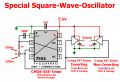
Connect the Speaker between the 2 Output terminals of the below Schematic,
and make sure to cover your Ears before applying Power.
( change the 1K Resistor to a 4.7K Resistor first ).
.
.
.
Special Power Supply .png
.
 

Ian0

Joined Aug 7, 2020
13,097
Perhaps "no audible distortion" is better.
In which case any signal above 10kHz generates no audible distortion, because the 2nd harmonic is above audibility, so the removal of higher harmonics by the limited bandwidth is not distortion.
 

WBahn

Joined Mar 31, 2012
32,702
Perhaps "no audible distortion" is better.
In some situations, perhaps. But I would say "no significant distortion" is more general, since that allows the meaning of "significant" to reflect what is and what is not important for the system under consideration.
 

WBahn

Joined Mar 31, 2012
32,702
In which case any signal above 10kHz generates no audible distortion, because the 2nd harmonic is above audibility, so the removal of higher harmonics by the limited bandwidth is not distortion.
For audio systems, that is perhaps a reasonable assertion (at least some of the time).
 

BobTPH

Joined Jun 5, 2013
11,463
An audio amplifier is a silly way to amplify a square wave. All that us needed is a transistor switching a higher voltage.

Edited: Actually, two transistors in a half-bridge configuration.
 
Last edited:
Top