What about a transistor acting like an open collector? Supply the desired voltage to the collector via a resistor. When the square wave goes high the transistor conducts and pulls the collector to ground (an inverter circuit).
Like this ? ? ? [edit] oops - ignore that little plus sign. [end edit] [edit #2] the base of the transistor will also need a resistor. Forgot that when I drew this. [end edit #2]
Quick note - the pulses will be inverted. If the 5V pulse is high for 80% of the period then the 1V pulse will be LOW for 80% of the period. If you're working with a square wave then you shouldn't have any problems. But if the high side versus the low side is not symmetrical then my drawing won't work like you want.
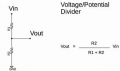
I tried using a simple voltage divider (with two resistors) put that didn't work. If the values of resistors are too high, in the Kilo ohm range , then there is nothing in the output.
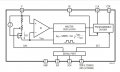
The AD835 has an input impedance of 100 K. The 6903 is characterized for high output currents of 1 mA and 4 mA. A 2-resistor attenuator with a Thevenin equivalent impedance of less than 1 K will introduce an amplitude error of less than 1% at the 835 input, without overloading the 6903 output stage. Is this 10 times better than what you need, 1000 times worse than what you need, or something else?
Like this ? ? ? [edit] oops - ignore that little plus sign. [end edit] [edit #2] the base of the transistor will also need a resistor. Forgot that when I drew this. [end edit #2] View attachment 256922
I’m not very experienced, but why not an inverting op amp configured with a gain of 0.2? If the pulse width is critical, use a transistor to invert the output?
The oscillator output is a 50% duty cycle square wave, so inverting it should not cause any downstream issues.
The 835 is specified for bipolar supplies only, so you need to either pee a little offset current into the summing node, or couple the output through a capacitor.
Still waiting for details about why a 2-resistor attenuator doesn't work.
I left certain things out because I don't know what the TS has available. However, it's quite possible a voltage divider could provide sufficient amperage for whatever he is running. He DID say that too low a resistance results in a dirty square wave and too high results in nothing happening. Somewhere in between is where the answer lay. I wouldn't recommend another regulator. I think the 5V could be divided down sufficiently. The easiest solution consists of very few parts. If those options don't produce the desired results then something more is needed. Since I don't have part-in-hand I can only offer minor guidance.
With my drawing above, the square wave would be inverted. A second transistor to invert the signal back would also potentially solve the problem.
To design a simple voltage divider that will reduce the 5.00 volt square wave to 1.00 volts I need to know the resistance of both the source and the load. To get a voltage divider that will reduce the 5 volt square wave to a 1 volt square wave we can guess that the source resistance is zero and that the load resistance is very high. Then, because precision resistors are not handy, I can build a series string of five 1000 ohm 1% tolerance resistors, and apply the 5 volts to the top of the string and find the one volt across the bottom 1000 ohm resistor.
Realize now that two guesses were made here, and both of them matter quite a bit. If the driving circuit has feedback to keep the voltage at 5 volts independent of load, the the guess of zero source resistance is reasonable, and if the load has a reasonably high input resistance, such as a stereo amplifier, then the high resistance input guess is reasonable. But if it is the 50 ohm impedance input of an oscilloscope, then the input will be much less.
In my first post I mentionned the output of the LTC6903 goes directly into the AD835 input. From the datasheet of the AD835 ports are : High input impedances.
Or you can measure the Vout resistor from Ve(Pin e of bjt) and Ground (You should turn off the power, and separate the SVR from the transistor), and then to find two fixed resistors to replace the SVR, if you can find the appropriate values of resistors.
this is the best solution for me, The resistor divider works but with low ohmic values not in the K ohm values. I was down to 2ohm with 10 ohm resistors, But I needed a Pot and as soon as I introduce that in the circuit, then the output was unstable. The 2N3904 is a low cost transistor anyway. thank you
Maybe the resistor divider worked with extremely low resistor values but not with high resistor values because it was built on a breadboard and the high resistances and their wires picked up interference.

 Facebook
 Google
 GitHub
 Linkedin