Facebook
 Google
 GitHub
 Linkedin
Hello All,
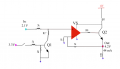
I have designed the circuit below to buffer an op-amp output to deliver 4.2V to a 100 ohm load. The load is just a representative of a circuit which sink 44 mA current. I appreciate if you help me find answers for questions listed below,
1) As the output of the OP-Amp going to be 0.7V more than 4.2V, I chose Rc= 50 to provide Vs =2*(4.2+0.7)= (12-50*0.044)= 9.8 for the op-amp power supply. Is my approach correct?
2) I would like to power down or at least decrease the power consumption of my circuit.Therefore, I thought of using Q1 as a switch as shown in the figure. However I do not know if I should place R1 resistor or not and if R1 is required how should I find the proper value? I appreciate i you could give me some hints.
Regards
Samaneh
I have designed the circuit below to buffer an op-amp output to deliver 4.2V to a 100 ohm load. The load is just a representative of a circuit which sink 44 mA current. I appreciate if you help me find answers for questions listed below,
1) As the output of the OP-Amp going to be 0.7V more than 4.2V, I chose Rc= 50 to provide Vs =2*(4.2+0.7)= (12-50*0.044)= 9.8 for the op-amp power supply. Is my approach correct?
2) I would like to power down or at least decrease the power consumption of my circuit.Therefore, I thought of using Q1 as a switch as shown in the figure. However I do not know if I should place R1 resistor or not and if R1 is required how should I find the proper value? I appreciate i you could give me some hints.
Regards
Samaneh