How to clean water based flux residues

Thread Starter

jsbach

Joined Jan 18, 2025
7
Hello,

I've read several sources about cleaning PCBs after soldering and still confused. Some necessary details are lacking. There's even a controversy on some points. For example, some sources tell that you have to immerse the PCB into deionized water. Other sources are saying that such an immersion can damage some components.

Does anybody know at least one resource which explains the cleaning process in every single detail? Here's the list of matters I'm not sure about:
  1. To immerse or not to immerse?
  2. If using immersion, is it sufficient just to leave a PCB in the water for some time or should I also scrub a PCB with a brush?
  3. If NOT using immersion, how to do a final rinse to not to damage the components?
  4. What should be the water temperature?
  5. How to warm the deionized water to keep it deionized?
  6. How to clean the areas under the components?

Please note again, I'm using a WATER SOLUBLE flux.
If there are no such detailed sources, would be great having the answers here on the forum.

Thanks.
 

MisterBill2

Joined Jan 23, 2018
27,315
I would not ever immerse a PCB with components attached in water. The exception would be to remove a more damaging contamination such as salt water or some acid.
Solder flux can be cleaned from on the solder side with an alcohol solvent or similar that is compatible with the materials and will not harm the person using it.
 

nsaspook

Joined Aug 27, 2009
16,273
DI water won't stay DI for very long unless it's constantly processed with the resin.
https://www.bulkreefsupply.com/bulk...systems/reverse-osmosis-filters/di-resin.html


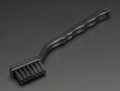
99% isopropyl and a ESD-safe cleaning brush, then lint-free cloth wipes. I don't use just DI for PCB cleaning as some of the burnt-in flux contamination can be water-insoluble, as are oils from fingers and other chemicals.
1737254557915.png
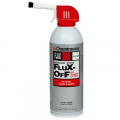
This works too but is not cheap.
1737254452732.png
 
Last edited:

Thread Starter

jsbach

Joined Jan 18, 2025
7
99% isopropyl and a ESD-safe cleaning brush, then lint-free cloth wipes.
I've read that people use IPA, but believed that this is for rosin based flux only. I'm not good in chemistry and was not able to understand if IPA would work for water based flux too.

Should I put isopropyl directly on the area to clean or should I damp the brush in it?
 

nsaspook

Joined Aug 27, 2009
16,273
I've read that people use IPA, but believed that this is for rosin based flux only. I'm not good in chemistry and was not able to understand if IPA would work for water based flux too.

Should I put isopropyl directly on the area to clean or should I damp the brush in it?
https://www.microcare.com/en-US/Products/IPA-Based-Flux-Remover-IsoClean

IsoClean IPA-Based Flux Remover is safe for cleaning all of today's electronics
Applications:
  • Use on rosin, no-clean and water-based fluxes and pastes
  • Removes light oils and grease, organic residues and ionic deposits
  • Works as a stencil cleaner
  • Head cleaner for recording systems
  • Ideal for repair depots where a wide variety of components and materials are used

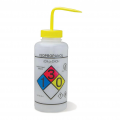
I use an standard industrial IPA bottle to apply it to both brush and board. Once you have loosened it, you have to rinse it off with *more* IPA/Water/Cleaner. There are times when one is better than the other but I don't like soaking any electronics in pure DI water. YMMV
1737256228103.png
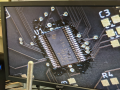
I've used 70% IPA for immersion cleaning while brushing for cleaning something like this 'no-clean' tack flux.
1737257107970.png
Would you leave this on your PCB?
1737257284186.png
1737257171395.png
 

MisterBill2

Joined Jan 23, 2018
27,315
I would dip the tips of the brush in the alcohol as I was cleaning off the flux. That was adequate and did not spill it everywhere. The drips were captured by a paper towel. No big mess left behind on the bench.
 

Tonyr1084

Joined Sep 24, 2015
9,744
I would not ever immerse a PCB with components attached in water. The exception would be to remove a more damaging contamination such as salt water or some acid.
First, I want to acknowledge @MisterBill2 's practices as valid to him. Not finding fault, just going to offer a different point of view.
Three experiences:

First; my wife decided to do a deep cleaning of the microwave oven. She sprayed cleaner over everything. This resulted in the loosening of grease that had accumulated over the control board. That grease migrated onto the board and caused it to become non-functional. I took the board out and washed it with soap and tap water removing the grease. Then I rinsed it in tap water. Finally, I used compressed air to blow-dry the PCB. Then IPA to mix with any remaining water, then blow-dry it again. Put the board back into the MO and everything is working to this day. That was several years ago. While Mister Bill says he would never "Immerse" a populated board, I did not immerse mine. However, under running water from the kitchen faucet, the result speaks for itself.

Second; Back in 1994 the engineers were arguing about PCB's and the Hydroscopic nature of PCB's (unpopulated). While some argued that a bare board MUST be baked at 250˚F for 2 hours others were saying it was unnecessary. I was working as the shop Microsection Technician. I had access to all the incoming PCB's. So I contacted one of our suppliers and explained the nature of the experiment I wanted to do. Asked them to send 9 boards of one type, 9 boards of another type and 9 boards of yet another type. The three different types of boards were different in the composition of their construction. Then, taking three boards from each group I submersed them in a tub of water for 3 days. Meanwhile I took 3 more boards from each group and placed them in the bake oven for 3 days. The remaining three boards from each group were left in their shipping bags with desiccant. After the 3 days I took all the boards and marked them as to which test group they were from. Ran them up the wave solder machine then evaluated them. The boards that soldered best were the ones that were left untouched and in their sealed bags. The second closest soldered boards were the ones that were submerged in water for three days. The difference between the best and second best was hardly detectable. Likely there may have been some water on the board. Nevertheless, the boards soldered all 100% acceptable. The third group, the ones in the oven for 3 days soldered the worst. And they had issues with solder flow. - - - The conclusion from this experiment was that baking the boards to drive water out of them was both unnecessary and potentially degraded the solder ability of the boards.

Third; Back in 2014 I worked at a board shop that built commercial grade electronics. Some customers required construction of the boards to be done with Water Soluble flux. After assembly the boards went to the wash. A board washer that sprayed hot water all over the boards. Yes, this was DI water (De Ionized). From there they went to inspection. If passed they went to test. There was never any harm caused by water washing a board.

MY conclusion: You can wash a board built with water soluble flux and wash it in the kitchen sink. But the traces of minerals that could be left behind need to be flushed as well. Hence, the reason why I used IPA to do a final flush and to use compressed air to blow dry the boards.

WARNING: Blow Drying with compressed air CAN lead to static buildup, which could potentially harm a board.

As a cabinet maker I make a lot of sawdust. It's everywhere. When vacuumed up the vacuum hose gets highly static charged. This is caused by the sawdust particles hitting each other and the walls of the vacuum hose. I build up a ton of static voltage from close contact. When vacuuming around the table saw - cast iron top - grounded - when contacted there's a hell of a static discharge that makes me jump every time. So blow drying a PCB should be done as briefly as possible. If you can afford a deionizer air nozzle you can dry the boards that way without fear of static discharge or static charges developing on your board. And I live in a desert climate, dry. Dry air is when static is best produced. Humid air does not produce as much static.

So I am in disagreement with Mister Bill. I'm not knocking him, just offering a different point of view.
 

MisterBill2

Joined Jan 23, 2018
27,315
OK, and thanks for the explanation for the reason you disagree. I point out that yours WAS NOT just a simple wash!! Certainly with that level of additional effort the potential for harm is removed. So really, THAT is quite different from "just a wash" that I was addressing.
Those who follow THAT WHOLE PROCEDURE, described in post #7, will most probably do no damage.
 

nsaspook

Joined Aug 27, 2009
16,273
OK, and thanks for the explanation for the reason you disagree. I point out that yours WAS NOT just a simple wash!! Certainly with that level of additional effort the potential for harm is removed. So really, THAT is quite different from "just a wash" that I was addressing.
Those who follow THAT WHOLE PROCEDURE, described in post #7, will most probably do no damage.
This is simplification of a complex subject.

The problem I have with hobby level use of DI (as opposed to plain ultra pure water) for cleaning is that ultra clean DI water is not benign, it needs to be completely removed/displaced off of substrates. It can be corrosive to some metals (like copper) as I've seen brass DI fittings get completely eaten through by 18M (resistance) DI water pumping systems on machines.

I would use distilled pure water or (UPW from a RO process) instead of DI water (DIW ) for hobby PCB cleaning followed by IPA to displace any water left behind. UPW is what is used for cleaning bare silicon wafers while DIW, that likely will also be UPW is typically used when there is a specific requirement of low charged particle interactions (currents) like cooling high voltage plates with tens or hundreds of thousands of volt potentials that need isolation. Normally UPW is treated with resin 'filters' to make DIW but DI is not a specification of no contaminants only no ionic contaminants.


Top