How to calculate a resistor

Thread Starter

mikelynch

Joined Jun 30, 2007
23
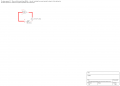
I have a 5V battery powering a lamp that requires 60mA , but when cold the lamp will try and draw 600mA. The lamp uses 3V+

I wanted to vfind out the resistance of the lamp -> (5 - 3)/.06 A = 33 Ohms

or when lamp is cold (5- 3)/.6 A = 3 Ohms

When I want to calulate the current flowing through the circuit I also did this
when the lamp was cold. 5V/3A = 1.6 Amps

Or (5 - 3)/3A = 0.6 Amps.

I dont know which way to get the current. Then I have to work out what resistor to use.

Sorry about the poor png, how do i save a picture so that it comes up clear. I have PAINT and Photoshop.
 

Attachments

Last edited:

someonesdad

Joined Jul 7, 2009
1,583
It's not clear exactly what your question is (actually, you didn't ask a question about the circuit). It sounds like you have a 3 V lamp that draws 60 mA. That means it has a resistance of 3/0.06 = 50 Ω. To run this lamp from a 5 V supply, you need to drop 2 V across a resistor in series with the lamp. Thus, the resistance needed is 2/0.06 = 33.3 Ω. The total resistance is 83.3 Ω and we'd better get 60 mA of current with that: 5/83.3 = 0.06 A. Thus, things check. A resistor with a power rating greater than 3*3/33.3 = 0.27 W is needed -- probably a half watt resistor.

If the lamp draws 0.6 A when cold, that means its cold resistance is 3/0.6 (you didn't specify the voltage across the lamp when this current is drawn, so I assumed it was the same as in the first paragraph). That means the resistance is 5 Ω, or 10 times less than the heated resistance (reasonable if the current was 10 times higher). If the start-up current is too large, you'll have to find a way other than a plain resistor to limit the current.
 

Thread Starter

mikelynch

Joined Jun 30, 2007
23
Thanks for your answer, it was very helpfull.

1. Why did you multiply by three to get Resistor Watts 3* 3 / 33.3 = 0.27 W

2. How do i calculate 1/2 Watt resistor into Ohms ? Or can resistors with the same Ohmns have totally different Wattage thresholds ? In either case can this be simply calculated ?

I guess the answer will be that a resistor of around 33 Ohms and 1/2 Watt is available ?

Thx again.

Mike.
 
Last edited:

Wendy

Joined Mar 24, 2008
23,811
I think it may be a typo, the equation is Watts = V²/R, which is another way of saying Watts = V*I (ohms law is in play here, the textbook equation is P=E*I). In this case the V would be 2V, the voltage drop of the resistor, so 2V²/33.3Ω = .12W. As a check figure V*I, or 2V*0.06A = 0.12W. A 33 Ω¼W resistor would suffice.

The logic was good, but brain farts can happen anywhere and anywhen to anyone, voice of experience.
 
Top