Facebook
 Google
 GitHub
 Linkedin
I am building an additional light for a storage room that needs to operate from 12 volts and needs to shut off after 10 minutes.
There are already some lights but they are not bright enough. The new light will be connected to the existing light's power source, but consumes more power and since people only enter to take or deposit something, it should not stay on for longer than 10 minutes (if someone forgets to turn the light off).
I checked some timers available on the market, but none seemed to do what I need, so I decided to build my own circuit.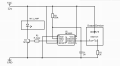
MY_LAMP is where the lamp will go. My problem is that the capacitor will remain charged for quite a while, thus reducing the shutoff delay the lamp is turned on next time. I need a something to discharge the capacitor in 10 seconds. I tried adding a resistor in parallel with the capacitor, but if I want to keep the 10 minute delay, the discharge time is still minutes. I came up with the idea to have a smaller resistor in parallel with the capacitor, that gets disconnected when power is applied to the circuit.
The things closest to achieving this I could find were depletion-type MOSFETs. But those need a negative voltage applied to the gate to open, which I do not have present. So my question is: what do I need to put in the place of "Some Device" that opens what is now marked 'SWITCH' if 'INPUT' is present. Otherwise the switch should close to discharge the capacitor. And all this preferably without any moving parts, so no relay.
The values of some components, are not yet determined, because I do not know the exact power consumption of the lamp yet.
Or if someone knows an easier design that can achieve what I need, please share it with me.
Thanks for the help.
There are already some lights but they are not bright enough. The new light will be connected to the existing light's power source, but consumes more power and since people only enter to take or deposit something, it should not stay on for longer than 10 minutes (if someone forgets to turn the light off).
I checked some timers available on the market, but none seemed to do what I need, so I decided to build my own circuit.
MY_LAMP is where the lamp will go. My problem is that the capacitor will remain charged for quite a while, thus reducing the shutoff delay the lamp is turned on next time. I need a something to discharge the capacitor in 10 seconds. I tried adding a resistor in parallel with the capacitor, but if I want to keep the 10 minute delay, the discharge time is still minutes. I came up with the idea to have a smaller resistor in parallel with the capacitor, that gets disconnected when power is applied to the circuit.
The things closest to achieving this I could find were depletion-type MOSFETs. But those need a negative voltage applied to the gate to open, which I do not have present. So my question is: what do I need to put in the place of "Some Device" that opens what is now marked 'SWITCH' if 'INPUT' is present. Otherwise the switch should close to discharge the capacitor. And all this preferably without any moving parts, so no relay.
The values of some components, are not yet determined, because I do not know the exact power consumption of the lamp yet.
Or if someone knows an easier design that can achieve what I need, please share it with me.
Thanks for the help.
Last edited: