How should I stop 7 segment for counting? It should be only be counting 0-8.

RdAdr

Joined May 19, 2013
214
The only courses that I really understood something were coming from teachers that did not use powerpoint and made us take notes.

In year 2 only 4 out of 10 did that. In year 3 only 1 out of 10 did that. In year 4 only 1 out of 10 did that.

The others came with powerpoints.

And I tried to learn on my own. Luckily edx formed in 2012. But still what a difference could have made if the teaching was made differently.
And maybe if they had some solid courses in pdf format at least. But no.
 

JoeJester

Joined Apr 26, 2005
4,390
I would not blame the tools (PowerPoint and simulators). When CAD first hit the scene, I imagined how that could have saved me time creating some of the block diagrams I drew in 1979 with my drafting board.

There are good teachers out there. I've seen a few on TV and read a few here that if the opportunity presented itself, I would love to sit in on a lecture.

Some teachers need to look into a mirror to see who can improve their course.

If one is using pre packaged material, they should be on the ass of the publisher and author each time they find an error.

I fully understand that labs are, at their root, programmed instructions to produce a specific set of results used for further assessment of the students knowledge.
 

RdAdr

Joined May 19, 2013
214
I don't know. All that I am saying is that if Walter Lewin used PowerPoint in his lectures, his lectures would have been unknown.

Khan from the celebrated KhanAcademy also writes. If he showed slides and spoke on the background, he would have been unknown.

Drawing the circuits on the whiteboard is infinitely better than just showing them on a ppt slide. It impresses the students and makes them believe that you actually know what you are talking about. The students also draws the circuits by hand and this is good practice.

Just showing circuits repeatedly on ppt slides and presenting them without expecting the students to actually draw the circuit because the ppt will be anyway handed to them is really bad in my opinion. Some teachers will agree with me (for example, a teacher that I had and is from the few that I will remember with gratitude and admiration), others don't.

That is what they are called PPT presentations. Presentations. But there is a difference between presenting and teaching. You present things to clients, but teach things to students.
 
Last edited:

JoeJester

Joined Apr 26, 2005
4,390
His lectures notwithstanding, the distance between WalterLewin and MIT is widening. I haven't watched any of his lectures but I guess I'll have to before they disappear completely.

Just showing circuits repeatedly on ppt slides and presenting them without expecting the students to actually draw the circuit because the ppt will be anyway handed to them is really bad in my opinion.
I can agree with some of your statement. What is the objective? Drawing the circuit? Do you think one must draw the circuit to recognize it and understand it? What about the instructor, using the "white board" and writing the formula that describes a second order phase locked loop, taking up all 30 feet of the whiteboard and then proudly announces ..."As you can plainly see, this is the behavior of a 2nd order phase locked loop." I've sat in alot of classes listening to the professors and watching the students reactions. I've met many who didn't get a damm thing the professor was talking about.

I've just saw an example of due diligence failure when the dis tractor was how the circuit was drawn. It's a simple task to draw circuits neatly in the simulators, yet, we see poor examples of this "drawing" routinely. I mean, if you want to teach them to draw, that's fine. I'd rather see them understand the circuit no matter how it's drawn.
 

WBahn

Joined Mar 31, 2012
33,021
Some techniques (PowerPoint, whiteboard, whatever) lend themselves better to certain materials and different instructors are more effective with some techniques than others.

For many of the things I teach, it would be great if the classroom were set up so that I could use both. Then I could have a slide with the some things (such as the circuit and input waveforms) and I can work the problem on the whiteboard. If I'm talking about the ASCII table then it is very helpful to be able to project the ASCII chart on one board while I then work problems on the other while being able to reference the chart in way that everyone can see. But very few classrooms are set up this way and switching between projection and whiteboard is difficult, especially if you can't blank the projector but, instead, have to turn it off before you can write on the board and have people see it.

Overall I admit that I have an aversion to using presentations as the main component in a lecture (for techy stuff, anyway), but I do believe that they CAN be used very effectively. The problem is that the people that tend to use them tend to use them as a replacement for their own firm understanding of the material and/or ability to present it coherently.
 

RdAdr

Joined May 19, 2013
214
His lectures notwithstanding, the distance between WalterLewin and MIT is widening. I haven't watched any of his lectures but I guess I'll have to before they disappear completely.


I can agree with some of your statement. What is the objective? Drawing the circuit? Do you think one must draw the circuit to recognize it and understand it? What about the instructor, using the "white board" and writing the formula that describes a second order phase locked loop, taking up all 30 feet of the whiteboard and then proudly announces ..."As you can plainly see, this is the behavior of a 2nd order phase locked loop." I've sat in alot of classes listening to the professors and watching the students reactions. I've met many who didn't get a damm thing the professor was talking about.

I've just saw an example of due diligence failure when the dis tractor was how the circuit was drawn. It's a simple task to draw circuits neatly in the simulators, yet, we see poor examples of this "drawing" routinely. I mean, if you want to teach them to draw, that's fine. I'd rather see them understand the circuit no matter how it's drawn.
Does not matter if the distance between Walter Lewin and MIT is widening. What he did in his personal life does not coincide with the quality of his lectures.

The objective? It is well know that writing down strengthens the learning process. I noticed that myself years ago. Now as I got older (24 is older than a 19 year old) I no longer need to write down to remember things. But at that age of 7-21,22,... (depends on the individual) writing down is very important. As you get older you tend to forget that this is the case and just assume that everyone learns that same way as you do.

I do not know anyone that learned mathematics just by staring at the theory. You learn maths by doing maths. That is available everywhere.

Keeping in mind that the students spend half a day at the university, writing in that day and not just listening (like they are in some concert hall) is better.

http://www.lifehack.org/articles/featured/writing-and-remembering-why-we-remember-what-we-write.html
http://www.nytimes.com/2014/06/03/science/whats-lost-as-handwriting-fades.html
http://www.wsj.com/articles/SB10001424052748704631504575531932754922518
http://mashable.com/2015/01/19/handwriting-brain-benefits/#j6e7B2cQwEq3
http://wac.colostate.edu/books/bazerman_wac/chapter5.pdf
https://uwaterloo.ca/centre-for-tea...discipline-skills/using-writing-learning-tool

And is not about teaching them how to draw or making them understand. These two are linked.


I remember one story that my teacher told me. When he himself was a student, he had an old teacher that was able to write with two hands at once different ideas. That was a brilliant teacher, after his words. My teacher also did not use ppt or even notes in case he forgot something. He will teach for two hours electronics and mathematics from his head. And I respected that.
 
Last edited:

JoeJester

Joined Apr 26, 2005
4,390
I've known people who recorded the lectures and jotted down salient points and paying attention. My wife four pointed every class she approached in that manner. Granted she didn't take electronics so there was no drawing.

Tools are inanimate. Teachers are animated.
 

WBahn

Joined Mar 31, 2012
33,021
Noting that what works for a given student is spread across a wide spectrum (and what works for a given student is often quite topic-dependent, too), I agree that student participation is quite important for most students. Getting the handouts and recording the lecture is far too passive for most students and is a pretty inefficient means of learning (with plenty of exceptions, no doubt).

Keep in mind that there are two sides to this coin -- it's one thing to point out and criticize instructors for using PowerPoint and the like, but don't forget that, increasingly, students are demanding that they get lecture note handouts from the instructors and be able to record lectures (or, again increasingly, insisting that the school/instructor record the lectures and make those available online).

One interesting note: Studies have shown (don't have any references handy) that students that take notes on a computer do not do as well as students that take notes by hand on paper (on average).
 

JoeJester

Joined Apr 26, 2005
4,390
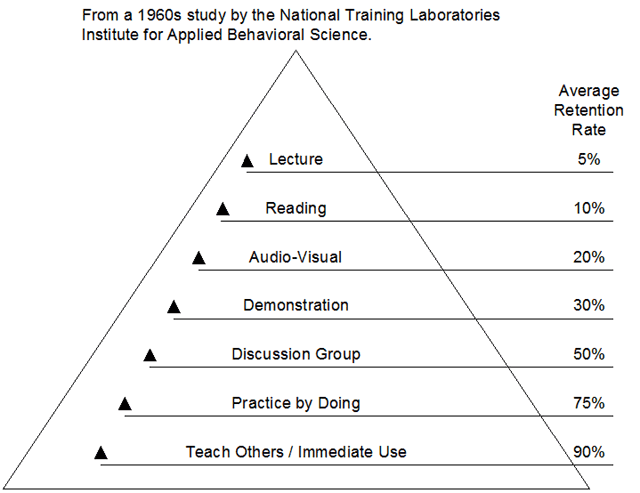
In my view, learning and retention gon hand in hand. Retention is the highest when you put the lesson to immediate use.


The study, I found out later, is probably false , as I can not find it anywhere. Some say this was a derivative work, but I haven't tracked that down either. Still it reflects what I observed over the years.o
 

WBahn

Joined Mar 31, 2012
33,021
While my experience roughly agrees with their ordering (I don't know that I would rate Discussion Group that high), I don't think I agree with some of their percentages. In particular, I don't think that lecture and reading are as low as they indicate -- but having said that I can attest that I see a lot of students that don't seem to be a whole lot higher than that. For me, personally, lecture is actually pretty effective, particularly if it is in a venue where I can interact and ask questions of the lecturer. Demonstrations (again, for me) are overrated. They are useful primarily for me to learn what can be done, not so much how to do it. I definitely agree with the high utility of practice by doing and, particularly, by teaching others. It's so valuable that, at times when I've struggled with some concept, I actually would turn to my dog (or thin air) and "teach" the material. In trying to verbalize the concept I would usually be forced to identify and confront what it was that was giving me problems. To this day I don't think I have ever taught a course, no matter how many times I've taught it, when I didn't learn at least as much (albeit it about different things and to a different depth) as most (if not all) of the students.
 

JoeJester

Joined Apr 26, 2005
4,390
I revisited NAVEDTRA 134A, Navy manual for instructors and downloaded the USAF manual for instructors. A cursory view of the TOC reveals some of the same instructional theories are present. The Navy manual was where I first read about the discriminations percentages. Chapter 4 of the current manual mentions the generational diffferences in the learning process as well as Blooms Taxonomy etc.

I'll read the AF sections tonight when I get home.

The instructors always learn something during the course they teach. That has been my experience as well.
 
Top