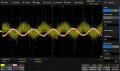
Yes, it was in dot mode. The vector mode gives a lot of excursion spikes. ERES mode does give a better display but apparently since it is a meas function, it cannot have meas applied to it. Have to measure it the old way by the graticule. K, learned a couple of things. Tried averaging the signal with 128 points but it was not as good as the ERES trace. This is a 10mV signal @ 1kHz.
Yes, it was in dot mode. The vector mode gives a lot of excursion spikes. ERES mode does give a better display but apparently since it is a meas function, it cannot have meas applied to it. Have to measure it the old way by the graticule. K, learned a couple of things. Tried averaging the signal with 128 points but it was not as good as the ERES trace. This is a 10mV signal @ 1kHz. View attachment 320497
2 further things
Why are you examining a waveform with the trigger level set to outside its amplitude ?
Press the level knob and it will automatically be set to a 50% level.
You have engaged 1 Maths operation but in these scopes you can use 4 which permits Maths on Maths where you can use some further averaging on the ERES trace.
Then you have other options too, hiding both the source and the ERES trace to only display the math on math averaging trace to do your measurement on.
Hiding traces is in the menu for each channel and each channel hidden will display a H in the channel tab.
Because that was the point where the waveform stabilized. I also thought it was odd. I could stop the waveform display to fix the trace in place on screen but would rather not.
You have engaged 1 Maths operation but in these scopes you can use 4 which permits Maths on Maths where you can use some further averaging on the ERES trace.
Hmmm... I only saw the availability for 2 "Functions". K, I will investigate further averaging the ERES trace. What the screenshot does not show is there is a secondary slower frequency of the ERES trace (in addition to the 60Hz noise). Oscillation possibly?
Interesting about the trigger level, weird in fact.
I see you have Ch1 AC coupled, is the waveform riding on some offset you needed to remove ?
FYI, in a soon to be released FW update you will indeed have 4 Maths traces to allow for math on math for 2 channels.
I can slip the beta your way if required.
Yeah, I thought it bit weird but that is where it stabilized. In the past, I've run noisy signal through an opamp buffer to clean them as a sort of pre-filter. Haven't done that yet and just might build a small strip board module to keep on the bench. Our home is ~100' from the 3-phase power distribution lines and always has 60Hz noise in the signals.
The SDS2104 Plus Sensitivity spec (manual page 11) is +/-0.5 div on the 2 mV/div setting. This is 1 mV P-P noise and is your measurement noise floor.
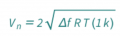
Let's convert this to noise voltage per root Hertz. 1 mV P-P noise is 0.2 mV RMS (using the 5:1 rule-of-thumb). And let's say the 'scope noise bandwidth is 100 MHz. The noise is 20 nV/Hz. Given a 10x probe the probe-referenced input noise is 200 nV/rt. Hz. As a reference point the thermal noise of a 1k resistor is 4 nV/rt. Hz. I believe the 'scope noise is specified with its input shorted. Open it and noise will increase. Signal averaging will help and measured noise voltage will be reduced as the square root of the number of samples. Average 100 samples and the noise voltage is reduced by a factor of 10.
For your experiments a Spectrum Analyzer, a frequency domain instrument, is the tool to use. Because it views a signal in a relatively narrow bandwidth it can view a much more feeble signal. A $70 TinySA spectrum analyzer (Amazon sells them) might work. The TinySA minimum resolution bandwidth is 2.6 kHz. A quick search found a noise "spec" of -90 dBm in what I assume is 2.6 kHz BW. Working the numbers this is -124 dBm in 1 Hz and is a NF (Noise Figure) of 50 dB. I believe that is typical for a spectrum analyzer having no input preamplifier. Working -124 dBm to volts we get 398e-18 watts in a 50-ohm system which is 141 nV/rt Hz. So, similar input noise in a 1 Hz bandwidth as the SDS2104; 141 nV vs. 200 nV. But with the spectrum analyzer viewing the signal in a 2.6 kHz vs. the 'scope in a 100 MHz bandwidth the spectrum analyzer sees 1/38,000 as much noise power or 1/196 as much noise voltage.
Note that the a spectrum analyzer input is 50 ohms. A cheap and very wide bandwidth probe you can build is a 500 ohm or 1000 ohm probe. While 500 ohms might seem like quite a load consider a 10M ohm/10 pF High-Z probe. At 32 MHz it's input capacitive loading is 500 ohms. A 500 ohm probe -- that is 10X -- is built with a 451 ohm resistor (or whatever you have) on the end of a length of 50-ohm coax. The coax shield is connected to circuit common by the shortest wire practical. Using the rule-of-thumb of 25 nH/inch a 4 inch wire is 100 nH and is 0.6 ohms at 1 MHz. At 30 MHz it is 18 ohms and is not a problem.
@dovo I have been "shopping" for a signal analyzer and looked at USB and TinySA along with used HP variants. USB's are out due to several reports of poor performance and still looking at whether TinySA vs. HP (or similar bench analyzers) are the way to go. The problem with USBs seems mostly related to the PC software and not necessarily the hardware (for some units) but there is also a question as to accuracy of signal with their low bit resolution and minimum bandwidth. A used bench analyzer under 1k USD is which way I'm leaning and keeping a watch on eBay's availability but have a few other pricey items also on the wish list that have priority. Stopgap, a TinySA (or similar) is a possibility that I'm still investigating or saving the money to go to a bench unit. One of these days... Thanks for your input.
@dovo I have been "shopping" for a signal analyzer and looked at USB and TinySA along with used HP variants. USB's are out due to several reports of poor performance and still looking at whether TinySA vs. HP (or similar bench analyzers) are the way to go. The problem with USBs seems mostly related to the PC software and not necessarily the hardware (for some units) but there is also a question as to accuracy of signal with their low bit resolution and minimum bandwidth. A used bench analyzer under 1k USD is which way I'm leaning and keeping a watch on eBay's availability but have a few other pricey items also on the wish list that have priority. Stopgap, a TinySA (or similar) is a possibility that I'm still investigating or saving the money to go to a bench unit. One of these days... Thanks for your input.
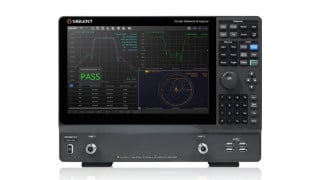
Yes, the TinySA does look to be limited. Getting up the $1k price range things looks much better. The Siglent Technologies SSA3021X ($1400) has some decent specs and the 1 Hz to 1 MHz RBW (Resolution Bandwidth) is impressive. I want one. I always had access to the best Spectrum Analyzers at several jobs and am spoiled.
Yeah a few years back but now SSA3021X Plus is the only one to go for.
Sure just a few $ more but those few $ gets you more functionality and I'll not mention what it can be improved into.
You'll have to do your own homework......

 Facebook
 Google
 GitHub
 Linkedin