How low can they go?

Thread Starter

SamR

Joined Mar 19, 2019
5,488
I've been working with some BJT amplifiers lately and reached the limits of my scope and function generator. 2mv is dead bottom on my function generator and decent cleanly displayed signals are really in the >50mA input range although I can get very fuzzy scope displays down to ~15mV. Even then the minimum display range of the scope is 500uV per division. Of course, I can go lower simulating in LTS and assume I will have reasonably accurate results building the circuit. But, out of curiosity, just how low can be tested? Are uV level signals able to be generated and displayed with current test gear manufacturers equipment?
 

crutschow

Joined Mar 14, 2008
38,506
Are uV level signals able to be generated and displayed with current test gear manufacturers equipment?
You would need to amplify the signal with a low-noise high gain amplifier, which likely are commercially available if you don't want to build your own.
What is the maximum frequency and minimum amplitude of the signals you want to see?
 

nsaspook

Joined Aug 27, 2009
16,322
I've been working with some BJT amplifiers lately and reached the limits of my scope and function generator. 2mv is dead bottom on my function generator and decent cleanly displayed signals are really in the >50mA input range although I can get very fuzzy scope displays down to ~15mV. Even then the minimum display range of the scope is 500uV per division. Of course, I can go lower simulating in LTS and assume I will have reasonably accurate results building the circuit. But, out of curiosity, just how low can be tested? Are uV level signals able to be generated and displayed with current test gear manufacturers equipment?
What's the frequency range? If it's audio then a preamp might be useful.
 

Thread Starter

SamR

Joined Mar 19, 2019
5,488
Right now, I'm just using 1kHz for testing but mostly interested in <30MHz. Hadn't even considered sweeping the frequency at this point. Putting a pre-amp together should not be a problem. Mostly just curious as to measuring LOW inputs. After amping them up to above that floor it's not a problem and what the output signal is like is what I'm looking at anyway. My interest is more in Rf than Audio although it does eventually have to be converted to an amplified Audio output. That covers a lot of bandwidth from ~100Hz to 30MHz. So sub mV signals will have to be amplified to study then? Even Tektronix scopes never got down into the uV ranges?

The scope does have some noise filtering but even with that the bottom 50mV is still pretty fuzzy. Watched the video and got a couple of good pointers from it. Using a voltage divider to decrease the output signal from the function generator to below its floor level output. Something that I had not considered and a good thing to remember. Plus using a differential probe which I do have. The Micsig I have has 10X and 100X capability and 80db and lower noise attenuation depending on frequency. So I have some new ideas to work on tomorrow.

Thanks guys!
 
Last edited:

WBahn

Joined Mar 31, 2012
32,836
I've been working with some BJT amplifiers lately and reached the limits of my scope and function generator. 2mv is dead bottom on my function generator and decent cleanly displayed signals are really in the >50mA input range although I can get very fuzzy scope displays down to ~15mV. Even then the minimum display range of the scope is 500uV per division. Of course, I can go lower simulating in LTS and assume I will have reasonably accurate results building the circuit. But, out of curiosity, just how low can be tested? Are uV level signals able to be generated and displayed with current test gear manufacturers equipment?
The short answer is yes, but as with all things, the lower you want to go, the more you are going to pay.

Back in 1988 I was working as a co-op student with NBS/NIST and we routinely measured voltages in the single nanovolts scale. At that level, not only does the quality of the equipment come into play, but LOTS of other things. Turning a connector around so that the signal went through a joint could have devastating effects. Air currents in the room would produce thermal voltages in the signals that swamped the actual signal, requiring very careful and thorough thermal packing of all connections. Even something as mundane as a three-foot length of rubber vacuum hose moving around would induce crippling noise into the measurement. So all of these things, and more, had to be managed, but they were all manageable.
 

Thread Starter

SamR

Joined Mar 19, 2019
5,488
That I understand. I don't think I'll want to venture into the nV range of measurement. I will work with the couple of good ideas gleaned from this to see how it goes with some uV inputs tomorrow and look into some possible opamp preamp ideas.
 

nsaspook

Joined Aug 27, 2009
16,322
That I understand. I don't think I'll want to venture into the nV range of measurement. I will work with the couple of good ideas gleaned from this to see how it goes with some uV inputs tomorrow and look into some possible opamp preamp ideas.
Be sure to use differential frontend preamp amplification even if your probe/test points are single ended in nature. Have fun.
 

Thread Starter

SamR

Joined Mar 19, 2019
5,488
I'll start with the differential probe to see how clean a signal I can get first and then work down to see what happens. I'll report back with the results.
 

Thread Starter

SamR

Joined Mar 19, 2019
5,488
I have (among others) a Siglent SDM3055 5.5 digit multimeter that gives me in the 200mV range 6 digits so it's capable of uV readings up to 100kHz. Been looking at used 6.5 digit HP34401a which will do a bit better and up to 300kHz. They also have some other impressive features (and better specs) for what they are but lack a few of the Siglent features so still sitting on the fence to get another bench meter. Also looking at the Keithly 2015 THD meters but they can get really expensive although THD metering is intriguing. Scope is up to 100MHz and up to 30 or 60MHz on a couple of the function generators which also have frequency counter inputs. So far, I've limited myself to 30MHz since I'm not doing anything higher HAM wise.
 

tautech

Joined Oct 8, 2019
498
Sam, why not pad the AWG output down further with a BNC attenuator ?
@ uV levels even the process of measurement affects the measurement and is active or Zo probe territory so to minimise circuit loading.
 

Thread Starter

SamR

Joined Mar 19, 2019
5,488
No Joy. Seems that I've reached the resolution limit of the scope. Even with the 10x or 100x differential probe and it's 80db CMNR the bottom is still 10mV before the resolution gets so fuzzy that the scope measurements are invalid. I'll put super low noise opamp 100x amplifier circuit together next and see how it does. IF I can get down to 1mV on the function generator I'll look at running the function generator through a divider and see how that goes.
 

Ian0

Joined Aug 7, 2020
13,132
Does your scope have an averaging function? If your input is a repetitive waveform then averaging will remove the noise.
Most digital scopes these days are able to average 128 sweeps.
 

tautech

Joined Oct 8, 2019
498
Does your scope have an averaging function? If your input is a repetitive waveform then averaging will remove the noise.
Most digital scopes these days are able to average 128 sweeps.
Yep this ^
ERES also can clean up waveforms dramatically also.
 

Thread Starter

SamR

Joined Mar 19, 2019
5,488
Yes it does and I tried it and the average is still double what the signal actually is. Under ~10mV the trace is very fuzzy even using the differential probes amplification and CMNR filtering. Worked a bit just using a TL072 opamp to boost the low level signal but was using a breadboard and getting lots noise and oscillations. I've started pulling parts together to put it on strip board and solder it up to clean up the signal. Also spent some time looking at signal amplifiers on eBay and AliX. There is an AD620 module there that looks promising although I find it's specs a bit questionable of 1000X but it's rather cheap and worth taking a look at to see what it may actually do. Also another LM386 that looks interesting for audio freqs. Might get em both to see what they do. The real question seems to be "Is the input signal even needed" since what is really important is the output signal? Anyway learning a few things as I go...

@tautech What is ERES?

It's not really noise. The signal from the function generator is very clean but on the scope under ~20mV, it loses its fine line resolution and becomes a wide blurry signal that the scope's analytics can't resolve very well. I need to take some screenshots...
 
Last edited:

tautech

Joined Oct 8, 2019
498
@tautech What is ERES?

It's not really noise. The signal from the function generator is very clean but on the scope under ~20mV, it loses its fine line resolution and becomes a wide blurry signal that the scope's analytics can't resolve very well. I need to take some screenshots...
You do.
Remind me what scope you have please ?
ERES = Enhanced resolution, a function of Maths calculi.

Remember that when looking at small signals with a 10:1 probe your input attenuation is near max sensitivity where any/all local noise can be detected and added to the signal. This is when probing technique plays a crucial role in supplying the scope with a clean signal.
 

Thread Starter

SamR

Joined Mar 19, 2019
5,488
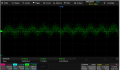
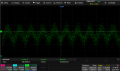
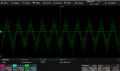
SDS2104 Plus and I actually used a 1x probe at times as it was giving me a better image at this level. All @1kHz
.1713708511467.png
This is 10mV @1kHz
1713708844682.png
Again 10mV
1713708947528.png
This is actually correct @ 50mV. Below that the "fuzziness" yeilds incorrect values.

Found and read about ERES. Will try it after I finish putting my opamp module together. Never used the math section other than FFT so I need to go over that section of the manual. Thanks!
 
Last edited:

tautech

Joined Oct 8, 2019
498
SamR, you have the scope set to display in Dot mode, change to Vectors. Further, to 100 MHz BW you also have a 10bit mode that will clean up traces further.
 

Thread Starter

SamR

Joined Mar 19, 2019
5,488
K, already had it in 10 bit I thought. Also thought it was in vector which is what I normally keep it in. How does the 100MHz affect it? I would think reducing the bandwidth would cut down on CM noise? I've put 2 TL072s on a test board today, one for 100x and another for 1000x but haven't tested them yet. I did look at ERES and tried it with no appreciable difference in the trace. I also had already tried an averaging function without much success.

Double checked and yes, the scope is set for Full Bandwidth, Vector, and 10 bit.
 
Last edited:

tautech

Joined Oct 8, 2019
498
K, already had it in 10 bit I thought.
You did and I see it now I know how to hide the AAC image popup.

However I see some other crazy settings and I'll list them:
Trigger not assigned to the channel in use.
Trigger AC coupled, should be DC coupled in most cases.
Additional channels active impacting system sampling rate and memory depth.
Also thought it was in vector which is what I normally keep it in
The dots display suggests otherwise.
How does the 100MHz affect it?
In all SDS2000X Plus models 10bit mode is limited to 100 MHz capability.
I would think reducing the bandwidth would cut down on CM noise?
Not at LF but engaging the 20 MHz BW limit available for each channel might improve results.
 
Top