How far can you drive a BJT transistor into saturation before it fails?

Thread Starter

dpetican

Joined Jan 13, 2016
38
I've been trying to work through some switching applications and I'm wondering what limits the collector current more:

Ic = Ib x hfe or
Ic = Vc / Rc

If I calculate Rb using hfe(min) to just saturate the transistor but in reality hfe is more, does Ic go up? Common sense would say no because its still limited by the series resistor Rc. So this leads to another question. How far can I [over]saturate a BJT biased as a switch without it blowing up? There has to be a limit to the base-emitter current it can handle otherwise a zero resistance would work to turn on the transistor. But I don't see that value on my data sheet.

[EDIT] I think it has to do with max power dissipation the transistor can handle. I think the total current through the transistor is Ie = Ic + Ibe. So increasing the base-emitter current will dissipate more power. Is this correct?

What I want to do is switch several different LEDs each with a different current Ic but try and use the same base resistance for each transistor. I want to know if I can use the lowest calculated Rb for all the transistors. That would correspond the the led with the highest Ic. Thanks.
 
Last edited:
When the transistor is in the amplifying mode, small Ib

Ic = Ib x hfe

As you increase the Ib of the transistor, the transistor will eventually saturate. In saturation the current is closer to

Ic = Vc / Rc

Or more accuately

Ic = (Vc - Vce,sat) / Rc, where Vce,sat = 0.2 V

Increasing Ib at this point will have no effect on Ic.

When using LEDs in the collector, it is still best to use a resistor in series with it to control the saturation current.
 

Thread Starter

dpetican

Joined Jan 13, 2016
38
Yes I know increasing Ib will have no effect on Ic when already in saturation. But what if I keep increasing the base current? I can do that and Ic will stay roughly the same. There has to be a way to calculate the lower limit of Ib. Am I on the right track with max power dissipation and Ie = Ic + Ibe?
 

AlbertHall

Joined Jun 4, 2014
12,619
If you want the transistor to be fully saturated, the general approach is to make the base current 0.1 times the collector current.
 
Calculate the saturation current of your circuit. Find Ib for this current using hfe. Ib greater that this does not change Ic significantly. Ib is often run at Ic(sat)/10. That was once considered "rule of thumb" for keeping transistor in saturation.

Ib = Ic(sat)/10 is much larger than Ib using hfe.
 

crutschow

Joined Mar 14, 2008
38,322
There has to be a way to calculate the lower limit of Ib. Am I on the right track with max power dissipation and Ie = Ic + Ibe?
The maximum base and emitter currents are given in the data sheet, and is related to the maximum localized heating the transistor chip can tolerate.

The power dissipated in the transistor is Vce * Ic plus Vbe * Ib.
 

AlbertHall

Joined Jun 4, 2014
12,619
Find Ib for this current using hfe. Ib greater that this does not change Ic significantly.
Except that you don't know the hfe of the transistor and at that calculated ib the transistor will not be fully saturated. The difference between 0.2V and 0.3V Vce won't change the collector current much but it means a large difference in the dissipation in the transistor.
 
Except that you don't know the hfe of the transistor and at that calculated ib the transistor will not be fully saturated. The difference between 0.2V and 0.3V Vce won't change the collector current much but it means a large difference in the dissipation in the transistor.
Agreed.

Sometimes even rough calculations can lead to some insight.
 

Thread Starter

dpetican

Joined Jan 13, 2016
38
Thanks crutschow. For an Ic = 20mA and hFE = 100 then IB = 0.181mA. Lets make it 10x for safety IB = 1.81mA So now RB = 2.37K

Vce(sat) = 0.25V
Vbe(on) = 0.7V

So Pd = (0.25 x 0.02) + (0.7 x 0.00181) = 6.27mW

Set Pd = 500mW then we get IB = 707mA NOT POSSIBLE!

IB must be limitied to IC(max) - IC which in the case of the 546B is (0.1 - 0.02) = 80mA

The interesting thing is that it seems the max power dissipation is not in saturation but somewhere in between saturation and cutoff.
 
Last edited:

Thread Starter

dpetican

Joined Jan 13, 2016
38
You should be able to figure out this.I
What do you know about maximum power transfer?
Not as much as I should but its coming back to me LOL But since the max current is 100mA and max power is 500mW then Vce at max power must be 5V Wait I remember now :) Its when the source and load resistances are the same. I'm thinking that roughly translates to about 1/2 way between saturation and cutoff. Okay then it makes sense now that BJT transistors dissipate the most power when they are switching. Hmm, which I will be doing.
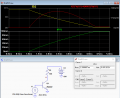
So that seems to indicate that if I push the the transistor too far into saturation I might exceed the max power dissipation when I switch. Do it often enough and the heat will build up. Pop goes the transistor. Huh o_O
 

crutschow

Joined Mar 14, 2008
38,322
IB must be limitied to IC(max) - IC which in the case of the 546B is (0.1 - 0.02) = 80mA
As I said, the maximum Ib is stated in the transistor data sheet and is limited by internal hot-spot temperature, not the maximum power transistor rating.

You can't determine the maximum base current solely from the transistor power ratings.
The maximum Ib is determined by internal temperature limitations.
 

Thread Starter

dpetican

Joined Jan 13, 2016
38
Well its not in the datasheet for the 546A that I have. But a quick check of datasheet for a 2N2222 shows that its not there either.
 

Thread Starter

dpetican

Joined Jan 13, 2016
38
Ha ha. But thanks for the help. I've got the idea now. From all the calcs I've done its clear to me that for the 546A at collector currents of ~20-35mA doubling the calculated base current will increase the saturation power dissipation slightly but otherwise will not affect the operation of the circuit. So I can safely use the base transistor for the 35mA led with the 20mA led. I would in principle have to decrease the base resistance by a factor of at least 10 before I had to start to worry. Still I may need to take into account the switching power dissipation at maximum power transfer. I actually would have gone there eventually anyway because I need to know how much heat my complete board is going to dissipate.
 

MrChips

Joined Oct 2, 2009
34,628
The series resistor RB on the base limits the base current. Drive the base too hard and you destroy the base-emitter junction.

The series resistor Rc on the collector limits the collector-emitter current. So you have figured out that the maximum power dissipation occurs when the collector-emitter resistance equals Rc, i.e. the transistor is in the linear mode and VCE is half VCC (assuming VE is 0V).

Hence driving the transistor into saturation does not destroy the transistor assuming that you have not exceeded ICMAX.
In fact, that is what you want to do when using the transistor as a switch. That is why we derate beta to 10 in order to drive the transistor into saturation.

Leaving the transistor in the linear region at ½Vcc is what is going to kill the transistor from over heating (as for Class A amplifier) if not mounted on a proper heat sink.
 

crutschow

Joined Mar 14, 2008
38,322
Leaving the transistor in the linear region at ½Vcc is what is going to kill the transistor from over heating (as for Class A amplifier) if not mounted on a proper heat sink.
Here's a simulation to demonstrate the maximum power point theorem.
As you can see, the maximum transistor dissipation (red trace) occurs when the transistor collector voltage, V(c), is 1/2 the 10V supply voltage (where the transistor equivalent resistance equals the load resistance).
The transistor dissipation starts out at zero with zero current, reaches a peak at the halfway point, and drops to the saturation dissipation at the maximum current.

upload_2017-7-10_20-56-34.png
 
Last edited:

WBahn

Joined Mar 31, 2012
32,706
I've been trying to work through some switching applications and I'm wondering what limits the collector current more:

Ic = Ib x hfe or
Ic = Vc / Rc

If I calculate Rb using hfe(min) to just saturate the transistor but in reality hfe is more, does Ic go up? Common sense would say no because its still limited by the series resistor Rc. So this leads to another question. How far can I [over]saturate a BJT biased as a switch without it blowing up? There has to be a limit to the base-emitter current it can handle otherwise a zero resistance would work to turn on the transistor. But I don't see that value on my data sheet.

[EDIT] I think it has to do with max power dissipation the transistor can handle. I think the total current through the transistor is Ie = Ic + Ibe. So increasing the base-emitter current will dissipate more power. Is this correct?

What I want to do is switch several different LEDs each with a different current Ic but try and use the same base resistance for each transistor. I want to know if I can use the lowest calculated Rb for all the transistors. That would correspond the the led with the highest Ic. Thanks.
If you are trying to do switching applications, forget about hfe -- it doesn't apply.

Even if you aren't, you shouldn't design circuits around hfe values since they vary all over the place for all sorts of reasons. You want your circuit to be as insensitive to hfe as possible.

Most small-signal transistors are considered to be in "saturation" when hFE has dropped to 10 (power transistors often use a lower value). Spec sheets usually give a max collector current value, at least for continuous operation. So a reasonable limit to use for the max base current is 10% of this, though you can probably be pretty sure you can push it to 20% without getting into too much trouble (as long as you allow proper heat sinking).

In hard saturation, an increase in base current causes about three to ten times the increase in power dissipation than the same increase in collector current does, simply because the base-emitter voltage is about three to ten times larger than the collector-emitter voltage. It is far from uncommon for more than 50% of the heat to be due to the base current and not the collector current in switching applications.

You can use the same base transistor for all of your transistors, because if your highest-current transistor can handle that base current, then so can all of the others (assuming the same transistors being used in similar environments, of course).

I'm assuming the current in the LEDs are being controlled by a series resistor and not by trying to control the base-current and count of hFE.
 
Top