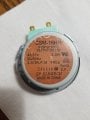
For a microwave oven, the motor does not have any mechanism to select the direction, so it can start in either direction. To select an "always" direction would usually require a shaded pole or a rachet scheme. The "shaded pole" consists of a one-turn copper coil around part of one pole piece, which creates a phase shift thatthen always starts in one direction.
Disagree. Going back 30 years, 3 ovens, 2 still running; 7- and 20- years old. As long as mains power has not been interrupted, all of them reverse direction every time they operate. Nothing random about it.
Disagree. Going back 30 years, 3 ovens, 2 still running; 7- and 20- years old. As long as mains power has not been interrupted, all of them reverse direction every time they operate. Nothing random about it.
I have seen an example of how that is achieved, the consistent reversal mechanism is simple enough. BUT, why does it matter??? AND why ?
In answer to the question in post #1, the random reversal is not accomplished. It is simply not prevented. For that type of motor, assuring a single direction of rotation every time requiresan addition to the motor assembly that adds cost. And since minimum cost is a big design driver, it is not included.
When this type of synchronous motor was used in wall clocks, they had a spring lever that automatically 'flipped' the armature in one direction at start up , you could always tell when the mechanism had worn etc, after a power outage, it was likely to run backwards !
Disagree. Going back 30 years, 3 ovens, 2 still running; 7- and 20- years old. As long as mains power has not been interrupted, all of them reverse direction every time they operate. Nothing random about it.
I had a clock like MAX described in post #9, that descripton of the mechanism of the reverse is the same.
As for the reversing MWO platform, the direction control rachet device is always flipped as the startup is happening. Very simple and very cheap to produce.
When the microwave stops, the gears come to rest against the weight of the turntable. When it restarts, the motor will tend to rotate the opposite way, i.e. reverse of this load.
My cat's water dish (with filtration) runs a low voltage AC pump. Whichever way it spins it still pumps the water through the filter and up to the drinking level. Same is true of my fish pond filter motors. They consist of two coils representing north and south poles that change 120 times per second (north/south then south/north). When energized a magnet will rotate to meet the corresponding opposite pole. That can be clockwise or counter clockwise - the choice is random because the motor armature is a magnet. Same is true of your microwave rotisserie plate motor. It will go one direction or the other.
Try this: Put a cup of water in the oven. Rotate the plate fully to the right (or left - your choice). Then start the oven. Note which way it goes. Stop it and then rotate the plate in the opposite direction. Chances are good you will discover you CAN influence which direction it turns. But as far as the oven is concerned, all it needs to do is rotate the food. Doesn't matter which direction; just rotation.
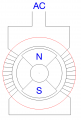
Here's an illustration that might help you visualize:
When AC is applied it is in some unspecified polarity. Whatever that polarity is the N pole will be attracted to one of the two coils on either side of the motor while the S pole will be attracted to the other side. The AC will reverse. What prevents the motor from spontaneously reversing is inertia. The pull is strong enough to spin the motor but not so strong that when the magnets align with their counter-poles that they don't spin partially past that point.
If the plater rotates once every 10 seconds then it is a 600:1 gear ratio. The motor is spinning at 60 RPS (or 50 RPS if on a 50Hz source). Gear reduction reduces the plater down to 6 RPM.
After editing this post I still think my numbers are wrong But the principal is right.
The microwave platter motor does not need to turn in any specific direction. The same motor in applications where direction is important, has a one-way latch. The mechanism of the latch is very similar to ratchet.
Re my post #12, I tested one for this and found with no load, it was sheer lottery which way it turned so seems to confirm the. dependance on which way it has stopped in order to alternate..
Disagree. Going back 30 years, 3 ovens, 2 still running; 7- and 20- years old. As long as mains power has not been interrupted, all of them reverse direction every time they operate. Nothing random about it.
I mess with mine all the time. When I want it to rotate clockwise I push the plate counter-clockwise and sure enough, it rotates clockwise. When I want it to rotate counter-clockwise I push the plate clockwise and sure enough it rotates counter-clockwise.
It all has to do with there the motor stopped last. It will rotate in the direction that offers the least amount of resistance. By pushing the plate fully in one direction, if the motor tries to run in that direction it encounters the full weight of the plate. So it will more easily start spinning in the opposite direction.

 Facebook
 Google
 GitHub
 Linkedin