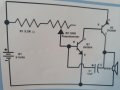
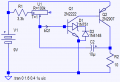
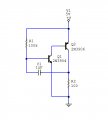
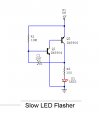
How does this circuit oscillate? I don't understand what is happening with the capacitor. I know that transistors will turn on when the capacitor charges to about 0.7 volts but after that I have no clue.
The speaker is an inductor and in conjunction with the capacitor it will form a resonant circuit. Every time Q2 turns on it pulls the junction of the inductor and capacitor up to +9 Volts.
The speaker is an inductor and in conjunction with the capacitor it will form a resonant circuit. Every time Q2 turns on it pulls the junction of the inductor and capacitor up to +9 Volts.
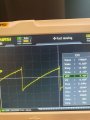
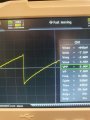
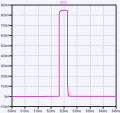
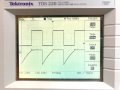
I looked with oscilloscope and If I understand correctly, it shows that positive side of the capacitor drops from 0.7 volts to about -7 volts. This negative voltage will obviously make transistors turn off. But why does this happen?
First of all the C1 is incorrectly polarised (+ and - is reversed in schematic).
Function:
When collector of Pnp is swithed to Vcc the C1 starts to supplied the base of Npn.
Once the C1 is fully charged the current stops to flow to the Npn base so base of Pnp is disconnected also, the collector of Pnp falls to Gnd (speaker disconnected) and left side of cap falls deep below Gnd.
The capacitor begins to discharge through R1R2.
Once the left side of cap reaches +0.7V the base of Npn is supplied again and everything repeats.
At startup, capacitor C1 is discharged. C1 begins to charge via R1.
When Q1 B-E voltage reaches about +0.7 V, Q1 conducts and turns on Q2 hard.
C1 is immediately charged to about +8 V while the base of Q1 remains around +0.7 V.
With Q1 now turned on, C1 and Q1 base node slowly discharges through the base-emitter junction.
When Q1 base-emitter voltage drops below +0.6 V, Q1 and Q2 turn off. This pushes Q1-C1 node to about -8 V.
Then the whole cycle starts over.
There are two time intervals at play.
1) The R1-C1 charging time where the base of Q1 has to go from -8V to +0.7 V.
2) The C1 discharge time where the base of Q1 has to fall from about +0.7 V to +0.6 V via the base-emitter current.
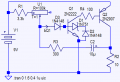
TEST CIRCUIT
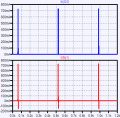
Here is the test circuit I used to produce the oscilloscope waveforms. Note that the supply voltage is 5V.
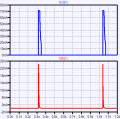
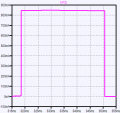
Channel 1 is the voltage at C1 - R2.
Channel 2 is the waveform at C1 - Q1.
At startup, capacitor C1 is discharged. C1 begins to charge via R1.
When Q1 B-E voltage reaches about +0.7 V, Q1 conducts and turns on Q2 hard.
C1 is immediately charged to about +8 V while the base of Q1 remains around +0.7 V.
With Q1 now turned on, C1 and Q1 base node slowly discharges through the base-emitter junction.
When Q1 base-emitter voltage drops below +0.6 V, Q1 and Q2 turn off. This pushes Q1-C1 node to about -8 V.
Then the whole cycle starts over.
There are two time intervals at play.
1) The R1-C1 charging time where the base of Q1 has to go from -8V to +0.7 V.
2) The C1 discharge time where the base of Q1 has to fall from about +0.7 V to +0.6 V via the base-emitter current.
TEST CIRCUIT
Here is the test circuit I used to produce the oscilloscope waveforms. Note that the supply voltage is 5V.
View attachment 329164
Channel 1 is the voltage at C1 - R2.
Channel 2 is the waveform at C1 - Q1.
With Q1 now turned on, C1 and Q1 base node slowly discharges through the base-emitter junction.
When Q1 base-emitter voltage drops below +0.6 V, Q1 and Q2 turn off. This pushes Q1-C1 node to about -8 V.
I wonder why Q1-C1 drops to -8v. Is it because C1 voltage difference was 0.7v - 9v = -8.3v. When 9 volts drops to 0 volts it tries to keep the same voltage difference of -8.3 volts? So 0.7 volts changes to -8.3 volts? Now it is -8.3v - 0v = -8.3v?
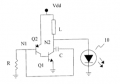
As a follow up on post #12, in the circuit below, when R1 is very large, the LED ON time is dependent on C1 and not on R1.
R1 and C1 determine the OFF period.
With,
R1 = 10 MΩ
C1 = 1 μF
LED ON = 2.5 ms
LED OFF = 5 s

 Facebook
 Google
 GitHub
 Linkedin